
Whenever a new NFL contract gets announced to the internet, the initial reaction stems from the total value of the contract, as well as any guaranteed money amount and their signing bonus.
The NFL signing bonus is usually one of the first numbers that everyone notices, mentions and discusses. When a top player gets $200+ million and a signing bonus of $50 million, the immediate feeling is “wow, this guy is loaded and that team just overspent on him”.
However, the $50 million is of course a large portion of the contract, but it is just that, a portion of the overall value of the deal.
It is not a separate entity, it is cash in the deal that is promised to the player up front, but in reality can still be prorated across all of the contractual years after its signed.
So, while the signing bonus is obviously important and definitely is beloved by the players receiving them, the bonuses are actually a way that NFL teams manipulate their cap space.
Like most things in the National Football League, there’s way more to the story. As, that initial number doesn’t actually hit the player’s bank all at once, and it sure as hell doesn’t hit the cap like fans often believe.
So how are NFL signing bonuses actually structured? Let’s break down the flow of the money, the strategy teams use behind it, and what it means for both players, front offices and the NFL as a whole.
What Is a Signing Bonus?
A signing bonus is a one-time payment agreed to at the start of a contract that guarantees a player gets paid, regardless of how long they stay with the team.
It’s basically the team saying: “Here’s your upfront bag for choosing us. It may not work out here since this is a business after all, but this is the amount our organization is going to pay you regardless if you stay and have success or leave the second your next chance arrives.”
Unlike base salary, which is paid weekly during the season, signing bonuses are guaranteed money and usually paid within a specific time frame. Sometimes immediately, sometimes over the first year.
The signing bonus does in fact get paid to the player’s personal bank account typically within weeks, months and definitely by the end of their first contractual year on their new/rookie deal.
However, to the NFL itself, the league allows for a players signing bonus to be spread out across the entire length of the deal, incentivizing teams to pay their players more upfront and off load at the backend of their contracts.
So while the franchise is going to be paying a player out directly the full sum of their bonus within that first season, it does not affect their salary cap in full, allowing for teams to remain competitive in this never ending inflation of NFL contract values.
Case Study
Joe Burrow’s $23.88 million signing bonus from his rookie deal was paid in full within 15 days of signing a rare move that signaled how much faith the Bengals had in him.
How It’s Paid: (Bank Account vs. Cap Hit)
From a player’s perspective, that check clears pretty quick.
However for the teams signing the checks, on the salary cap side, the NFL lets teams spread out the signing bonus across the length of the contract for cap purposes.
The league allows teams to prorate the signing bonus amount up to five years, even if the deal is structured to be longer.
Let’s say a QB signs a 5-year, $200 million deal with a $50 million signing bonus. That $50 million doesn’t count all at once.
It hits the cap at $10 million per year for five years. This is called prorating the signing bonus, and it’s one of the key tools front offices use to manipulate cap space.
Cap space seemingly never actually gets tapped out in today’s league and certain teams, such as the Los Angeles Rams, have been a prime example of this over the past few seasons.
For the 2024 NFL season the Rams were originally over the cap, however after restructuring some of their veteran players’ deals and prorating bonuses into future years, they were able to retain nearly their entire Super Bowl winning squad.
There are plenty of other loopholes that organizations use to manipulate their cap space as well, however the most common ways are through veteran restructures and signing bonuses.
Why Teams Use Signing Bonuses
The answer to the question of why signing bonuses in the NFL are high value and a prevalent way to keep top talent in organizations for extended periods of time without detriment to their cap space is simple: It is because the proration ability of said money lets them give players guaranteed money up front while spreading the cap hit out over time.
It also helps teams front-load deals with cash, while keeping the cap number low during the players’ early years. This is also an incentive for organizations to remain competitive while being able to retain their top talent, especially when the franchise is in “win now” mode.
Cap strategy is the name of the game. A team can keep a star happy, make him feel rich on Day 1, and still keep the roster flexible by limiting his cap hit early.
Dead Cap and Bonus Acceleration
Dead cap and bonus acceleration are often not considered on the fan and media level.
This is not to say fans and media alike do not understand the concept, it is just “boring”.
However, for an organization wanting to both display a quality product on the field and maintain their bottom line, dead cap strategy and the use of bonus acceleration is important.
If a player is cut or traded before his bonus is fully accounted for on the cap, the remaining prorated bonus money accelerates into the current year’s cap. That’s called dead cap.
Teams are able to accelerate this rate, by pushing a majority of the players signing bonus to the backend years of the contracts terms.
Then, teams pay the bonus out on their books faster than the allowed timeframe that the league provides (5-years or length of contract.)
Bonus acceleration allows for teams to push the dead cap money into the future, but retaining the ability to repay it quicker, allowing for teams to continue signing top talent as the cap inflates year over year.
Example
If a player still has $20 million in unallocated signing bonus money and gets cut, all $20 million hits that year’s cap as dead money.
However the amount the franchise owes is also accelerated at the time of the players’ trade or release, meaning that the cap space is still available for use after the current season.
This allows for players to still be paid their promised amount and teams to not be forced into keeping players around that they no longer see eye to eye with or simply are unhappy with the production they have been displaying.
This is why teams eat huge dead cap charges to move on from stars.
Because those bonus hits don’t just disappear, however they also do not lock teams in for extended periods of detrimental financial graves, so there is a balance between dead cap and acceleration that tends to turn a loss into a win for all parties involved (the player, organization and NFL itself.)
Signing Bonuses vs. Other Guarantees
Not all contract guarantees are created equal.
A signing bonus is the cleanest form of guaranteed money. This is because once it’s signed, it’s paid.
With the proration ability, it is one of the best ways for teams to retain top roster talent while also being able to fill the rest of their squad with more than minimum contract players.
The signing bonus is not the only guarantee that teams can include.
There is also guaranteed salary, roster bonuses, and option bonuses, which have different structures and rules. signing bonus = cold hard cash.
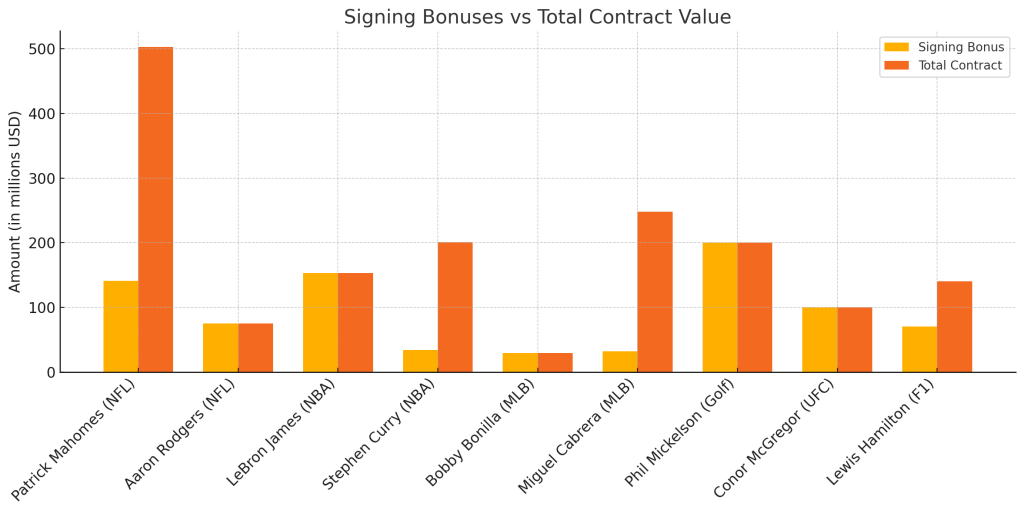
Financial Manipulation
Signing bonuses are one of the smartest and most used financial manipulation tactics in the NFL.
They reward players up front, keep teams competitive, and serve as the glue for some of the league’s biggest deals.
While in todays’ league most players will receive some amount of their contract in the form of a signing bonus, when a Patrick Mahomes or Josh Allen is signed, they can use some of the saved cap to then “give” to their other roster spots.
This ensures that teams have a solid balance of top tier talent and starter quality, but not superstar talent.
If only the top market teams were able to sign the most valuable players, both contract and skill wise, then teams like the Cincinnati Bengals, Jacksonville Jaguars and even the Tampa Bay Bucs, would never stand a chance to the New York and Los Angeles organizations.
Money does control the bottom line of organizations and the league, so how much a teams front office has is quite important, however the reason for the cap and financial loopholes the league offers, is so that their smaller market teams can still put out a quality product, or at the very least not be the Browns.
Cleveland keeps firing and hiring coaches and losing top talent, maybe its time they hire a new accounting team instead? The real game behind signing bonuses is how they’re structured, prorated, and sometimes used against the very players they were designed to reward.
Welcome to the business side of football.
Next Reads
- How the NFL Franchise Tag Works Financially
- 5 NFL Signing Bonuses That Changed the Market
- The Largest NFL Contracts From 2015-2025
- Luther Burden III’s Fully Guaranteed NFL Rookie Contract
- T.J. Watt’s 3-Year, $123 Million Contract Extension
Credits
Written by: Aidan Anderson
Research and Analysis: Apostle Sports Media LLC
Sources: NFLPA Public Records, ESPN, Spotrac, OverTheCap, The Athletic, Forbes, NFL CBA 2020, APSM Proprietary Analysis.
Featured Image: Public Domain / Instagram
Disclaimer: This article contains general financial information for educational purposes and does not constitute as professional advice.
Do you not know that your bodies are temples of the Holy Spirit, who is in you, whom you have received from God? You are not your own; you were bought at a price. Therefore honor God with your bodies.
– Corinthians 6:19-20






















 Apostle Sports Media