

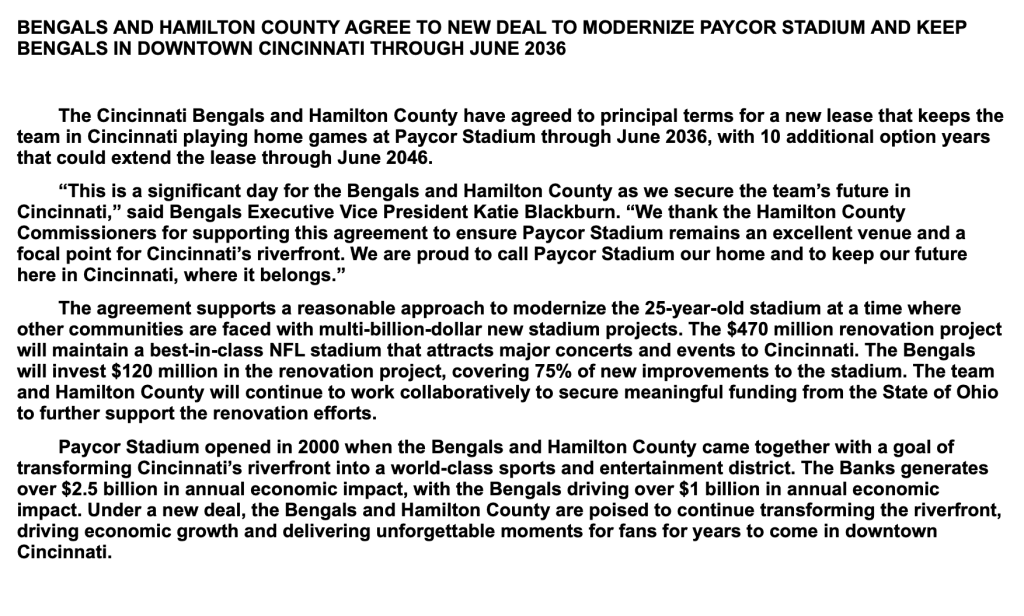
The Cincinnati Bengals and Hamilton County have reached a tentative agreement for a $470 million renovation of Paycor Stadium.
The deal locks in the team’s stay in Cincinnati through at least 2036, with the potential for extension options through 2046.
This isn’t just a local story, it’s a financial blueprint that could shift how cities approach stadium deals across all pro sports.
The Deal Breakdown
- Total Cost: $470 million
- Public Contribution: $350 million (Hamilton County)
- Private/Bengals Contribution: $120 million
- Includes NFL G-5 loan program funds
- Term: Through 2036 (with extension options to 2046)
Instead of pushing for a new $1+ billion facility, the Bengals and the county are betting on a “renovate and reinvest” strategy.
This is the strategy of modernizing what already exists, not demolishing it for something flashier.
The route that the Bengals ownership and the county were able to get done lessens the taxation burden on Cincinnati and surrounding cities in the counties residents, as well as maximizes the potential for ROI for the team itself.
Surely the team would have enjoyed a shiny new dome like the deal that got done in Cleveland in June (2025), but it did not make financial sense for any parties involved to do this.
So, Paycor stadium will remain where it currently resides and aim to make the stadium and facilities inside top class for players, personnel and fans, while not having to redesign the entire structure and rezone the city for a new structure.
What Gets Upgraded?
- Premium club lounges & suites.
- Concession areas and hospitality.
- Video boards & audio systems.
- Fan experience modernization without complete overhaul.
This model mirrors what we’ve seen in Green Bay (Lambeau Field updates), rather than Cleveland’s ~$2.4 billion dome or Tennessee’s brand-new $2.1B Nissan Stadium.
Why This Deal Matters
This isn’t just a Cincinnati story. This is a signal to other NFL franchises and municipalities:
Big stadiums don’t always mean big wins, financially or politically.
Here’s why this renovation deal is a potential new model:
1. Cheaper, Faster, More Sustainable
- At under $500 million, this is less than 1/4 the cost of a new stadium.
- Construction disruption has a lesser impact on the city and its residents.
- Long-term leases are secured without triggering new land battles or ballot issues. (zoning laws)
2. Private Money Has Skin in the Game
- The Bengals contributing ~25% of the total cost shows accountability.
- It protects taxpayers from footing the entire bill.
- NFL’s G-5 loan system enables teams to invest without crippling franchise liquidity.
3. Flexibility for Cities
- Renovations allow cities to keep NFL teams in-market while avoiding billion-dollar funding disagreements.
- More palatable for voters and budget-conscious counties.
- Extends the stadium’s ROI timeline another 15–20 years.
What It Means for the NFL
This move contrasts sharply with:
- Cleveland’s potential $2 billion dome.
- Tennessee’s massive new stadium plan.
- Buffalo’s $1.4 billion taxpayer-heavy build.
Instead, the Bengals’ deal could inspire:
- Mid-market teams to rethink stadium expansion needs.
- Cities under budget pressure to negotiate smarter deals.
- The NFL to back more G-5 renovation strategies vs mega builds.
A Blueprint for the 2030s
This $470 million renovation is more than a patch job. It’s a test case.
The Bengals’ willingness to split the bill, paired with a county ready to invest just enough, creates a sustainable long-term agreement.
It’s a win for civic engagement, financial responsibility, and long-term stadium ROI, without the political backlash that often follows billion-dollar builds.
If it works, expect teams like Jacksonville, Tampa, New Orleans, and even Chicago (Soldier Field) may start considering the option of following suit with Cincinnati.
Rather than falling in line for entirely new stadiums and fighting with counties for a new deal that isn’t promised.
APSM Outlook
As the sports finance world evolves, APSM will continue tracking:
- Real ROI on stadium renovations vs. rebuilds
- Public-private splits in future lease extensions
- NFL G-5 fund usage and loan repayment models
- Political and fan response to long-term city spending
Next Reads
- Inside the Washington Commanders’ Stadium Fight
- Inside the Chiefs’ Push for a New Stadium Location
- The Actual Costs of the Cleveland Browns’ New Stadium Deal
- How the Dodgers’ Ownership Built a Multi-Billion Dollar Sports Empire
- Lakers’ $10 Billion Sale
Credits
Written by: Aidan Anderson
Research and Analysis: Apostle Sports Media LLC
Sources: ESPN, Sportico, Front Office Sports, NFL.com, Hamilton County Commission, Cincinnati Enquirer, StadiumDB.com, USA Today, The Athletic, Bengals.com, Pro Football Talk, APSM Proprietary Analysis.
Featured Image: Public Domain/ Wiki Commons
Disclaimer: This article contains general financial information for educational purposes and does not constitute as professional advice.
“Above all else, guard your heart, everything you do flows from it.”
– Proverbs 4:23


























 Apostle Sports Media