
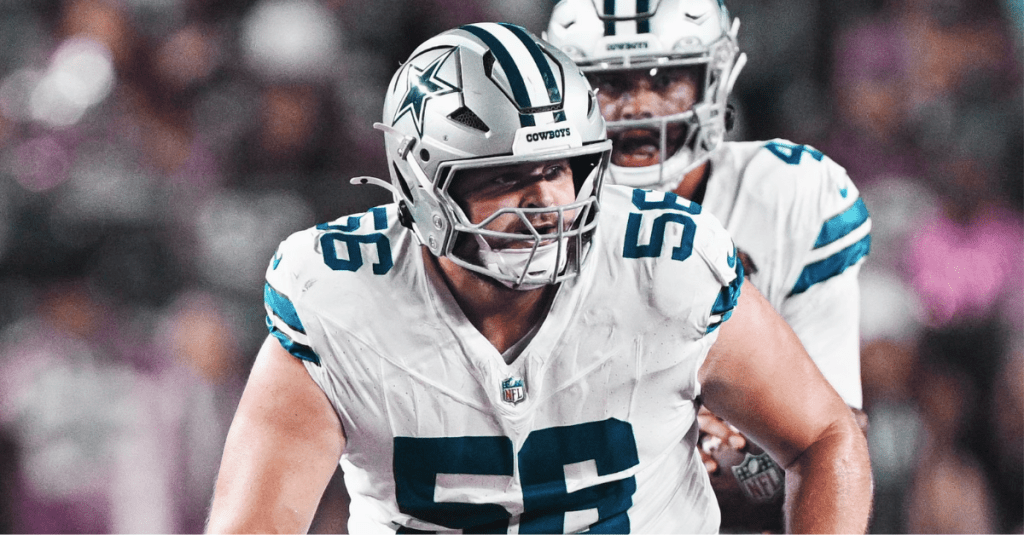
The grind from college star to NFL starter is an economic as well as athletic leap and for Cooper Beebe, that leap has already paid tangible financial dividends.
A third‑round pick (No. 73 overall) by the Dallas Cowboys in the 2024 NFL Draft, Beebe stepped into a starter’s role at center instantly, a rare transition for linemen, who often take years to earn consistent snaps.
Beebe’s rookie deal is a textbook example of the NFL’s structured rookie wage scale, where draft slot and round directly determine the size, bonuses and guarantees of early‑career compensation.
As a third‑round selection, his contract gives him both a secure financial baseline and the platform to prove long‑term earning power through play and durability.
Contract Details
- Team: Dallas Cowboys
- Draft Position: Round 3, Pick 73 (2024 NFL Draft)
- Contract Type: Standard NFL Rookie Scale Deal
- Total Value: ~$5,939,718
- Length: 4 years (2024–2027)
- Signing Bonus: ~$1,139,796 (fully guaranteed)
- Average Annual Value: ~$1,484,930
- Fully Guaranteed Money: ~$1,139,796 (at signing)
Beebe’s contract runs through the 2027 season and carries typical wage‑scale progression, modest by veteran standards but significant given his draft position. The signing bonus provides immediate liquidity, while base salaries are stacked to rise yearly, reflecting natural progression and cost‑of‑living adjustments embedded in rookie deals.
Salary Timeline & Cash Delivery
Here’s how his cash flow shapes up over the deal:
- 2024: Base ~$795,000 + prorated signing bonus ~$284,949
- 2025: Base ~$1,064,987 + prorated signing bonus ~$284,949
- 2026: Base ~$1,334,974 + prorated signing bonus ~$284,949
- 2027: Base ~$1,604,961 + prorated signing bonus ~$284,949
This structure gives Beebe incremental income growth even without renegotiation, a rare luxury outside of rookie scale contracts.
On‑Field Value
Beebe’s financial story is tied directly to performance and reliability.
After transitioning from guard to starting center, he started all 16 games as a rookie and carried that role into the 2025 season before a high‑ankle sprain sent him to injured reserve for several weeks, a status he’s since returned from.
His early starting experience is uncommon for third‑round interior linemen and increases his future leverage when the time comes to compete for an extension or second contract, especially if he continues to develop as a reliable anchor on the Cowboys’ offensive front.
Residency & Tax Strategy
NFL contracts offer headline figures, but state and federal tax planning materially affects take‑home pay:
- Primary/Offseason Residence: Texas (no state income tax)
- NFL Income Tax (“Jock Tax”): Beebe owes income tax in states where games are played with state income tax (e.g., New Jersey, California, Pennsylvania, etc.)
- Federal Tax: Top marginal rate ~37%
Dallas’ location is a net positive for Beebe’s residency planning: Texas has no state income tax, meaning offseason endorsement and offseason income receive favorable net treatment compared with players in high‑tax states like California or New York.
However, away‑game income is taxed in each state the Cowboys play in, which increases filing complexity and cumulative tax drag.
Estimated Net Contract Value (2024–27)
To understand Beebe’s real take‑home over his rookie contract, we estimate deductions common for early‑career NFL players, including federal, state, agent fees, and professional costs and expenses:
Gross Contract Value: ~$5,939,718
Estimated Deductions:
- Federal Tax (~37%)
- State/Local “jock taxes” (~3‑7% effective)
- Agent/Management (~3%)
- Professional/Training Costs (~1‑2%)
Estimated Net Take‑Home:
~$3.0 – $3.5 million
This net range accounts for year‑by‑year taxation and standard professional expenses, meaning the acceleration of signing bonus and base salaries yields meaningful early security for a young lineman.
Financial Outcome
- For the player: Beebe’s rookie contract gives him a secure earnings base with room to grow into better pay via performance, a blend of security and incentive.
- For the team: Dallas secured a foundational offensive lineman on cost‑controlled money, preserving cap space while aligning performance with team building.
- For the market: His contract illustrates the NFL’s rookie scale economy, where draft slot typically dictates initial earnings, and exceeding expectations (as Beebe has done) builds future leverage.
Because linemen often peak later than wideouts or QBs, his early starting experience and performance history position him well for an extension on the financial upside.
Cooper Beebe’s rookie contract with the Cowboys, ~$5.94 million over four years, is a quintessential example of how NFL entry‑level economics work:
Draft position translates to structure, signing bonus brings liquidity, and performance sets the stage for future financial leverage. In the NFL’s variable performance economy, linemen who start early, stay healthy, and perform consistently build contract credibility fast.
Beebe’s early play coupled with financial footing through his rookie deal gives him the economic runway most offensive centers only dream of, a foundational step toward much larger future earnings.
Next Reads
- Nick Emmanwori Seattle Seahawks Rookie Contract
- Travis Hunter’s Rookie Contract with the Jacksonville Jaguars
- Luther Burden III’s Fully Guaranteed Rookie Contract
- Cam Ward’s Rookie Contract with the Tennessee Titans
- The Financial Fallout of the Demond Williams Jr. Case
Credits
Written By: Aidan Anderson
Research & Analysis: Apostle Sports Media LLC
Sources: ESPN rookie contract tracker, Over The Cap, Dallas Cowboys media guide, NFL Rumors, APSM proprietary analysis
Featured Image: Public Domain / Wiki Commons
Disclaimer: This article contains general financial information for educational purposes and does not constitute professional advice.
But many who are first will be last,
and many who are last will be first.
– Matthew 19:30


























 Apostle Sports Media