
An option bonus is a lump-sum payment written into a player’s contract, activated by a team’s decision to pick up a future year (or years) of the deal.
Unlike a signing bonus, which is paid at the moment the contract is signed, an option bonus comes later, often in year two or three, and gives a team the choice to extend the contract without a full restructure.
For athletes, an option bonus can act as a guaranteed payday once activated.
For teams, it’s a tool to defer cap hits and delay long-term commitments.
How Option Bonuses Work In Different Leagues
🎓NCAA / NIL Athletes
Option bonuses are not a standard feature in NCAA or NIL agreements because college athletes are not employees and do not sign multi-year salary contracts with schools.
However, NIL collectives and brands sometimes structure future-option style clauses that function similarly in spirit, even if they are not legally labeled as “option bonuses.”
These arrangements allow a brand or collective to retain an athlete for a future period without renegotiating an entirely new deal.
Use Cases
- Collective choosing to extend an NIL agreement year-to-year
- Brand reserving the right to renew a deal at a preset payment level
- Deferred lump-sum NIL payments tied to continued enrollment or eligibility
- Early commitment incentives for projected draft prospects
Example
A NIL collective signs a freshman quarterback to a one-year NIL deal worth $150,000, with a clause allowing the collective to activate a second year for an additional $200,000 if the player remains enrolled and starting.
While not called an option bonus, the second-year lump payment functions similarly: the athlete receives guaranteed money if the “option” is exercised, and the collective avoids renegotiating in an open market.
🏈NFL
Option bonuses are now a common aspect in NFL contract structures, especially for quarterbacks and high-value positions like WR or DE.
They’re typically triggered in the second year of a multi-year deal and can be used to offer early extensions to players they would like to keep long-term, while continuing to prorate the players salary.
It also assists in front loading payouts while having to actually pay it on the back-end, so if a player does not live up to expectations or their contract amount, the team can trade or release them without further financial impact.
When picked up, the player gets a lump-sum bonus, which can then be prorated over the remaining years for cap purposes.
It’s a creative way to backload cash without a full new deal.
Example
Josh Allen received a $30 million option bonus in year 2 of his $258 million extension.
This allowed the Bills to delay cap hits and spread the bonus out evenly across the remaining contract years, while Allen still got his guarantees.
🏀NBA
The NBA rarely uses option bonuses. Instead, the league includes team options or player options as part of guaranteed salary clauses.
In the NBA, the “option” refers to a decision to keep a player for another year, not an additional bonus.
Bonuses are governed under the CBA and tied to performance, games played, or incentives, rather than option triggers seen used in NFL contracts.
Example
James Harden’s $35.6 million player option with the Sixers came with no bonus, just guaranteed base salary.
No team or player options trigger additional lump-sum payments under the current CBA.
⚾MLB
Option bonuses do not exist in standard MLB contracts.
The only “option” that the MLB uses are contract extensions.
Contracts are fully guaranteed in MLB, and year options are typically built into base salary.
Performance or milestone bonuses exist, but option-triggered bonuses are not standard.
Example
Justin Verlander had a vesting option on his 2023 deal, but the clause triggered additional years, not new bonus payments.
🏒NHL
Similar to MLB, the NHL rarely uses option bonuses in contracts. Instead, signing bonuses and front-loaded deals are favored.
The NHL CBA limits mid-contract bonus flexibility. Teams rely on structure up front to secure guarantees, not optional triggers.
Example
Connor McDavid’s $100 million extension was front-loaded, paying over $60 million in signing bonuses, but no option bonuses were used.
⚽MLS / International Soccer
Option bonuses are uncommon in soccer contracts, but option clauses are widely used across MLS and international leagues.
Instead of triggering a bonus payment, clubs typically exercise team options or extension options that lock in additional contract years at predetermined salary levels.
In some international markets, signing bonuses or deferred payments may be paid when an option year is exercised, effectively mimicking an option bonus.
Use Cases
- Team options for additional contract years
- Extension clauses tied to appearances or performance thresholds
- Deferred payments triggered when an option year is picked up
- Retaining young talent without renegotiating market salary
Example
An MLS club signs a young midfielder to a 2-year deal with a club option for a third year.
When the option is exercised, the player receives a scheduled lump-sum payment tied to the extension.
While the contract language may not label it an option bonus, the financial outcome is similar:
the club secures future control, and the player receives guaranteed cash once the option is activated.
🥊UFC / Combat Sports
Not applicable.
There are no “option bonuses” in individual sport fighter contracts.
Contracts are negotiated per fight or per deal cycle. Promotions may extend a contract via “renewal clauses,” but no bonus is paid out to athletes to trigger it.
Example
Israel Adesanya received a deal extension, but payments were structured around fight purses and PPV points, not option bonuses.
⛳Golf / Tennis / Racing
In individual sports, the “option” format does not apply because there are no salary-style contracts.
Instead, appearance fees, win bonuses, and sponsorship guarantees are used.
Why Option Bonuses Matter
Option bonuses allow teams to
- Secure talent longer without full restructuring.
- Defer cap hits into future seasons.
- Retain contract flexibility.
- Offer players cash guarantees without new negotiations.
For Players
- It’s a second signing bonus that often comes with less risk.
- Locks in guaranteed money later in the deal.
- Helps athletes get multi-year cash flow without cap inflation.
In leagues like the NFL where every dollar of cap space matters, option bonuses are chess pieces, not checkers.
However, in other leagues and the UFC, option bonuses tend to be optional.
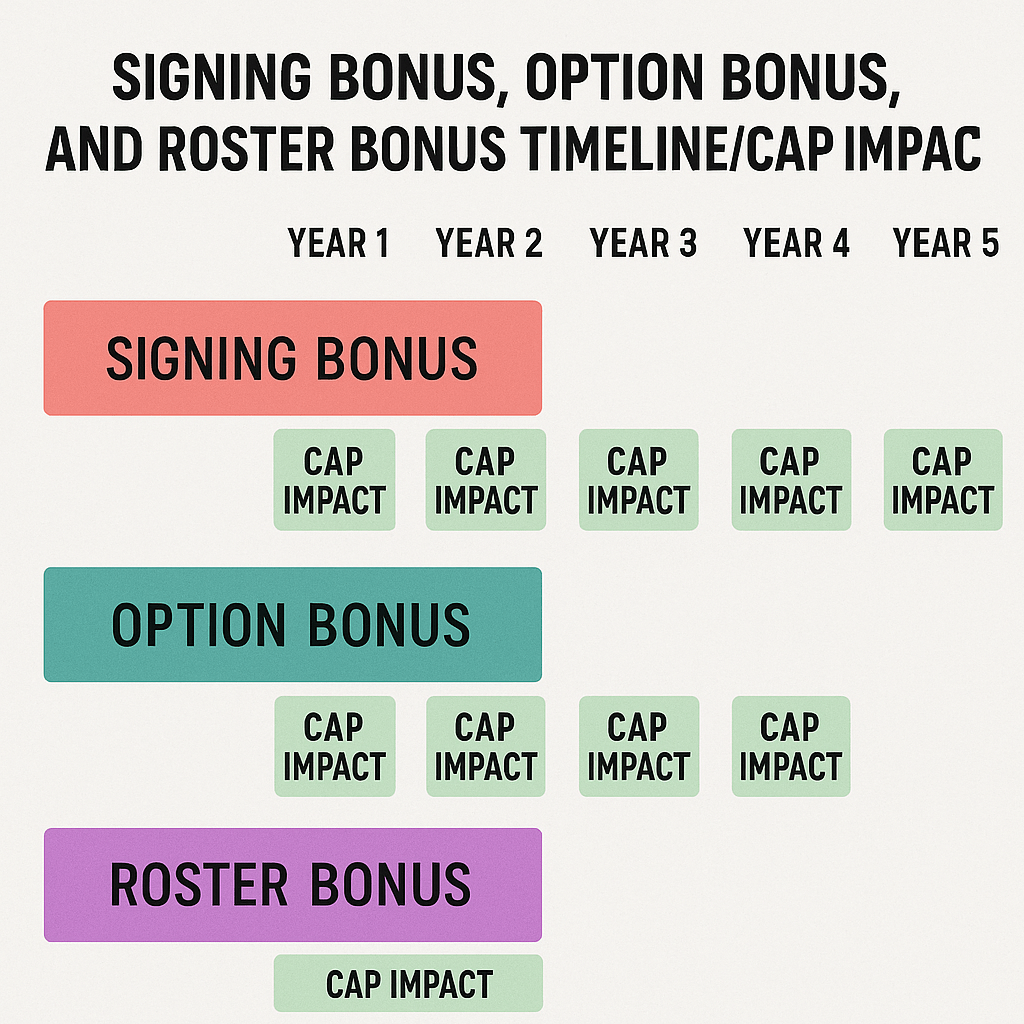
📊 Graphic
🔗Related Terms
🔗Next Reads
- How NFL Signing Bonuses are Structured
- How UFC Promotion Drives Revenue
- Highest-Paid MLB Players of 2025
- Top 5 Longest NHL Contracts In History
- Cooper Flagg Could Earn Over $1 Billion in Future NBA Contracts
“I am the Lord your God who takes hold of your right hand, says to you, don’t fear; I will help you.”
– Isaiah 41:13













 Apostle Sports Media