
When NFL contracts hit the social media timeline of fans worldwide, everyone sees the big numbers and the value of athletes insane contract signings, often worth tens of millions of dollars “on paper.”
What is typically left out of the quick post to fans to be the fastest one to report it or gather the most impressions they can, it is not just the total value that matters.
It’s also important to understand how the money flows, and when those direct deposits actually hit the players’ bank accounts.
Signing bonuses are often the second number leaked, and for good reason.
They’re immediate, guaranteed, and, when structured right, can shift the balance of power in the league, at the click of the pen used to sign the deal.
These five signing bonuses didn’t just pay: (Most did though). These deals and the signing bonus they hold, reshaped rosters, shifted leverage, and rewired how money in the National Football League moves.
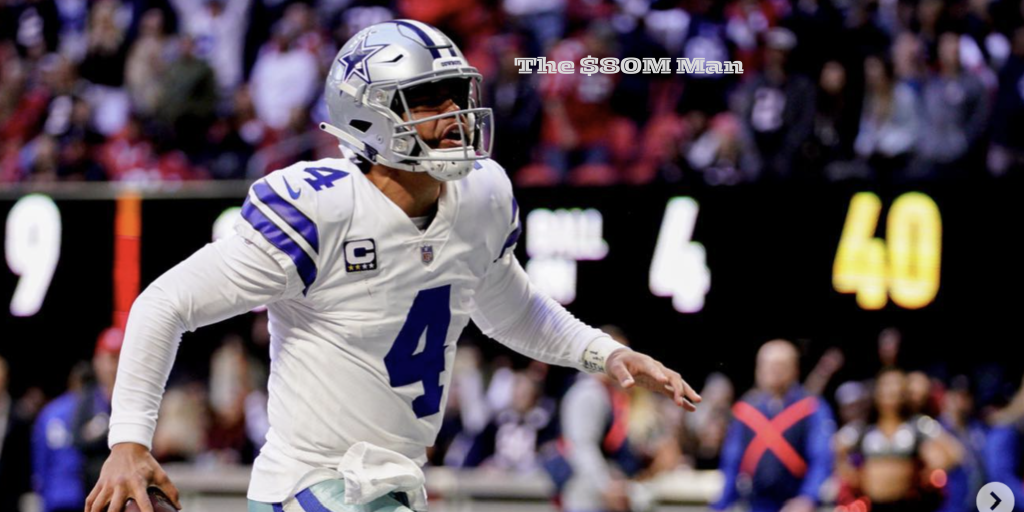
1. Dak Prescott: $80 Million (2021)
Team: Dallas Cowboys
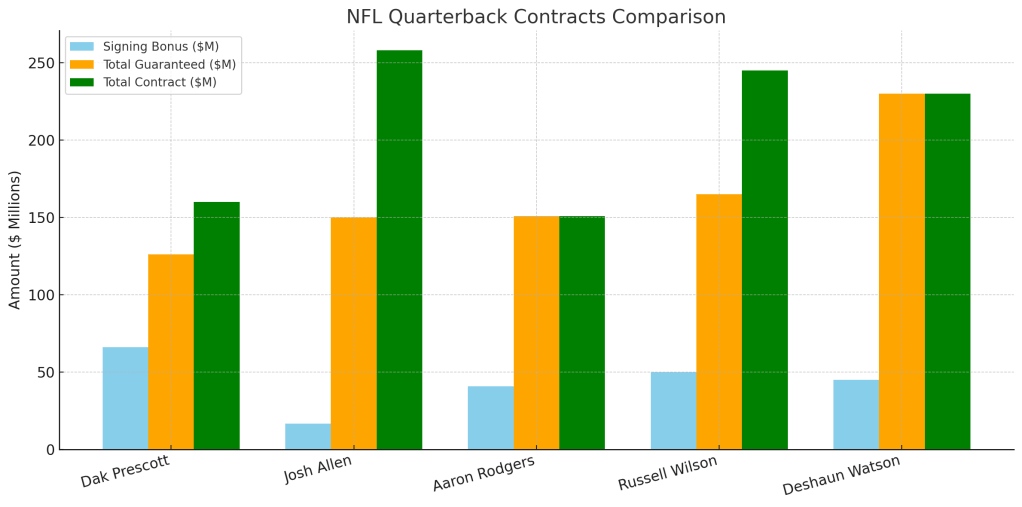
Contract: 4 years, $240 million ($231 million guaranteed)
Average Yearly Salary: $60 million
Signing Bonus Structure: $80 million (paid at signing)
How The Signing Bonus Changed the NFL
Jerry Jones and the Cowboys accounting department put together both the largest signing bonus in NFL history and the most money paid to a player by year.
Here at APSM we don’t care if the Cowboys win the Super Bowl, or the drama of if Dak deserved this money. The cold truth: he got it anyway.
While prorating and structuring the actual deal all over the salary cap, in the form of other bonuses, guarantees and other payments’ they spread out like peanut butter and jelly.
This wasn’t just about Dak Prescott. It was about keeping their franchise QB in Dallas and informing the rest of the league, that they are not running from their struggles and are digging their heels deeper.
Jerry Jones got the pockets for it, right? He may not be liked by all but the way he formats his deals and does business, there is a reason the Cowboys are one of the biggest sports brands globally.
Meanwhile, $80M will hit Dak’s bank account this summer like a lottery win. The moment that Dak put ink on the contract signature line, It redefined QB leverage and made the Cowboys the face of front-loaded power deals.
The way the deal is structured is a work of financial manipulation art.
The signing bonus of $80 million, prorated across all four seasons amounts to $20 million per year on the Dallas Cowboys books. That is already nearly 1/3 of his contract value “out of the way”.
Then, the front office made it so most of the remaining 2/3 of the contract are in the form of guaranteed bonuses, meaning they will be able to prorate his guaranteed payments as well, while offsetting the books with the average salary amount.
Due to this, Dallas will retain $53 million in cap space for the 2025-2026 season, as they did a similar contract structure with their QB’s number one option, CeeDee Lamb.
When these deals were originally signed and prior to the structurization of them, the Cowboys were in debt $3 million.
This deal changed the NFL because it shows two things:
- Inflation of NFL Contracts Is Never Ending
- Financial Loopholes Make Large Deals Much Smaller on Paper.
2. Josh Allen: $46.5 Million (2021)
Team: Buffalo Bills
Contract: 6 years, $258 million ($150 million guaranteed)
Average Yearly Salary: $43 million
Signing Bonus Structure: $16.5 million + $30 million option bonus
How The Signing Bonus Changed the NFL
Josh Allen’s deal didn’t just reward early performance, it set a framework for how modern extensions could protect both parties in the deal.
The Bills front office was proactive. Instead of waiting to see if Allen could sustain his MVP-level leap, they extended him after his first elite season and backloaded the guarantee structures to manage future risk.
The signing bonus ($16.5 million) wasn’t league-shaking in size, paired with a $30 million option bonus in the following year allowed the Bills to stretch cap hits and show long-term commitment without a cap catastrophe up front.
The organization essentially saw what the Packers had done with Aaron Rodgers in 2022 and the new way to front load deals while still spreading out the total over the cap effectively, so they paid their star in the form of multiple bonuses with terms to save the team from a potential backfire.
Here’s the genius: The option bonus, structured for 2022 but signed in 2021, was guaranteed money the team could prorate across the remainder of the deal. This gave Allen the security of a near-$50 million payout while Buffalo preserved cap agility.
The difference between the signing bonus and the option bonus is that the signing bonus amount is due at sign. Whereas, the option bonus is still considered to be apart of the signing bonus, but it does not have to be paid out until year 2 of the deal and beyond.
Essentially Allen got his signing bonus in waves that meant he still got the millions, but the Bills front office was able to prorate both bonuses due to the timing of the payment.
The deal worked because Allen kept performing. But this hybrid setup has since been used by teams wanting to keep a young franchise QB without risking a fully guaranteed, Watson-style apocalypse.
You’ll see echoes of this deal in Justin Herbert, Jalen Hurts, and even Joe Burrow’s structures.
Allen wasn’t just paid, his contract became a blueprint.
As seen throughout the last few seasons despite the shortcomings of the Patrick Mahomes and Kansas City heartbreakers, the way this deal and bonus system was structured by the Buffalo organization made it so that Allen is getting paid bank.
While also being able to build an actual super bowl winning potential team around him and not send the organization into cap oblivion.
3. Aaron Rodgers: $40.8 Million (2022)
Team: Green Bay Packers
Contract: 3 years, $150.8 million (fully guaranteed)
Average Yearly Salary: $50,237,667
Bonus Structure: Option bonus, paid within first year
How The Signing Bonus Changed the NFL
This was Green Bay’s last gesture to their future Hall of Fame and 3x League MVP QB Aaron Rodgers.
At the time of the deal, Rodgers was already coming off of a massive extension in 2018 that paid him an average of $33.5 million per season and had a total value of $134 million across 4-years.
The signing bonus for this deal was $57.5 million, which was actually higher than the signing bonus amount from this 2022 extension.
What made this new extension in 2022 standout however, despite the lower signing bonus, is that this set a new mark for QB’s in the NFL, as Rodgers became the first player in NFL history to earn $50 million/season.
Now, it seems that after this benchmark, there is a new highest paid player in the league every season.
While the total contract value and yearly salaries are indeed increasing year over year mostly due to cap inflation, this deal in 2022 between Green Bay and Rodgers set new standards for how contracts are structured.
The signing bonus amount for this deal was $40.8 million, $16.7 million less than his deal from 2018, however, his guaranteed money by ~$22.3 million and his total guaranteed amount hit $150 million, while his previous deal was just shy of $100 million.
This extension is reported to be one of the most complex contract structures in league history and provided “give and take” to both the Packers organization and the veteran QB himself.
The option bonus route that the Packers chose to structure this deal in the form of upfront capital and backloaded reporting of the funds through proration inspired new contract structuring.
Primarily around veteran QBs looking for short-term cash without long-term ties. Both sides got what they wanted, the Packers paid him quicker so that they could get him off the books faster but also have enough cap space to keep a playoff team around Rodgers.
4. Russell Wilson: $50 Million (2022)
Team: Denver Broncos
Contract: 5 years, $245 million ($165 million guaranteed)
Average Yearly Salary: $49 million
Bonus Structure: $50 million signing bonus (paid at signing)
How The Signing Bonus Changed the NFL
The Russell Wilson signing bonus was the definition of blind faith. Bronco country handed him $50 million up front prior to playing a single down in orange and blue.
This deal is infamous now, but at the time, it signaled Denver’s desperation to return to relevance.
The $50 million lump sum, prorated over 5 years, gave the team initial cap flexibility: but buried them in long-term risk.
As we have now seen with the way they cut the veteran and one time Super Bowl winning QB, the way this deal was structured ruined the Denver Broncos financial books from the initial snap.
When Wilson underperformed, the Broncos were still on the hook for $124 million guaranteed over the next three seasons, and staring down over $80 million in potential dead cap if they wanted to move on.
The lesson? Signing bonuses can be structured perfectly on paper, but if the talent vs. timeline doesn’t match, teams are stuck paying for hope that never delivered.
The Russ deal reminded NFL front offices that while signing bonuses are cap-friendly, they can still become financial anchors if paired with the wrong player, at the wrong time.
Proration is awesome until you don’t want the player on the roster anymore and now have to pay him out the signing bonus and remaining guarantees at once.
5. Deshaun Watson: $44.9 Million (2022)
Team: Cleveland Browns
Contract: 5 years, $230 million (fully guaranteed)
Average Yearly Salary: $46 million
Bonus Structure: $44.9 million signing bonus
How The Signing Bonus Changed the NFL
Let’s not sugarcoat this one: Deshaun Watson’s contract shook the league to its core.
The $44.9 million signing bonus was massive but it wasn’t the number that rattled the cage.
It was the fully guaranteed structure, which made the entire contract a ticking time bomb.
While at APSM we do not cover drama. It is apparent that this amount of money being paid to Watson after the events that have reshaped his career and life as a whole, was considerably striking as well.
Cleveland not only gave a player facing over 20 civil lawsuits the largest guarantee in NFL history at the time, they also restructured the first year’s base salary to a microscopic $1 million.
This meant that the other $239 million was protected by the Browns organization for Watson by being backloaded into the remaining years on the deal.
Making it so he was able to dodge losing out real money during his suspension and the Browns able to spread out his huge payday across the cap effectively.
While the Browns organization was able to make the cap situation with this deal work.
Watson has far underperformed the value of this signing. However, he once was seen as the future of the league and went toe to toe with Mahomes on multiple occasions.
This wasn’t just a signing bonus: it was a franchise-altering gamble, both in cap strategy and public image. The contract sent the NFLPA into celebration mode and every other front office into panic mode.
It broke unspoken rules about guarantee ceilings, contract optics, and PR sensitivity.
This signing bonus was not nearly as much as Dak Prescott’s, however the way that the bonus itself was structured, made it known to the league that value of a player is based on past performance, regardless of off the field issues if they happen to be “resolved”.
Regardless of the precedent, the way that the signing bonus and deal itself was structured between Watson and the Browns, has defiantly changed the way the league operates.
Players will continue to make more and more money, as long as they performed to a high level prior to the signing or their personal issues.
Even now, GMs use the Watson deal as the one to never repeat. It set a new high bar for player leverage, but teams like the Ravens (with Lamar), Bengals (with Burrow), and Chargers (with Herbert) made sure not to follow Cleveland’s path when doing extensions post-Watson.
Signing Bonuses are Messy, but Beautiful
These signing bonuses didn’t just make headlines for their values. They changed how front offices negotiate, how players think about leverage, and how the NFL itself has evolved financially. These five signing bonuses became financial signals. Blueprints. Red flags. Warnings.
Every one of these signing bonuses rewired something in the NFL contract world.
Whether it was the Dak deal setting new cap structures, Allen laying down a hybrid extension model, or Watson’s bomb that will continue to scare GMs in future generations.
These signing bonuses changed the landscape of the league. Not with tweets. With leverage. Paperwork.
Some sparked trends. Some caused chaos. All of them = Game changing.
Graphic
Want Every APSM Report In One Place?
The APSM Master Report Bundle includes all current APSM reports:
- Travis Hunter’s 2025 Net Worth Valuation
- Tyrese Haliburton’s 2025 Net Worth Valuation
- 7 Ways Athletes Build Wealth
- 7 Ways Athletes Go Broke
- (Will Include future additions of reports as APSM grows)
You’ll Get:
- Deep financial literacy designed through a sports lens
- Net Worth projections, contract forecasts & tax modeling
- Wealth frameworks & risk analysis
- Lifetime value mapping for both athletes and professionals
The most valuable way to learn the game of money through APSM.
Next Reads
- How NFL Signing Bonuses are Structured
- The Largest NFL Contracts From 2015-2025
- 5 Worst NFL Free-Agency Contract Busts
- T.J. Watt’s 3-Year, $123 Million Contract Extension
- Garrett Wilson’s $130 Million Contract with the New York Jets
Credits
Written by: Aidan Anderson
Research and Analysis: Apostle Sports Media LLC
Sources: Spotrac, OverTheCap, NFLPA reports, ESPN, CBS Sports, The Athletic, NFL team cap sheets, APSM Proprietary Analysis.
Featured Image: Dak Prescott Instagram Account, Public Domain
Disclaimer: This article contains general financial information for educational purposes and does not constitute as professional advice.
“When I said, “My foot is slipping,” your unfailing love, Lord, supported me.”
– Psalm 94:18



















 Apostle Sports Media