
Free agency is the ultimate high-stakes gamble in professional sports. Every March, NFL front offices splash hundreds of millions of dollars across the open market, hoping to buy an immediate championship window. But when evaluation metrics fail and cash gets handed out based on past pedigree rather than future performance, teams quickly find themselves trapped in salary cap purgatory.
Here’s a finance-forward breakdown of five of the most catastrophic free-agency busts in NFL history, deals where massive paychecks yielded minimal returns and permanently changed how general managers structure contracts.
1. Deshaun Watson: Cleveland Browns (2022)
- Contract: 5 years, $230 million, fully guaranteed
The Financial Fallout
When Cleveland traded three first-round draft picks for Watson and handed him the first fully guaranteed contract in NFL history, worth roughly $230 million; they were betting the franchise on a generational return to elite quarterback play. Instead, the move became a historic financial and PR disaster.
Between a suspension, prolonged absences, and a torn Achilles that wiped out his entire 2025 season, Watson has missed well over half of his possible starts since arriving in Cleveland.
The League-Wide Impact
The magnitude of the fully guaranteed structure terrified opposing front offices. Locking up that much capital with zero contractual protection against decline or availability sent a clear message across the league, fully guaranteed veteran mega-deals are a corporate risk most GMs will actively avoid replicating.
Where the Situation Stands in 2026
This one’s still writing itself. Watson missed all of 2025, and Cleveland cycled through Joe Flacco, Dillon Gabriel, and fifth-round rookie Shedeur Sanders while he recovered.
Sanders actually finished the year with real starting experience, and in the 2026 preseason competition that followed, he graded out better than Watson on paper, a 72.3 PFF passing grade against Watson’s 59.1.
Cleveland named Watson the Week 1 starter anyway, with head coach Todd Monken citing Watson’s “overall body of work” rather than the preseason numbers. That decision is the sunk-cost fallacy playing out in real time on an NFL depth chart. Cleveland has one year left on a fully guaranteed contract they can’t trade and can barely afford to bench.
Starting the statistically worse quarterback isn’t necessarily bad coaching, it’s the financial reality of a front office that’s already committed the money and is still hoping the investment pays off before it’s forced to admit the loss for good. Watson’s Week 1 opener comes September 13, 2026, on the road against Jacksonville.
2. Albert Haynesworth: Washington Redskins (2009)
- Contract: 7 years, $100 million, $41 million guaranteed
The Financial Fallout
Coming off consecutive dominant seasons as the most feared interior defensive lineman in football with Tennessee, Haynesworth hit the open market as the ultimate defensive prize.
Washington owner Daniel Snyder opened the vault, making him the highest-paid defensive player in NFL history. What Washington got back was a masterclass in buyer’s remorse, a player who quickly fell out of shape, clashed with coaching staff over scheme, and managed a meager 2.5 sacks in 2010 before being unceremoniously cut and retiring from football.
The League-Wide Impact
Haynesworth became the poster child for the danger of paying a player after he’s already secured his generational bag. It forced teams to build stricter conditioning incentives and milestone structures into future elite defensive line contracts.
3. Brock Osweiler: Houston Texans (2016)
- Contract: 4 years, $72 million, $37 million guaranteed
The Financial Fallout
After starting just seven games for Denver, a young Osweiler cashed in on a quarterback-starved market when Houston handed him a $72 million deal. The return was abysmal, 15 touchdowns against 16 interceptions, followed by a mid-season benching.
Realizing their mistake, the Texans had to attach a valuable second-round pick to Osweiler’s own contract just to dump him onto Cleveland in a classic salary-cap rescue mission.
The League-Wide Impact
Osweiler’s contract proved that a small sample of good play combined with enough desperation can blind a front office. It also popularized the salary-dump trade, teams will occasionally pay real draft capital just to erase a bad financial decision from their books entirely.
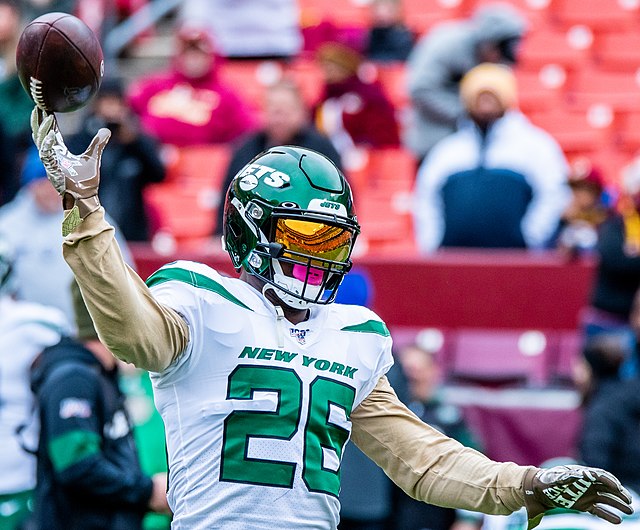
4. Le’Veon Bell: New York Jets (2019)
- Contract: 4 years, $52.5 million, $27 million guaranteed
The Financial Fallout
After sitting out a full season in Pittsburgh over a contract dispute, Bell signed with the Jets and immediately became one of the highest-paid running backs in the league.
Behind a struggling offensive line and a mismatched scheme, his production collapsed. He played just 17 games over two seasons, never eclipsed 100 rushing yards in a single game, and was released midway through year two.
The League-Wide Impact
Bell’s Jets tenure reinforced an unwritten rule of modern sports economics, never break the bank for a running back in free agency. Because the position leans so heavily on offensive line quality and absorbs disproportionate physical wear, front offices increasingly treat top-dollar veteran running back spending as poor capital allocation.
5. Nnamdi Asomugha: Philadelphia Eagles (2011)
- Contract: 5 years, $60 million, $25 million guaranteed
The Financial Fallout
Heralded as part of Philadelphia’s infamous “Dream Team” offseason, Asomugha arrived from Oakland as a consensus shutdown cornerback.
Football is scheme-dependent, and when the Eagles deployed him in zone coverage instead of the man-to-man island role where he thrived, his performance fell off a cliff. He was released after two seasons, leaving behind a massive financial footprint and almost nothing to show for it.
The League-Wide Impact
Asomugha’s failure taught front offices a lasting lesson, talent in a vacuum doesn’t guarantee anything. Fitting a player’s actual skill set into scheme matters just as much as raw ability when evaluating what a contract is really worth.
Free Agency Busts: Cost vs. Production Summary
| Player | Team | Contract Value | Guaranteed | The Ultimate Outcome |
|---|---|---|---|---|
| Deshaun Watson | Browns | $230M | $230M | Missed games, injuries, still on roster as sunk-cost QB1 in 2026 |
| Albert Haynesworth | Redskins | $100M | $41M | Traded/released early after severe decline |
| Brock Osweiler | Texans | $72M | $37M | Traded to Cleveland with a draft pick as a salary dump |
| Le’Veon Bell | Jets | $52.5M | $27M | Released in Year 2 after sharp production decline |
| Nnamdi Asomugha | Eagles | $60M | $25M | Scheme mismatch, released after two seasons |
Bottom Line
NFL free agency is often romanticized as the fastest way to build a contender, but history proves it’s equally effective at sinking one.
Whether it’s Watson’s fully guaranteed anchor still playing out in real time or Osweiler’s panic-driven payout, these five contracts stand as permanent warnings to general managers.
In modern sports finance, evaluating risk, projecting multi-year decline curves, and protecting cap flexibility will always matter more than chasing names in March, and the Browns’ situation proves that as six years later, teams still struggle to cut losses once guaranteed money is already sunk.
NFL Free Agency Busts FAQs
What makes an NFL free-agent signing a “bust”?
A free-agent bust occurs when a player’s on-field performance, availability, or production falls drastically short of the financial value and cap space committed to them by the organization.
Why do NFL teams continue to overpay in free agency?
Front offices operate under intense pressure from ownership and fans to win immediately, which frequently leads to bidding wars, causing teams to project a player’s peak performance forward while ignoring realistic age curves and injury risk.
Is Deshaun Watson still the Browns’ starting quarterback?
Yes. Cleveland named Watson the Week 1 starter for the 2026 season over Shedeur Sanders, despite Sanders grading out better in the preseason, illustrating how a fully guaranteed contract can keep a team financially and competitively committed to a player well past the point the on-field results justify it.
Why are RB free-agent signings particularly risky?
Running backs have shorter career arcs and high physical attrition rates. Because their success depends heavily on offensive line quality, paying top-of-market money to veteran running backs rarely produces a positive return on investment.
How did Deshaun Watson’s contract change future quarterback negotiations?
By demanding and receiving a fully guaranteed $230 million contract, Watson set an outlier precedent that other owners have aggressively resisted repeating, making fully guaranteed deals genuinely rare for high-risk veteran signings across the league since.
Next Reads
- How NFL Signing Bonuses Actually Work
- Who Really Pays for NFL Stadiums?
- How the NFL Franchise Tag Works Financially
- The Largest NFL Contracts From 2015-2025
- Free Agency (Finance Glossary)
Disclaimer: This article contains general financial information for educational purposes and does not constitute professional advice. APSM estimates are derived from publicly available information, tax assumptions, finance modeling, and industry-standard fee structures. Actual earnings may vary based on residency elections, private contract provisions, image/media rights agreements, bonuses, and tax filings.


