
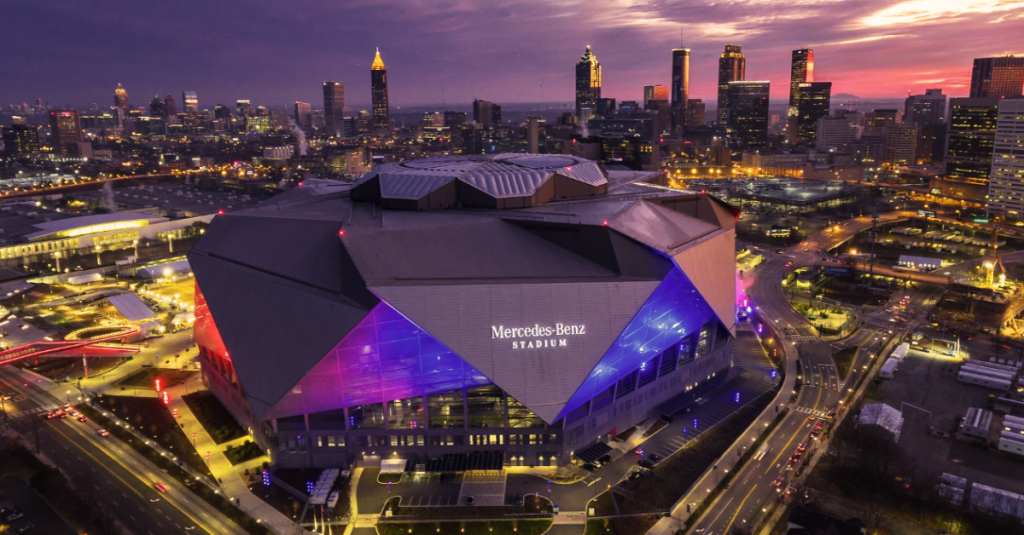
Mercedes‑Benz Stadium isn’t just the home field for the Atlanta Falcons and the destination for the CFP Peach Bowl, it’s also a monetization platform, built for the 21st‑century sports economy.
It stands at the intersection of real estate, hospitality, media, tourism, and premium event economics in the bustling city of Atlanta, GA, earning revenue far beyond Falcons football.
From powerhouse dual‑tenancy (NFL + MLS) to relentless event utilization and major global shows like FIFA World Cup 2026 matches…
Mercedes-Benz stadium functions less like a venue, and more like a diversified sports & entertainment asset portfolio, generating billions in revenue for both the sports industry and the local economy.
Construction Costs & Capital Structure
Mercedes‑Benz Stadium opened in 2017 after a construction process that ballooned to ~$1.5 – $1.6 billion in total capital expenditures.
This figure represents expenses well above early projections, which were closer to ~$1 billion than to two.
Funding Breakdown
- Private: Majority of financing came from the Falcons organization via equity, NFL G‑4 loans, corporate bonds, and PSL (Personal Seat License) revenue.
- Public: ~$200 million of bonds backed by Atlanta hotel‑motel taxes covered a portion of construction costs, with hundreds of millions more anticipated for operational support and debt service over decades.
Unlike older stadium builds where cash was handed over directly, modern subsidy structures like this use tax‑backed bond vehicles, a more indirect but financially significant public commitment.
Risk & Amortization
Stadium capital structures operate on long‑duration amortization schedules (20–30+ years).
Depreciation and interest serving occur over decades, meaning public cost debates must factor in net present value, tourism inflows, and opportunity cost for ROI projections, rather than just headline figures.
Public debate often stops at the price tag; financial insight flips that to what the asset produces over decades, utilization, tourism taxes, hospitality revenue, and corporate investment uplift.
The long-term upside is more important than the short-term cash.
Balancing them is the key to a return on investment in the stadium, construction and real estate industry.
Ownership, Valuation & Enterprise Strategy
Mercedes‑Benz Stadium sits within AMB Sports & Entertainment (AMBSE), Arthur Blank’s holding vehicle that combines:
- Atlanta Falcons (NFL)
- Atlanta United (MLS)
- Peach Bowl (CFP)
- Stadium operations
- Premium hospitality experiences
- Sports & entertainment assets
This integrated model allows the stadium to support multiple valuation engines, not just one team.
Valuation Impact
- Falcons franchise: Estimated ~$4+ billion valuation in recent team valuations, tied closely to stadium control, media rights, and revenue share.
- Atlanta United: Among the most valuable MLS clubs estimated near or above ~$1 billion, partly because of Mercedes‑Benz Stadium’s record attendance and event draw.
Traditional franchise valuation models treat stadium ownership as a revenue multiplier, not a cost center.
The asset:
- controls premium seating inventory
- captures event arbitrage value
- builds year‑round cash flows
- increases media inventory for advertising and sponsorship
Without stadium control, franchises lose critical revenue streams that boost enterprise value.
Stadium Revenue Architecture
Mercedes‑Benz Stadium monetizes across diversified channels that operate more like a hospitality & media business than just a venue.
Today’s stadiums are synthetic economic ecosystems, part real estate, part broadcast facility, part tourism hub, and part large‑scale events center.
Ticketing & Event Gate Revenue
Ticket sales are fundamental, but they’re now volume‑driven across a calendar, not just NFL Sundays:
- Falcons NFL schedule
- Atlanta United MLS calendar
- College Football Playoff Semis + SEC Championships
- Neutral‑site college games (Peach Bowl, SEC games, etc.)
- Concert megatours
- FIFA World Cup 2026 matches (Atlanta will have 8 total)
World Cup impact
Atlanta’s World Cup role alone is projected to bring more than $500 million in out‑of‑state visitor spending hotel, food, merchandise and entertainment across 8 matches.
These figures underscore how global events exponentially scale demand beyond local gate receipts.
Ticketing today is a utilization game.
more revenue generating events → better capital productivity.
Premium Hospitality & Corporate Spend
Premium hospitality accounts for some of the highest margins in stadium economics.
Suites, clubs, loge boxes, and VIP lounges aren’t just seating, they’re B2B hospitality inventory used by corporations to:
- entertain clients
- host sales teams
- run employee incentive events
- engage in branded experiences
- pursue tax‑advantaged entertainment spend
These products often generate multiples of standard ticket revenue per square foot, especially during high‑scarcity events like CFP games or World Cup matches.
Sponsorships & Naming Rights
Mercedes‑Benz’s naming rights contract is a strategic branding platform, estimated in the $12 – $20 million per year range over a long term
Naming rights are not just signage, they’re also global broadcast impressions, corporate hospitality packages, integrated event rights, good for global brand alignment and act as media inventory for partners, sponsors, and other stakeholders.
In a city where major corporate headquarters abound (Delta, Coca‑Cola, UPS, Home Depot), the cumulative sponsorship ecosystem becomes significantly more valuable.
Concessions & Fan Economics
Arthur Blank’s concession pricing strategy departed from the traditional “RevPerCap (Revenue per Capita) maximization.”
Instead, Mercedes‑Benz Stadium uses a fan‑first pricing model:
Lower prices → higher consumption frequency → stronger loyalty → increased ancillary revenue =
bigger return on investment.
This resembles lifetime value economics seen in retail discounters like Costco, where consumer goodwill drives broader spending across ticketing, merchandise, and stadium experiences.
Short‑term margins are less important than long‑term fan ecosystem growth.
Special Event Revenue Arbitrage
Stadiums make money when dates are full and events are priced at a premium. Mercedes‑Benz Stadium has cracked the utilization problem better than most:
- Super Bowl host city
- CFP Semi‑Finals anchor site
- SEC Championship host
- MLS Cup host
- High‑grossing concert residencies
- International matches + global sports events
By turning the venue into a global event node, Atlanta captures far more revenue types than a typical NFL and MLS‑games‑only calendar.
Attendance & Utilization Advantage
Where many NFL venues see ~8–12 major dates per year.
Mercedes‑Benz Stadium hosts and runs 20–30+ meaningful revenue generating days annually.
Atlanta United alone has broken MLS attendance records multiple times, proving that soccer market economics can significantly impact stadium ROI and utilization.
A fact some traditional U.S. sports investors still underestimate.
High utilization impacts:
- capital productivity
- valuation multiples
- hospitality yield
- corporate suite inventory sell‑through
- ancillary tourism revenue
Smart utilization drives better long‑term ROI.
The Peach Bowl Effect
The 2026 CFP Peach Bowl exemplified stadium economics at full tilt.
With attendance ~75,600, exceeding nominal capacity through standing room and premium inventory, the event created:
- premium ticket pricing
- corporate hospitality scarcity
- national media leverage
- tourism inflows
- sponsorship uplift
While gate receipts for major postseason games can land in the tens of millions, the real economic value flows into the city’s hospitality ecosystem, hotels, restaurants, entertainment, rideshares, and retail, far beyond the ticket turnstiles.
Fiesta Bowl Contrast & CFP Strategy
Comparatively, venues like State Farm Stadium (Fiesta Bowl) operate excellent standalone facilities, but Atlanta’s edge is structural:
- global hub air logistics (Delta)
- deep lodging inventory
- corporate spending density
- broader entertainment district
- larger tourism throughput
CFP rotation decisions are increasingly shaped by economic logic, not just geography because cities that can pack spectators into hotels, restaurants, and corporate suites at scale are more financially attractive hosts.
APSM Takeaway
Mercedes‑Benz Stadium is not a single‑use sports venue.
It’s a multi‑tenant capital asset engineered to generate diversified cash flow across:
✔ ticketing volume economics
✔ global event calendars
✔ hospitality & corporate spend
✔ sponsorship & naming platforms
✔ real estate & tourism spillover
✔ broadcast and media ecosystems
✔ special event arbitrage
This is what modern stadium economics actually look like, blended real estate, entertainment, and global monetization in a single asset.
It’s why stadiums are seen as revenue multipliers, not cost centers.
Next Reads
- Inside the Bengals’ $470 Million Stadium Renovation Deal
- Travis Hunter’s $3.275 Million Jacksonville Mansion
- Oregon vs Indiana Peach Bowl Projected Gate Revenue: Tickets, Attendance & Economic Impact
- Total Betting Revenue on the 2026 Peach Bowl: Handle, Economics & Market Impact
- How Much the 2026 CFP Fiesta Bowl Generated in Revenue: Miami vs Ole Miss
Credits
Written By: Aidan Anderson
Research & Analysis: Apostle Sports Media LLC
Sources: APSM Proprietary Analysis; Atlanta Journal‑Constitution; Wikipedia; Economic impact studies
Featured Image: Public Domain / Wiki Commons
Disclaimer: Financial information provided for educational purposes only. Not financial advice.
Blessed are the peacemakers,
for they will be called children of God.
– Matthew 5:9


























 Apostle Sports Media