
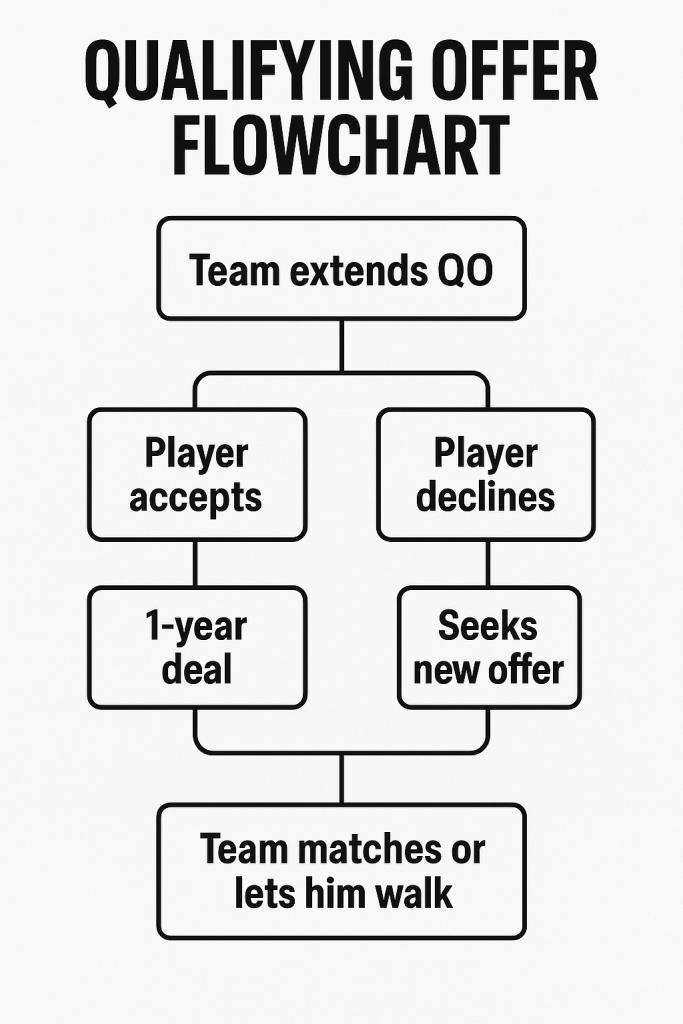
A qualifying offer is a one-year contract offer extended to a restricted free agent, typically at a pre-determined base salary based on tenure and previous salary.
It allows a team to retain the right to match any offer the player receives from another team during free agency.
If the team does not offer a qualifying offer by the deadline (usually late June), the player becomes an unrestricted free agent.
Qualifying offers are not the same as regular free agency offers. They’re used to trigger a restricted status and protect a team’s rights.
How Qualifying Offers Apply In Different Leagues
🏀NBA
In the NBA, qualifying offers are tied to rookie-scale contracts and Restricted Free Agency.
They are the trigger for whether or not a player stays restricted or becomes unrestricted.
Use Cases
- Applies to players coming off rookie contracts.
- Teams submit a qualifying offer to make the player an RFA.
- The offer is a one-year deal based on draft position, service time, and the collective bargaining rules.
If the player accepts the qualifying offer, they play one more year on that number and become an unrestricted free agent the following summer.
If they decline it and sign an offer sheet elsewhere, their current team has the right to match.
This would keep the player on their original teams roster until their next free agency period, where they would then become an unrestricted free agent.
Example
In 2022, Miles Bridges (Hornets) was given a qualifying offer by the Hornets, making him a restricted free agent. But after off-court legal issues, no team offered him a deal when he hit the open market.
He later accepted the $7.9 million qualifying offer from Charlotte by betting on himself and knowing he would hit unrestricted free agency in the next season.
Another Example
Austin Reaves (Lakers) was extended a qualifying offer after the 2024-25 NBA season, became restricted and got a $54 million offer from San Antonio, but Los Angeles matched it.
The qualifying offer he received from the Lakers did not exceed the offer the Spurs laid out for the guard, but the Lakers were able to re-sign him for the same amount, as they had the power to match it.
Without the QO rule, Reaves would be playing in San Antonio for the 2025-26 NBA season.
🏈NFL
The NFL has Restricted Free Agency, but qualifying offers are structured as tenders, which is not the same as in the NBA.
- Players with 3 accrued seasons become RFAs.
- Teams can place original-round, second-round, or first-round tenders.
- The tender sets both the salary and draft compensation the team will receive if the player signs elsewhere.
Example
In 2021, J.C. Jackson received a second-round tender from the Patriots worth ~$3.3 million.
He signed it, played the year, and then hit UFA in 2022 and cashed in on a $82 million deal with the Chargers.
⚾MLB
MLB uses a “Qualifying Offer” system, but it’s entirely different than the way the NBA uses the term.
- It’s a one-year contract offered to pending UFAs, not RFAs.
- Value is based on the average of the top 125 salaries in the league
(~$20.3 million in 2023). - If declined and player signs elsewhere, team receives draft pick compensation.
Example
Carlos Correa rejected a qualifying offer from the Twins and entered free agency. The Twins later re-signed him, but the qualifying offer preserved their draft comp rights until the point he officially re-signed with the team.
🏒NHL
The NHL also uses qualifying offers to retain restricted free agent rights.
- Players coming off entry-level or bridge deals are given a QO.
- Offer is usually 100%-110% of the prior year’s salary.
- If no QO is extended, the player becomes unrestricted.
Example
Jesper Bratt (Devils) received a qualifying offer in 2022.
The team and Bratt couldn’t agree on a long-term deal, so he accepted the one-year qualifying offer from the Devils and entered into arbitration.
🎓NCAA /🥊Combat / ⛳Golf / 🏎️Racing /
Individual Sports
❌ Qualifying offers are not used in NCAA, UFC, golf, or racing.
- These sports don’t have salary caps or team-based contractual obligations like major U.S. leagues.
- Fighter, golfer, and driver contracts are negotiated independently.
Why Qualifying Offers Matter
Qualifying offers are more than just a formality in the leagues that use them or something similar.
They determine a player’s freedom in the free agency market.
- Teams use them to protect assets.
- Players use them to bet on themselves or force a team’s hand.
- Fans often confuse QOs with “offers to keep someone”, when in reality, they’re often strategic placeholders.
Why Accept a Qualifying Offer
- They believe they can earn more next year.
- Their market is cold.
- They want to hit unrestricted status.
Teams use QOs to keep matching rights in-house, keeping their cap flexible.
🔗Related Terms
🔗Next Reads
- Paolo Banchero’s $239 Million Contract Extension
- 5 Worst NFL Free-Agency Contract Busts
- Juan Soto Signs the Biggest Contract in MLB History
- Top 5 Longest NHL Contracts In History
- Inside the Fight for UFC Contracts
📊Graphic
“God “will repay each person for to what they have done.”
– Romans 2:6























 Apostle Sports Media