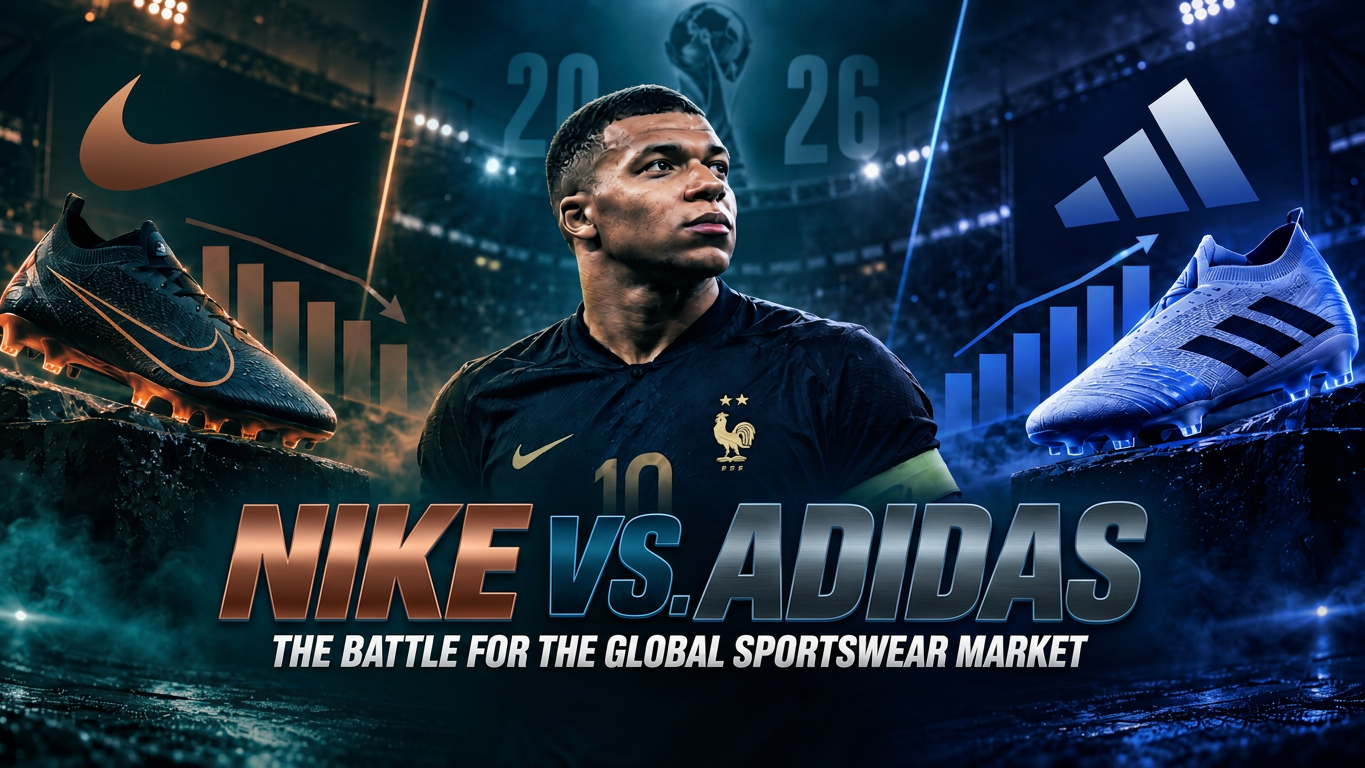
Nike’s revenue fell nearly 10% in fiscal 2025, down to $46.3 billion from $51.4 billion the year before.
Adidas, the same year, posted record revenue figures and double-digit currency-neutral growth across nearly every category.
For the first time in years, the gap between the two largest sportswear companies on Earth genuinely narrowed, and the FIFA World Cup, happening right now is about to decide where that momentum goes next, partly because of a single contract that expires 32 days after this tournament ends.
Most “Nike vs. Adidas” content compares logos, sneaker drops, or who’s “winning” in a vague cultural sense.
This is the actual financial mechanics:
- How each company makes its money
- Why one needs this World Cup more (Nike)
- Why the Mbappé contract sitting on the table right now might be the single most consequential signing in either brand’s recent history
Two Very Different 2025 Results
Nike remains the larger company by a wide margin. Even after a rough fiscal 2025, Nike still generated ~$46.3 billion in revenue, built primarily on footwear, which made up ~67% of total sales.
The direction of travel was the real story, as footwear revenue alone dropped over 12% year-over-year, with North America hit hardest, driven by declines across the Jordan Brand and core men’s and women’s lines.
Net income fell more than 40%, reflecting gross margin pressure and markdown-heavy inventory clearance, the kind of discounting that signals a brand working through excess stock rather than scarcity-driven demand.
Adidas moved in the opposite direction entirely. Footwear grew 12% on a currency-neutral basis. Apparel grew even faster, at 15%. Football specifically drove much of that growth, fueled by new Predator and F50 boot releases. A wave of FIFA World Cup 2026 kit launches also helped push Adidas revenue, as they started selling well before the tournament itself kicked off.
Adidas isn’t just smaller than Nike anymore by a comfortable margin, it’s the company that’s scaling while Nike is currently shrinking.

This infographic highlights the sheer magnitude of the gap that has closed between these two market leaders. By quantifying their results side-by-side, we see a massive 24-point swing in relative performance across the same period. This stark divergence, Adidas accelerating with +12% growth while Nike contracted by -12%, reveals the immediate impact of their competing strategies.
For investors and market analysts, this graphic isn’t just a summary; it is a clear warning that Nike’s strategic reset, which deprioritized wholesale partners, has directly allowed a surging Adidas to recapture significant market momentum.
Why the Gap Closed: Leadership, Inventory, and a Strategic Reset
Nike’s decline wasn’t really about Adidas getting better at making shoes. It was largely self-inflicted. The company spent the prior several years leaning hard into direct-to-consumer sales and digital, scaling back wholesale relationships with retailers along the way, a strategy that backfired as digital sales softened and wholesale partners that Nike had deprioritized began filling shelves with competing brands like Adidas, Puma and Under Armour.
Elliott Hill, appointed president and CEO in September 2024, has been steering the company back toward what insiders are calling a “sport offense”: rebuilding wholesale relationships, tightening product focus, and leaning harder into core performance categories rather than lifestyle expansion.
Adidas, under CEO Bjorn Gulden, took close to the opposite path over the same stretch, deliberately leaning back into wholesale-centric distribution to rebuild market share quickly, rather than prioritizing the slower, higher-margin direct-to-consumer model long-term. That’s a real strategic divergence, not just a difference in marketing budgets, and it’s the underlying reason the financial gap between the two companies has been closing.

Two Different Strategies, Same Underlying Logic
Both companies treat marquee athlete partnerships as serious capital investments, not simple marketing line items, but they’ve been building their rosters with different emphasis.
Nike’s most notable recent long-term signings have leaned into the fastest-growing visibility category in sports right now: women’s basketball.
They have started multi-year partnerships built around Caitlin Clark and A’ja Wilson positioning the brand inside a scalable cultural growth story rather than competing purely on Futbol. On the men’s side, Nike locked in Erling Haaland on a reported decade-long extension worth more than €20 million annually, the current going rate for a top-tier boot deal that doesn’t include a personal signature line.
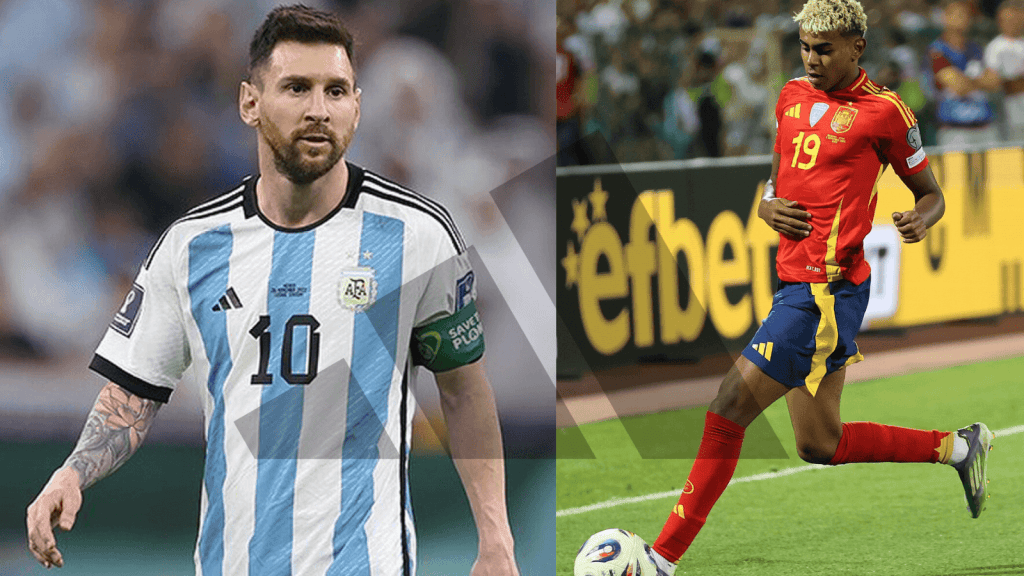
Adidas, meanwhile, has built its current football roster around generational continuity: Messi as the lifetime anchor, Yamal as the deliberately early long-term bet on the next generation. A deepening “Galactico” group of young Real Madrid talent including Jude Bellingham, Brahim Diaz, Trent Alexander-Arnold, and Dean Huijsen.
Both companies are running the same basic playbook, lock in a small number of athletes whose career arcs align with multi-decade brand value, pointed at different sports and different audiences.

The Mbappé Contract: The Biggest Swing Factor Sitting on the Free Agent Market Right Now
Here’s the detail that turns this comparison from a retrospective into something genuinely live and developing as this World Cup plays out.
Kylian Mbappé has been a Nike athlete since age eight, nearly two decades, under a current deal reportedly worth somewhere between €14-16 million annually. The superstar’s contract with Nike expires July 31, 2026, just over a month after this World Cup’s final, timing that places the renewal negotiation at the exact moment Mbappé’s commercial value is at its peak, with the entire football world watching.
Adidas has reportedly offered Mbappé significantly more than Nike in past negotiation cycles, with one report citing an offer roughly €20 million per year above Nike’s terms during a previous renewal, and Mbappé still chose to stay.
What’s different this time is that Real Madrid, Mbappé’s current club, plays in Adidas kits, meaning an Adidas signing would create the kind of integrated head-to-toe brand exposure neither company can manufacture through marketing spend alone, a real, structural argument that doesn’t depend on simply outbidding Nike.
Adidas’s complication is the French national team’s separate, long-running Nike kit deal, which runs to 2034; signing Mbappé personally wouldn’t pull his international kit away from Nike, fragmenting the exposure across his two biggest stages.
If Nike loses, it won’t be because of a pricing failure. Nike has historically been willing to pay for its true tentpole athletes, the Haaland extension and the company’s past willingness to match Adidas’s junior-level offers for Mbappé both prove that. It would be a loss built on structural club-kit synergy that money alone doesn’t fully solve, decided in the middle of the exact tournament built to showcase whichever brand wins him.
Why This Specific World Cup Matters More
Every World Cup is a marketing event for both companies, but timing made this one unusually consequential.
Adidas needed this tournament to convert a genuinely strong 2025 into sustained momentum rather than a single good year, and its kit and boot launches were built around World Cup timing specifically.
Nike needed this tournament to stabilize a declining fiscal year and prove its “sport offense” reset is working in its highest-visibility category outside the U.S. market.
Both companies are simultaneously negotiating the contract of a generational athlete whose decision will be made, announced, or at least meaningfully shaped, in the weeks surrounding the World Cup.
The Bottom Line
While the cultural debate between the Swoosh and the Three Stripes lives on social media feeds, the financial trajectory of both sports apparel titans is governed strictly by hard performance metrics and product distribution networks.
Nike’s pivot to scale back its wholesale allocations over the early 2020s opened up immediate shelf space at major global retailers, a logistical vacuum that Adidas capitalized on efficiently by expanding its classic terrace sneaker drops and high-performance boot lineages.
As the tournament cycle moves through North America, the macro-economic stakes shift toward consumer purchase habits following major international match days.
For Nike, stabilizing its footwear divisions requires a robust return to core sporting performance, leveraging its massive structural capital to out-innovate agile market entrants.
For Adidas, sustaining its record-setting momentum relies on scaling its regional supply chains to meet elevated merchandise demand without inducing over-saturation.
The resulting market intersection proves that modern sports marketing is no longer just about generating high visibility; it is about managing inventory velocity, protecting gross corporate margins, and capturing the long-term enterprise value of the world’s most elite athletes.
Nike vs Adidas World Cup Marketing FAQs
How did Nike’s corporate revenue change in fiscal 2025?
Nike’s global revenue declined by nearly 10% in fiscal 2025, dropping down to $46.3 billion from the $51.4 billion recorded during the previous fiscal cycle, driven primarily by a 12% drop in footwear sales and direct-to-consumer softening.
What drove Adidas’s record financial growth heading into 2026?
Adidas generated double-digit currency-neutral growth across multiple product segments, highlighting a 12% increase in footwear revenue, a 15% jump in apparel sales, and substantial retail momentum fueled by Predator and F50 boot releases alongside official FIFA World Cup 2026 kit launches.
When does Kylian Mbappé’s endorsement contract expire?
Kylian Mbappé’s long-standing endorsement deal with Nike is scheduled to officially expire on July 31, 2026, just 32 days after the completion of the World Cup tournament cycle.
How does club kit sponsorship create an advantage for Adidas in signing Mbappé?
Because Kylian Mbappé plays his club football for Real Madrid, a signature club locked into an active Adidas kit partnership, signing a personal endorsement deal with Adidas would create structural head-to-toe brand exposure across all domestic and European competitive matches.
What is the “sport offense” strategy being executed by Nike CEO Elliott Hill?
The “sport offense” strategic reset focuses on stabilizing Nike’s global market position by actively rebuilding relationships with key wholesale retail partners, tightening the company’s product drop focus, and reinvesting heavily into core athletic performance categories over lifestyle expansion.
Next Reads
- Nike’s Tariff Problem: How U.S. Trade Policy Reshaped the Swoosh’s Margins, Endorsements, and Global Strategy
- 3 Sports Companies on the Rise
- Athletes, Beware: Polymarket Allegedly Staged Viral Betting Videos On Copy Site
- The Streaming Problem in Sports
- How Media Rights & Streaming Deals Influence Player Salaries
Disclaimer: This article contains general financial information for educational purposes and does not constitute professional advice. APSM estimates are derived from publicly available information, tax assumptions, finance modeling, and industry-standard fee structures. Actual earnings may vary based on residency elections, private contract provisions, image/media rights agreements, bonuses, and tax filings.