
Major League Baseball created an entirely new sponsorship category that didn’t exist two years ago, and it’s reportedly worth up to $300+ million.
MLB reportedly has partnered with the prediction market platform Polymarket, a website that by definition, isn’t legally allowed to call itself a sportsbook. This is of course why the deal was structured specifically so it wouldn’t have to.
This is the part of the prediction market boom that gets buried under the bigger headlines about athlete endorsements and regulatory fights. The leagues themselves are quietly building an entirely new, fast-growing revenue line, and the numbers behind it say a lot about where sports business is actually headed.
The Deal That Set the Market: MLB and Polymarket
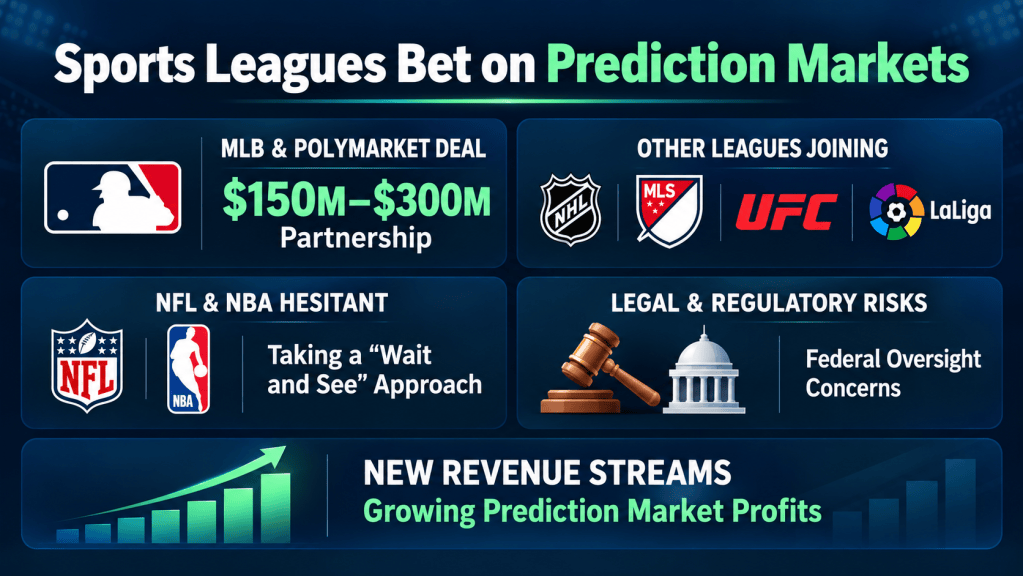
In March 2026, MLB signed a multi-year deal naming Polymarket its official prediction market exchange partner. The financial terms weren’t formally disclosed, but multiple outlets reporting on the deal pegged it between $150 million and $300 million over three years, with the wider range reportedly tied to performance benchmarks built into the contract.
The structural detail that matters more than the dollar figure, is that MLB explicitly classified prediction markets as their own sponsor category, “separate and distinct” from sports betting.
That’s not a technicality. FanDuel already holds co-exclusive status as MLB’s Official Sports Betting Partner. By creating a second, parallel category specifically for prediction markets, MLB didn’t have to touch its existing betting sponsorship at all, it simply added a new revenue line on top of one that already existed.
Polymarket also received exclusive rights to MLB logos and marks within prediction-market products, along with access to official league data through Sportradar to help settle markets accurately. MLB simultaneously signed a memorandum of understanding with the CFTC, the first such agreement between the regulator and a professional sports league, establishing a framework for information-sharing on integrity issues.
Commissioner Rob Manfred has been direct about why a federal regulatory structure appeals to leagues: dealing with one national regulator is simpler than navigating sports betting’s state-by-state patchwork. No one really knows when or how hard federal regulations will come into play, if at all, and so MLB has taken the risk to be the guinea pigs of the prediction sports markets across global pro leagues.
Whether it will backfire down the line is yet to be seen, but for now MLB is enjoying the ROI they are seeing when fans use Polymarket to “predict” things that specifically have to do with baseball. This is how MLB gets paid after all, why “predict” football game outcomes when you can “predict” a strike or ball, pitch by pitch.
The Leagues That Got There First
MLB was actually late to the prediction market party among pro sport leagues, they are just the first league to choose their “Official Prediction Market Partner, Polymarket”, instead of allowing both Kalshi and Polymarket to have access to MLB data.
The NHL moved first, in October 2025, signing deals with both Kalshi and Polymarket, rather than picking one exclusive partner. NHL granted both platforms access to NHL marks, official data, and branded placement during marquee events like the Stanley Cup Playoffs.
NHL Commissioner Gary Bettman has framed the dual-partner approach as a way to keep markets “based on real data,” while retaining the league’s ability to pull down any specific contract it doesn’t consider appropriate.
MLS followed in January 2026, naming Polymarket its official and exclusive prediction market partner. The UFC, through parent company TKO Group, signed with Polymarket the prior November. LaLiga became the first major European soccer league to follow, also partnering with Polymarket, in April 2026.
The dual-partner model the NHL used, letting Kalshi and Polymarket compete for the same league’s market, rather than handing one platform exclusivity, is emerging as a structural alternative worth watching. It creates ongoing competitive pressure between the platforms for league favor, which can mean better terms for the league over time, at the cost of the bigger upfront exclusivity number a single-platform deal like MLB’s commands.
NFL/NBA Are Sitting This Out
This is the more interesting story by omission. Of the major U.S. leagues, the NFL has kept prediction markets at arm’s length the longest, and the NBA’s full position still hadn’t been formally settled as talks accelerated through the first half of 2026.
The NBA did name a daily fantasy platform as an official partner in a smaller, related move, but stopped short of a full prediction-market exchange deal with Polymarket, Kalshi or someone else.
The NFL’s hesitation reportedly centers on integrity concerns specific to football, markets tied to granular in-game events like missed field goals, or markets around coaching changes that could leak information before becoming public. That’s a meaningfully different risk profile than a market on a season-long championship outcome, and it’s a sign that “prediction markets” isn’t a single, uniform product, the integrity risk scales with how granular and fast-moving the specific market is.
Both leagues face real pressure to eventually engage, given the size of the checks both MLB and the NHL have already cashed. All sports leagues are a business at the end of the day, and raising the bottom line and profit margins is hard to pass up.
Whether they hold out for better terms, wait for the regulatory fights to settle, or simply move slower out of caution, the eventual NFL or NBA deal, whenever it lands, will likely be the largest single agreement in the category, given each league’s relative size and audience.
The type of media and streaming rights deals that both the NFL and NBA are contracted under are a primary reason these two leagues have some of the highest salaries in all pro sports globally.
With global economies inflating quickly, sports and betting being at an all time high in interest, and prediction markets rising to the side of the federal regulations microscope, for now, it is hard to see the NFL, NBA and other major sport leagues being able to stay away from prediction market partnerships.
The NCAA definitely should stay away however, as sports betting has been a major problem for them with both athletes participating and damaging the integrity of the game, local governments refusing to do the feds dirty work, and issues with The House.
Why This Money Looks Different Than Betting Sponsorships
Traditional sportsbook sponsorships have functioned for years as relatively modest data-rights and marketing-integrity fees, paid by operators like FanDuel and DraftKings to leagues for official data access and branding rights.
The reported scale of the MLB-Polymarket deal dwarfs that historical structure. Prediction market operators are paying leagues directly, at a scale closer to a major media-rights add-on than a typical sponsorship line, for the right to use league data and branding inside a regulated commodities product rather than a state-licensed betting product.
That distinction is also exactly what’s under direct legal challenge right now. More than a dozen states are actively contesting whether prediction markets are functionally unlicensed sports betting wearing a different legal label.
- Arizona has filed criminal charges against Kalshi specifically due to false advertising.
- Nevada courts have upheld an operational ban on all prediction market partnerships and use.
- A federal appeals court ruling in a New Jersey case found in Kalshi’s favor, on the theory that federal commodities law preempts state gambling law for these specific products, which set a notable precedent, though New Jersey has requested for a larger panel to rehear the case.
- Congress has its own bipartisan bill in motion that would explicitly classify these contracts as gambling outright, thus suffocating them.
None of this is settled.
The Number Leagues Are Actually Betting On
Here’s the financial logic from the league side, stripped down: leagues are getting paid nine-figure sums for a product whose legal classification is genuinely still being argued in courtrooms and Congress simultaneously.
If prediction markets get legally classified as gambling outright, federal preemption of state gambling law could get rolled back, and the entire commercial structure these deals are built on could change overnight.
If the current regulatory framework holds, leagues that signed early, MLB, the NHL, MLS, UFC, are sitting on a head start in a sponsorship category that’s almost certainly going to keep growing as more leagues, including the NFL and NBA, eventually join in.
That’s a real bet, made with real money, on a legal outcome nobody can currently guarantee. Leagues aren’t waiting for the question to be resolved before signing the checks, which tells you how confident league finance offices currently are that this market survives its current legal fights in something close to its present form.
The Bottom Line
The prediction market boom isn’t just an athlete-endorsement story or a regulatory fight, it’s become a brand-new, fast-growing revenue category for the leagues themselves, structured deliberately to sit alongside existing betting sponsorships rather than replace them.
MLB’s reported $150-300 million deal with Polymarket set the going rate for what a major U.S. league’s data and branding rights are worth in this specific space, and the NHL, MLS, UFC, and LaLiga all signed on before the legal question of what these platforms actually are has even been settled.
Whatever happens in the courts and in Congress over the next year will determine whether this turns out to be the smartest piece of revenue diversification in modern sports business, or the leagues’ answer to a regulatory gamble.
Pro Sports Prediction Market Data Deals & CFTC Rules FAQs
What is the difference between a sportsbook sponsorship and a prediction market deal?
Traditional sportsbook sponsorships function as flat-rate media or marketing-integrity fees for brand exposure. Prediction market partnerships, like MLB’s $300M Polymarket deal, are structured as high-yield sports data rights agreements where leagues license official performance metrics directly to commodities exchanges.
Why did MLB create a separate sponsorship category for prediction markets?
MLB explicitly classified prediction markets as a standalone category separate from sports betting. This structural maneuver allows the league to protect its exclusive sports betting partnership with FanDuel while generating a completely parallel, multi-million dollar revenue line on top of it.
How does CFTC regulation affect professional sports prediction markets?
Leagues favor Commodity Futures Trading Commission (CFTC) oversight because navigating a singular federal regulatory framework is simpler than dealing with the complex, state-by-state licensing patchwork required by traditional sports gambling boards.
Which professional sports leagues have signed deals with Polymarket?
MLB, MLS, UFC (via TKO Group), and LaLiga have all named Polymarket as their official or exclusive prediction market partner. Conversely, the NHL utilized a non-exclusive model, licensing its data and marks to both Kalshi and Polymarket simultaneously to drive competitive pricing.
Next Reads
- Athletes, Beware: Polymarket Allegedly Staged Viral Betting Videos On Copy Site
- How Media Rights & Streaming Deals Influence Player Salaries
- Should MLB Introduce a Salary Cap
- The Streaming Problem in Sports
- A Lubbock Judge Just Saved Brendan Sorsby’s Season, and Broke College Sports in the Process
Disclaimer: This article contains general financial information for educational purposes and does not constitute professional advice. APSM estimates are derived from publicly available information, tax assumptions, finance modeling, and industry-standard fee structures. Actual earnings may vary based on residency elections, private contract provisions, image/media rights agreements, bonuses, and tax filings.