

The biggest and possibly most shocking trade in NBA history has been finalized.
The Dallas Mavericks officially traded their 5-Time All-NBA 1st-team & 25-year-old Superstar Luka Dončić to the Los Angeles Lakers, for a return of Anthony Davis, Max Christie and a 1st round draft pick.
This is the first time in NBA league history, that two All-Pro players were traded for one another during the middle of a season.
While fans debate who won the trade however, the story isn’t only on the floor. It is also the financial impact that this trade for the league itself.
From salary cap gymnastics, supermax extensions out the window, and massive tax implications, this deal has layers that go way beyond the three-point line.
The Trade Breakdown
Los Angeles Lakers Haul
- Luka Dončić (5 years, $215.2M)
- Maxi Kleber (3 years, $33M)
- Markieff Morris (1 year, $3.2M)
Dallas Mavericks Receive
- Anthony Davis (3 years, $186M)
- Max Christie (3 years, $5.2M)
- Lakers’ 2029 first-round pick (Unprotected)
This move not only reshapes two franchises on the floor.
It shifts the financial outlook for Dončić, Davis, both teams involved and the NBA in its entirety.
Luka Lost $115+ Million
Before the trade, Luka Dončić was on track to sign a $345 million supermax extension with the Dallas Mavericks next summer, which would have been the largest contract in NBA history. (Until SGA’s Extension).

Supermax deals are only available to players who stay with their original team, or a team that acquired them when they were still on their rookie contract. Now that he’s in Los Angeles, Dončić is no longer eligible.
Instead, the most he can sign for in the 2025 NBA off-season is a
four-year, $230 million max extension. Representing a significant drop of over $115 million in contract value from a Dallas supermax.
That’s not all
- Texas has no state income tax.
- California has a 13.3% income tax.
So, on Dončić’ $46M+ salary, Luka will now pay an extra $6.1M per year in state taxes alone to California.
Over the next four years, Luka will lose $24.4M lost to California. Factor in Federal Tax rates and the high cost of living in Los Angeles as well, and Luka Dončić may be losing out on close to $150 million or more, due to the impact of this trade.
However, the five-time 1st team All-Pro also lands himself in one of the biggest revenue generating markets in the world for both sports & entertainment, Los Angeles.
A market that potentially opens doors to other lucrative endorsement and investment opportunities for the perennial Superstar.
So, while the initial financial loss is certainly impactful, Luka will likely have other financial connections that he may not have had in Dallas.
Connections that may allow him to make some of, if not all of that money back that he will lose due to the trade, in “The City of Angels.”
Anthony Davis Just Got a Pay Raise
While Luka Dončić loses out on over $115M, Anthony Davis banks and extra $24.6M just by moving to the state of Texas.
He is possibly the biggest winner in this trade, at least financially, as he now moves away from the state of California, to a state where he won’t have to pay any state income tax.
His current three-year, $186 million contract remains intact, but every dollar he earns will now go further. With an average salary of $62M per year, AD is saving roughly $8.2M annually by playing in Texas instead of Los Angeles.
So while on the court, fans and media critics alike seem to believe that Anthony Davis was not the best package available for a Luka Doncic trade, Davis certainly won’t be worried about his bank account.
Over the next three years, Davis will earn $24.6M more in take-home pay than if he had stayed with the Los Angeles Lakers.
For AD, this trade isn’t just a fresh start, it’s a multi-million-dollar financial boost.
Although, Davis is not on a supermax deal himself, this generational trade between the Mavericks and Lakers actually balances his yearly financial valuation with Luka’s.
This of course is also due in large part, to Luka no longer being eligible for the supermax.
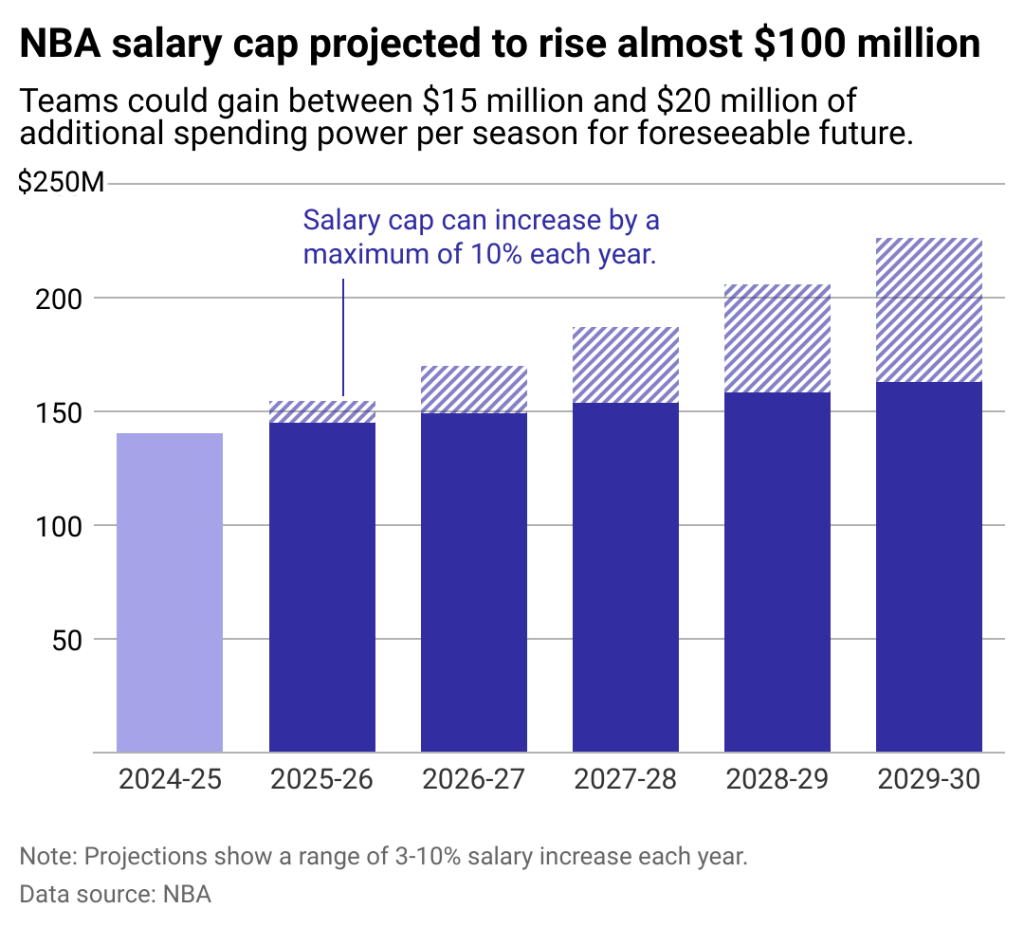
How This Impacts Each Team’s Salary Cap
Los Angeles Lakers
Luka’s Dončić’ contract puts the Lakers even deeper into the luxury tax. LA is projected to pay over $50M in tax penalties next season if they don’t move other contracts.
This also raises questions about LeBron James’ future in Los Angeles.
The Lakers have almost no cap flexibility to add another star.
Without depth that can compete with other rising western rosters like the OKC Thunder or Houston Rockets, the Lakers will need to shed tens of million in salaries and quick.
The Luka situation that owner Rob Pelinka has found himself seemingly gives the Los Angeles Lakers front office two options.
- Shed a significant amount of role player contracts over the summer and go all in on Luka, Lebron and either trade for, or sign another impactful star in Free Agency.
Attempting to go all in for Lebron James’ last few runs at a title and worrying about their future after his eventual retirement. - Decide that Luka Dončić is the future in the City of Angels and trade Lebron out of town before the trade deadline tomorrow, February 6th, 2025 or in the early off-season.
Considering that Lebron is currently earning roughly $50M per season on his current veteran-max deal, this seems like the obvious choice for the Lakers.
However, it is yet to be seen how Lebron and Luka will mesh on the court and if they end up being a dominant force and serious threat after all. The decision for the Lakers both roster wise and financially will only continue to become harder to make.
Dallas Mavericks
Anthony Davis’ contract is still massive, but it lowers Dallas’ future financial commitments compared to a Luka $345 supermax.
The Mavericks have more flexibility for moves around Davis and Kyrie Irving, as the trade provides Dallas with more cap flexibility.
While Davis is set to earn around $40M per season, his deal expires in 2028, giving the Mavericks an earlier window to reset their books. From a financial perspective, the trade sheds long-term risk for Dallas.
Luka’s contract would have locked them into a five-year supermax structure, limiting their continued ability to build a contending roster.
By pivoting to Anthony Davis, the Mavs lower their future salary cap burden, allowing them to pursue additional roster upgrades around Kyrie Irving and other potential free-agent targets. (Kevin Durant?)
Beyond immediate cap relief, Dallas also gains an extra 2029 first-round pick, which could become a key trade asset if used accordingly.
With Davis, the Mavs still have an All-NBA talent, but without the long-term financial constraints that come with keeping a 25-year-old generational superstar like Luka.
However. the question remains: Can Davis stay healthy enough long-term to justify the shift?
How Did This Trade Even Get Approved?
Unlike the Chris Paul fiasco, the NBA couldn’t block this deal even if it wanted to.
This is where NBA fans start screaming: How was this mind boggling transaction allowed when the Chris Paul-to-Lakers trade got vetoed in 2011?.
Quick refresher: The NBA blocked the CP3-to-Lakers deal because the league technically owned the New Orleans Hornets at the time and argued that the transaction wasn’t in the best interest of the association.
The infamous veto, led by then-commissioner David Stern, was framed as a basketball decision but was truly about league optics, small-market competitiveness, and ownership concerns.
For the groundbreaking & historic Anthony Davis x Luka Doncic trade, both teams are independently making their own moves under the current CBA.
This means that the majority owner(s) of the Lakers and Mavs were entirely in control of the trade.
In the NBA’s financial landscape, the new CBA actually makes blockbuster trades like this easier to execute, not harder.
The CBA Has Shifted Blockbuster Trades
- The second apron penalties haven’t kicked in yet. Under the NBA’s new tax rules, teams exceeding the dreaded “second apron” face severe restrictions on trades, sign-and-trades, and roster flexibility.
However, those penalties don’t fully activate until the 2025-26 season, giving teams like the Lakers and Mavericks a small window to make big moves before they start feeling the weight of the newly imposed restrictions. - The new extension rules changed how Luka’s deal could be structured. Before the 2023 CBA, a player of Luka’s caliber would’ve had fewer options for restructuring their deal mid-contract.
However, updated extension rules allowed more flexibility for long-term planning. Dallas found an actual pathway to move his contract without triggering financial turmoil.
On paper, it was purely a business decision that the Dallas Mavericks just didn’t want to cut the $345M check for the 25-year old Superstar this upcoming summer. - The NBA wants superstars in big markets. The league thrives on marquee names in major cities. While they won’t publicly admit it, having Luka in Los Angeles and Anthony Davis in Dallas makes for prime-time drama, the rebirth of elite ratings, and more international branding opportunities.
| NBA Teams Ranked by Revenue 2023-2024 (in millions USD) | Revenue (in millions USD) |
|---|---|
| Golden State Warriors | $800 |
| New York Knicks | $543 |
| Los Angeles Lakers | $522 |
| Boston Celtics | $457 |
| Dallas Mavericks | $437 |
| Houston Rockets | $416 |
| Chicago Bulls | $414 |
| Philadelphia 76ers | $396 |
| Cleveland Cavaliers | $391 |
| Brooklyn Nets | $381 |
| Miami Heat | $373 |
| Phoenix Suns | $369 |
| San Antonio Spurs | $363 |
| Washington Wizards | $362 |
| Denver Nuggets | $356 |
| Atlanta Hawks | $353 |
| Los Angeles Clippers | $341 |
| Toronto Raptors | $335 |
| Portland Trail Blazers | $333 |
| Milwaukee Bucks | $320 |
| Indiana Pacers | $320 |
| Oklahoma City Thunder | $320 |
| Sacramento Kings | $320 |
| Utah Jazz | $318 |
| Charlotte Hornets | $308 |
| Detroit Pistons | $305 |
| Minnesota Timberwolves | $305 |
| Memphis Grizzlies | $291 |
| Orlando Magic | $285 |
| New Orleans Pelicans | $272 |
What Happens Next?
- Lakers go all in: Luka Dončić’ is officially LeBron’s successor, but with their cap in the red, can they afford to build a real contender around him?
- Mavericks’ high-risk, high-reward move: Anthony Davis is still an elite two-way force, but his health is the multi-million-dollar question: Will his play elevate Dallas, or will this trade blow up in their face?
- Luka’s financial decision looms: Even without a supermax, the Lakers are betting on the facts that LA’s market power and brand appeal are enough to keep him long-term.
- The question here: Now that the supermax is off the table, what does Dončić want for his legacy and remainder of his career and Hall of Fame trajectory?
- Is Lebron on the move next?
One thing is certain: The Anthony Davis for Luka Dončić deal has changed the entirety of the NBA landscape forever, both on the court and financially.
Want Every APSM Report In One Place?
The APSM Master Report Bundle includes all current APSM reports:
- Travis Hunter’s 2025 Net Worth Valuation
- Tyrese Haliburton’s 2025 Net Worth Valuation
- 7 Ways Athletes Build Wealth
- 7 Ways Athletes Go Broke
- (Will Include future additions of reports as APSM grows)
You’ll Get:
- Deep financial literacy designed through a sports lens
- Net Worth projections, contract forecasts & tax modeling
- Wealth frameworks & risk analysis
- Lifetime value mapping for both athletes and professionals
The most valuable way to learn the game of money through APSM.
Next Reads
- Lakers’ $10 Billion Sale
- Luka Dončić Lost $345 Million: How the Lakers Trade Cost Him a Supermax
- Kevin Durant’s Trade to the Houston Rockets
- Cooper Flagg Could Earn Over $1 Billion in Future NBA Contracts
- Ace Bailey’s NBA Draft Fall Cost Him $9 Million
Credits
Written by: Aidan Anderson
Research and Analysis: Apostle Sports Media LLC
Sources: NBA salary databases, ESPN Insider, Spotrac, Basketball-Reference, team and player contracts, APSM Proprietary Analysis.
Social Media Clips: Instagram & X
YouTube Embed: Bleacher Report
Featured Image: Public Domain / Wiki Commons
Disclaimer: This article contains general financial information for educational purposes and does not constitute as professional advice.
He went on: “What comes out of a person is what defiles them. For it is from within, out of a person’s heart, that evil thoughts come, sexual immorality, theft, murder, adultery, greed, malice, deceit, lewdness, envy, slander arrogance and folly. All these evils come from inside and defile a person.”
– Mark 7:20-23




















 Apostle Sports Media