Back in January 2025, Shai was on the path to becoming the first player making $80M+ per season, but was still a what-if at the time.
Questions were looming around the basketball community about if SGA would become the first player in NBA history to earn $80 million a year, if he was worth it, if OKC would actually even pay it and of course, was Shai willing to stay in a small market to maximize his contract?
We have the answers now. Every single one of them.
Shai Gilgeous-Alexander won the regular season MVP. Then won the Finals MVP. Led the Oklahoma City Thunder to their first NBA championship.
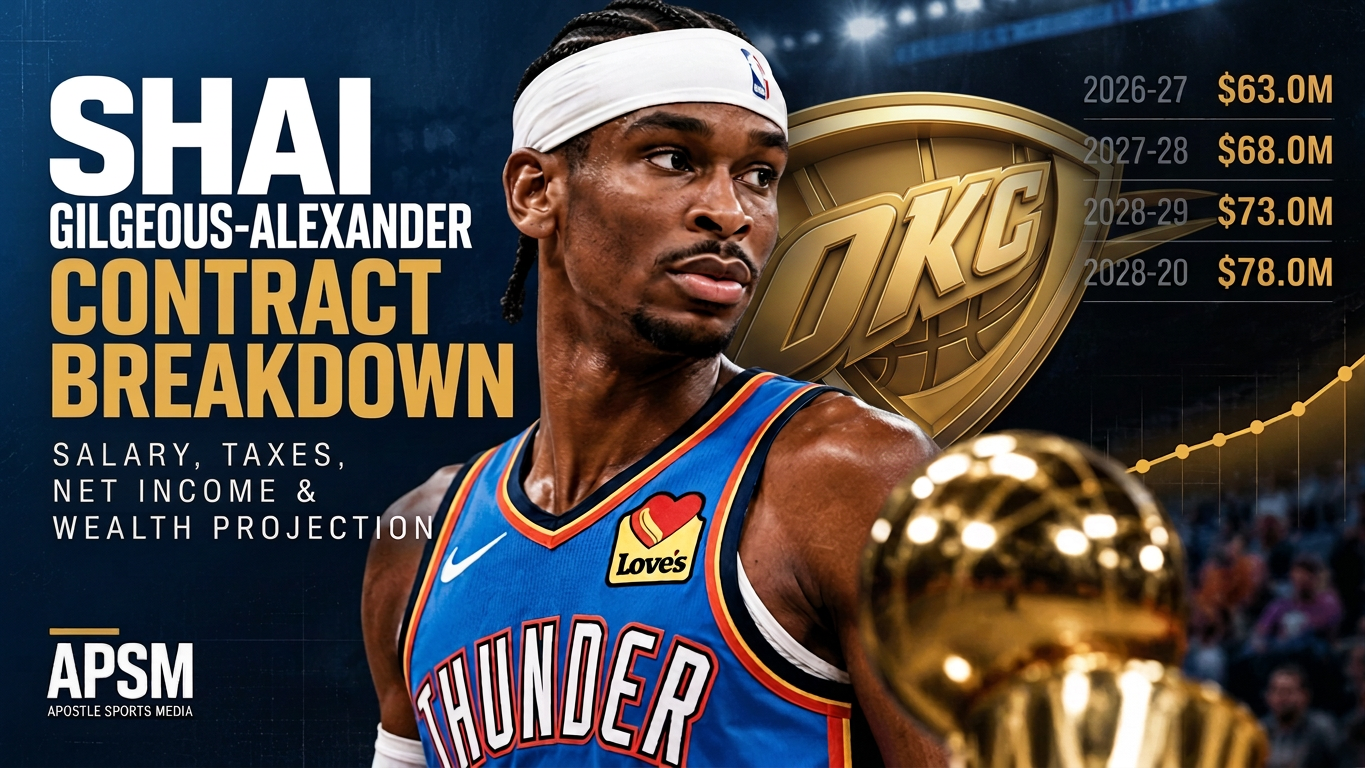
He then signed a 4-year, $285 million supermax extension, the richest annual salary in league history at $71.25 million per year at the time of signing and now second to Donovan Mitchell’s (signed in July, 2026), and by the final year of the deal he’ll earn ~$78 million in a single season.
The what-if is now the what-happened. So let’s break down what this money actually looks like in real numbers.
The Contract, Broken Down
| Season | SGA’s Salary | Notable Context |
|---|---|---|
| 2025-26 | Current deal (~$35.9M) | Final year of previous extension |
| 2026-27 | Current deal | Extension eligible year |
| 2027-28 | ~$63M | Supermax kicks in |
| 2028-29 | ~$68M | Cap escalation |
| 2029-30 | ~$73M | N/A |
| 2030-31 | ~$78M | Highest single-season salary in NBA history |
The supermax doesn’t start until after this upcoming 2026-27 season, but by the time his deal hits its peak Shai will be earning more than twice Michael Jordan’s highest single-season Bulls salary.
The fact that OKC can pay him that and still compete for a championship every year is a testament to how well Sam Presti and the Thunder front office have built this roster, but the bottom line is simple, SGA is now the highest-paid player in NBA history by annual salary, and one of the most financially positioned athletes in the world.
Total guaranteed career earnings by end of contract: ~$481.6 million
What Nearly Half a Billion Dollars Can Become
Shai is going to gross nearly half a billion dollars by 2032 in contract money alone. When you factor in off-court income from sponsorships, business ventures, real estate, portfolio appreciation, and smart long-term investments, SGA is on pace to become a billionaire if he maintains the right financial mindset moving forward.
In fact, it is highly likely that Shai ends up earning more from his business ventures and investments than he ever will from his NBA salary. Investments and appreciating assets outpace the growth of a set salary over time, and the athletes who understand that early are the ones who build true wealth.
If Shai eventually owns $50M in real estate that generates ~$1M to $1.5M in monthly net profit, deploys another $50M into a compounding stock portfolio, and adds the ROI flowing in from business equity, brand partnerships, and his signature Nike deal, he could realistically add $30M to $40M or more to his net worth every year without ever lacing up a sneaker.
These numbers sound insane, but Shai putting $100M into wealth-building vehicles like RE and the stock market is still only about 25% of his total gross contract earnings over his next six seasons.

The Public Number Is Not the Full Financial Picture
Most media coverage of athlete net worth focuses strictly on gross contract numbers and publicly known assets. The reality is that people who build and sustain generational wealth do not do it through public salaries and headline figures.
They do it through low-profile structures, like LLCs, holding companies, and investment entities that write off operational expenses, payroll, and depreciation to legally keep more of what they earn. The public number is almost never the real number.
You will never know the full scope of someone else’s finances without access to their tax returns, which is by design.
Athletes who flash their wealth publicly are typically the ones who eventually go broke.
The ones quietly compounding through diversified, structured investments throughout their collegiate and professional careers are the ones who actually live well, sustain wealth for decades, and set their families up in a world where the cost of living keeps climbing without a ceiling.
APSM covers net income and estimates NIL and pro athletes’ actual net worth rather than their gross headline figures. That means calculating the money an athlete actually pockets and the liquid income earned after accounting for taxes, lifestyle expenses, professional fees, payroll, capital run-off for international athletes, and known liabilities.
While SGA is the highest-paid player in NBA history by annual contract value, he could technically choose to live in Los Angeles, never invest a dime into the stock market, and skip buying rental properties or apartment complexes.
The money from his contract alone is still more than most people could fathom how to spend. But, if he wants to set up his children, grandchildren, and generations beyond his lifetime, he should absolutely compound his money and build as much as possible before his time is up.
What SGA’s Contract Teaches the Average Athlete
How this applies to the average athlete is straightforward. If you earn $3 million in your entire career, you will not have the same leverage or margin as SGA to build a massive compounding portfolio.
However, if you understand how the wealthy invest and protect their capital while generating passive profits year-over-year, you can still build a financial portfolio worth millions.
By understanding tax leverage, residency, real estate appreciation, and the power of index funds, single-stock portfolios, and smart capital allocation, you can take advantage of the exact same wealth-building tools the top earners use.
Sometimes knowledge is the best way to make money. It is not about buying sales courses, get-rich-quick schemes, or earning a formal finance degree. It comes down to the decision-making mindset, like choosing to own a ranch in Nebraska while renting a condo in LA or Miami, rather than buying a massive mansion in New York City and racking up multiple apartments across high-cost coastal states.
Now, here is what Shai will actually make from his contract, not what the typical headlines tell you, because gross earnings are not net reality.

What SGA Actually Takes Home
Here’s where it gets real, and where most sports coverage completely drops the ball. $71 million sounds like a life-changing number, because it is.
But, $71 million on a contract and $71 million in your bank account are two completely different things, and the gap between them is the entire reason APSM exists.
Federal Income Tax
hits first and hits hardest. The U.S. top federal tax bracket is 37%, and at $71.25M nearly all of Shai’s salary sits well above the threshold where that rate applies. After standard deductions, he’s looking at roughly $26 million in federal tax annually. That’s before a single other deduction is calculated.
Oklahoma State Income Tax
Oklahoma levies a 4.5% top rate, and because Shai plays his home games in OKC and the Thunder hold his contract, a significant portion of his income is sourced to Oklahoma for state tax purposes. On $71.25M that’s approximately $3.4M more per year out the door, simply because of where his team plays.
NBA Escrow
One of the lesser thought of deductions from an NBA salary/contract is escrow withholding. Under the league’s Collective Bargaining Agreement, roughly 10% of a player’s salary is withheld during the season so the NBA can reconcile total player compensation against the players’ agreed share of league Basketball Related Income.
That money is not automatically gone however; If league-wide revenue lands where expected and player salaries remain within the agreed revenue split, most or all of the escrowed money can be returned after the league completes its accounting. If player compensation runs above the negotiated share of revenue, however, some of the withheld amount may be retained.
At Shai’s peak salary, a 10% escrow withholding would temporarily remove roughly $7 million from his available cash flow during the season.
That matters when estimating what he can actually access and spend in real time, but it should be treated differently from federal tax, state tax, or agent fees because escrow is a reconciliation hold, not necessarily a permanent expense.
Agent Fees & Representation
The NBPA caps representation fees at 4% of the playing contract. On $71.25M that’s $2.85M per year going to his agent just for the playing contract, before any separate marketing or endorsement deal representation is billed on top of that.
Add it all up and here’s what the math actually looks like at peak salary:
| Deduction | Estimated Annual Amount |
|---|---|
| Gross Salary | $71,250,000 |
| Federal Tax (37%) | -$26,000,000 |
| Oklahoma State Tax (4.5%) | -$3,400,000 |
| NBA Escrow (10%) | -$7,100,000 |
| Agent Fees (4%) | -$2,850,000 |
| Estimated Net Take-Home | ~$31.9M – $35M |
Shai signed for $71M but he’ll take home somewhere between $32M – $35M in actual spendable income per year at the peak of his deal.
That’s still more money than most people see across entire careers, but it is not the number the headline says it is, and every athlete who has ever been surprised by their tax bill in April found that out the hard way.
This is exactly what the APSM Net Income Calculator is built for. Plug in your contract, your state, your agent rate, and see your real number before you start spending against the gross one. Download it free here.
The good news for Shai is that his take-home is only one piece of the financial picture, and honestly not even the most interesting one.
The Endorsement Stack on Top
Playing salary is just the start. SGA also pulled ~$18 million in off-court income during the 2024-25 season alone, tied for sixth among all players.
His current estimated endorsement portfolio:
| Brand | Estimated Annual Value |
|---|---|
| Converse (Nike-owned) | ~$5M+ |
| Jordan Brand | Reported partnership |
| Tissot | Luxury watch deal |
| Additional partners | Growing post-championship |
SGA had been with Converse since 2020, eventually signing a new multi-year extension in 2024 worth a reported $15 million annually, where he was also named Creative Director of Converse Basketball, a title that was anything but honorary.
He became just the 11th player in basketball history to receive a signature shoe from Converse, joining a list that includes Julius Erving, Magic Johnson, Dennis Rodman, and Dwyane Wade. The SHAI 001 launched at the 2025 All-Star Game and immediately sold.
Then in June 2026, headlines ran everywhere saying SGA “left Converse for Nike.” That framing missed the actual story entirely. Converse did the early-stage work that doesn’t scale, building a relationship, proving a signature shoe could sell, giving SGA a creative title so he’d feel invested.
Now that the MVP crown is on and the shoe line is established, the parent company upgraded him to the main brand where the bigger deals live. This is the kind of move that looks like chaos from the outside and like a spreadsheet from inside.
The Nike Deal “Upgrade”
The Nike deal is reported to be worth ~$15 million a year, matching what Converse was paying, but now with the full weight of Nike Basketball’s global marketing infrastructure, flagship retail placement, and the signature line infrastructure that produces generational wealth for the athletes who land on it.
Jordan Brand made Michael Jordan a billionaire. Nike’s flagship line has done the same for LeBron. SGA is now on that same track, not because he changed his shoe brand, but because a $50 billion corporation decided he was worth moving up inside their own house.
At 27 years old, with a $285M contract, a Nike signature deal worth $15M annually, and a brand profile that operates in both the U.S. and Canadian markets simultaneously, Shai’s off-court income floor is set. The ceiling is entirely up to how he manages the next decade.
Post-championship and MVP, that $18M figure is likely moving higher. Championship winners with Finals MVP hardware and international appeal, SGA is Canadian, which opens brand doors on both sides of the border that American players don’t have, tend to see endorsement portfolios jump within 12-18 months of a title run.
His Canadian citizenship specifically matters here. Players from the U.S. are limited to the American market for domestic brand deals. SGA can build parallel brand equity in Canada, access Canadian sponsorship dollars, and hold assets in both countries, a financial footprint most NBA players simply don’t have available to them.
What This Means for the Thunder
OKC won a championship while being one of the youngest rosters in the league. Now they have to pay their franchise player like the best player in the sport while keeping that core together.
SGA’s $63M+ salary starting in 2027-28 will consume roughly 35% of the team’s projected salary cap in year one and that number only climbs.
The second apron, the NBA’s strictest spending limit, which restricts trades, limits exceptions, and handcuffs roster-building, becoming a concern for a team that also needs to pay Chet Holmgren, Jalen Williams, and Lu Dort. The Thunder front office, run by Sam Presti, is widely regarded as one of the best cap management operations in basketball.
OKC stockpiled draft picks for years, developed players rather than buying them, and built a championship team without spending at the luxury tax level. Whether that same front office can maintain a title contender while paying their star a record-breaking salary is the most interesting roster-building story in the NBA going forward.
NBA Salaries Aren’t Slowing Down
SGA’s deal unseated Jayson Tatum’s $304M extension as the richest in NBA history by annual value, but Tatum still holds the record for total dollars. That record won’t last long.
The NBA’s new media rights deals, which kick in fully in 2025-26, will generate dramatically more revenue for the league, and the salary cap, which rises alongside revenue, is projected to climb toward $173M in 2027-28 and continue escalating annually at close to 10%.
When the salary cap hits those levels, a player earning 35% of it earns approximately $60-63M in year one. By the end of a supermax deal, $80M+ per season isn’t the ceiling, it’s the floor for the next round of extension talks Shai will be having.
The original question from January 2025, could SGA become the first $80M man, was answered in a way nobody fully predicted. He became a champion first. Then signed for up to $78M annually.
The player who actually hits $80M in a single season is probably already in the league right now, waiting for their MVP moment (Wemby).
The Bottom Line
SGA went from an afterthought in the Paul George trade to the highest-paid player in NBA history by annual salary.
That trajectory, 11th pick, traded in a deal where he wasn’t even the headliner, to league MVP and Finals MVP in the same season, is as good as it gets in basketball.
The $285M supermax is the financial reward for that arc. But what matters financially isn’t the number on the contract.
It’s the $35-38M he actually takes home after taxes and fees. The $18M in endorsement income building separately and also the $30 million he can build from historically proven wealth building vehicles just during his career. It’s the Canadian market he can access that most NBA players can’t.
And, it’s the front office in OKC now trying to build a dynasty around a player who costs 35% of their cap before they sign anyone else.
That’s the real financial story of SGA’s supermax, and it’s one that’s just getting started.
Shai Gilgeous-Alexander Contract Net Income FAQs
What is Shai Gilgeous-Alexander’s contract worth?
SGA signed a 4-year, $285 million supermax extension with the Oklahoma City Thunder on July 1, 2025. The deal kicks in for the 2027-28 season and runs through 2030-31, with an average annual value of $71.25 million, the highest annual salary in NBA history. By the final year of the deal, his salary reaches approximately $78 million.
How much does SGA actually take home after taxes?
After federal income tax (37%), Oklahoma state income tax (4.5%), NBA escrow withholding (~10%), and agent fees (up to 4% under NBPA rules), SGA likely takes home approximately $35-38 million in actual spendable income per year at peak salary, roughly half of the gross contract figure.
Did SGA win the NBA championship before signing his supermax?
Yes. SGA led the Oklahoma City Thunder to the 2025 NBA title, defeating the Indiana Pacers in Game 7 of the Finals. He won both the regular season MVP and the Finals MVP, becoming the first player in over a decade to win both in the same year, before signing his record extension nine days after the championship.
How does SGA’s salary compare to other sports?
His $71.25M annual average is the highest in NBA history. For comparison, the highest annual NFL salary is Dak Prescott at $60M, and the richest MLB contract by annual value is Shohei Ohtani at $70M per year (though 97% of that is deferred, lowering its present value significantly). SGA is effectively the highest annual earner in American professional sports in real present-day dollars.
What does SGA’s contract mean for OKC’s future roster?
Starting in 2027-28, SGA’s salary will consume approximately 35% of the Thunder’s salary cap. Under the NBA’s second apron rules, teams significantly over the cap face restrictions on trades and signing exceptions. OKC will need to make decisions on Chet Holmgren, Jalen Williams, and other core pieces while managing SGA’s cap impact, the central roster-building challenge of the next era of Thunder basketball.
Next Reads
Disclaimer: This article contains general financial information for educational purposes and does not constitute professional advice. APSM estimates are derived from publicly available information, tax assumptions, finance modeling, and industry-standard fee structures. Actual earnings may vary based on residency elections, private contract provisions, image/media rights agreements, bonuses, and tax filings.