
When a quarterback signs a quarter-billion-dollar contract extension on your timeline, sports media outlets lose their minds over gross headline numbers. Everyone loves to talk about the flashing lights, the jewelry, and the real estate portfolio. But here at Apostle Sports Media, we don’t care about the press release; we care about the balance sheet.
Over the past decade, the NFL salary cap has crossed the $301 million threshold, transforming franchise signal-callers into walking, breathing corporations. But gross income is an illusion.
To understand how sports wealth actually functions, you have to look at what happens after the IRS takes its 37% federal tax bite, after another layer of state income taxes claw back hundreds-of-thousands to millions, then also after agents collect their 3-5% representation fees, and don’t forget lifestyle inflation and mindset tests to an athlete’s discipline.
Let’s run a proper financial audit of the largest landmark contracts signed each season from 2016 through the 2026 season, examining the raw cash flow, the tax drag, and how a strict 20% average investment allocation separates broke retirees from generational wealth.
2016 Landmark Deal: Russell Wilson
The Contract & Gross Numbers
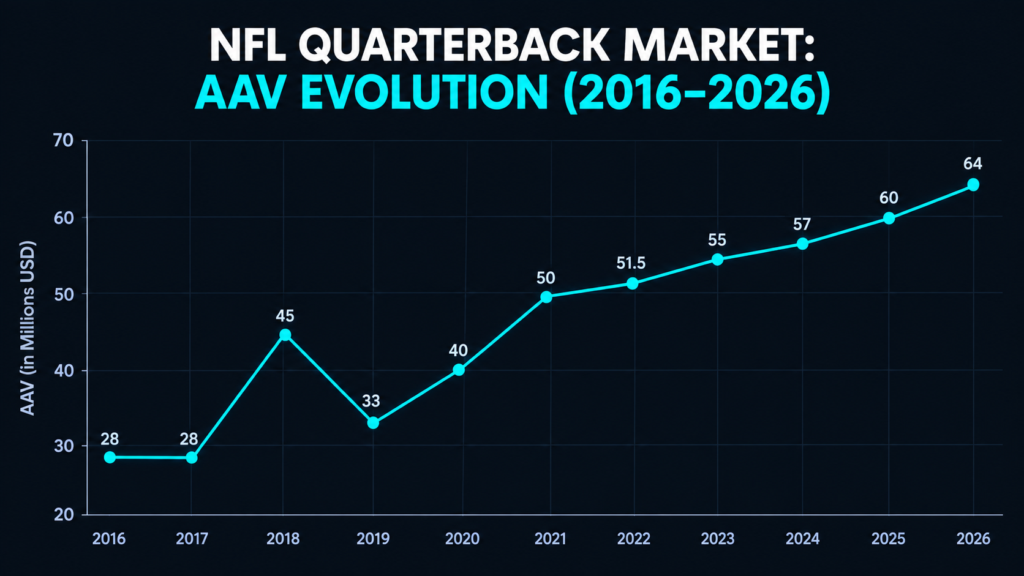
Russell Wilson | 4-Year, $140 Million Extension ($28M AAV)
Tax Drag, Net Reality & The 20% Playbook
When Wilson reset the market in Seattle, a $28 million annual average base salary was uncharted territory. Financially, Wilson caught a massive geographic break: Washington state levies a 0% personal income tax.
While he still got hit by top federal tax brackets and likely the standard 3% agent commissions, his net cash retention on home games hovered around a healthy 52% (jock tax likely lowered this to ~49-51%).
By siphoning 20% of his net cash inflows (~$2.9 million annually) directly into real estate and diversified index funds, Wilson also should have built a compounding asset base that worked for him long before his later career moves and eventual retirement; now joining the CBS Sports Panel.
2017 Landmark Deal: Kirk Cousins
The Contract & Gross Numbers
Kirk Cousins | 3-Year, $84 Million Fully Guaranteed Contract ($28M AAV)
Tax Drag, Net Reality & The 20% Playbook
While other quarterbacks chased staggering total aggregate values filled with non-guaranteed fluff, Cousins shocked front offices by demanding, and getting, a 100% fully guaranteed structure with the Vikings.
But shifting to Minnesota introduced a harsh tax drag, with state income tax rates climbing up to 9.85%. Combined with federal withholdings and jumbo-contract agent fees, Cousins’ net cash retention dropped to ~46%.
Because his downside risk was eliminated by the full guarantees, treating his upfront signing bonus as institutional capital rather than spending money allowed his financial team to run a strict 20% cash-flow sweep into fixed-income instruments and conservative real estate.
2018 Landmark Deal: Patrick Mahomes
The Contract & Gross Numbers
Patrick Mahomes | 10-Year, $503+ Million Megadeal with Kansas City
Tax Drag, Net Reality & The 20% Playbook
Mahomes completely rewrote the sports finance playbook with a decade-long commitment designed to give the Chiefs ultimate roster flexibility.
Operating in Missouri with a moderate state tax rate (~4.95%), Mahomes navigated massive gross inflows while managing public superstar lifestyle demands. Net cash retention on his structured bonuses sat around 48%.
Because the absolute dollar volume was so astronomical, a 20% investment rule funneled millions into private equity, venture capital, and local sports franchise ownership (including stakes in the Royals and Sporting KC), proving that elite athletes at this scale must move beyond public index funds into private enterprise equity.

2019 Landmark Deal: Dak Prescott
The Contract & Gross Numbers
Dak Prescott | 4-Year, $160 Million Extension ($33M AAV)
Tax Drag, Net Reality & The 20% Playbook
Prescott played a high-stakes game of leverage with the Dallas Cowboys, betting on himself through multiple franchise tags until ownership had no choice but to pay market rate. Geographically, Prescott hit the jackpot: Texas boasts a 0% state income tax.
This shelter allowed him to dodge state withholdings on half his games, keeping hundreds of thousands more in his pocket per season compared to NFC East rivals. Net cash retention pushed toward 50%. Utilizing this state tax advantage, his advisors deployed capital directly into commercial real estate developments and DFW-area business ventures.
2020 Landmark Deal: Deshaun Watson
The Contract & Gross Numbers
Deshaun Watson | Fully Guaranteed Deal ($230M)
Tax Drag, Net Reality & The 20% Playbook
Watson pushed guaranteed money into uncharted territory, culminating in his fully guaranteed Cleveland Browns contract.
Ohio’s state tax sits near 4%, but the real financial friction came from high escrow requirements, legal advisory overhead, and contract volatility, which dragged net cash retention down near 45%.
Watson’s trajectory serves as a stark warning in financial education: when career performance or health falters, unhedged lifestyle inflation combined with a lack of disciplined asset diversification can instantly strain a balance sheet, regardless of the headline gross value.
And now that Watson’s performance is subpar, the Brown’s would have to pay more than the rest of their roster is worth in dead cap just to move the massage maniac off their books. This is why they started him week 1.

2021 Landmark Deal: Aaron Rodgers
The Contract & Gross Numbers
Aaron Rodgers | 3-Year, $150 Million Extension ($50M AAV)
Tax Drag, Net Reality & The 20% Playbook
Rodgers became the first player to officially cross the sacred $50 million annual average threshold, kicking off the modern era of short-term, high-AAV veteran cash grabs.
Wisconsin’s state income tax rate tops out around 7.65%. Paired with the 37% top federal bracket, heavy taxation dragged Rodgers’ net cash retention down to roughly 44%.
As a late-career veteran, Rodgers allocated well beyond the standard 20% baseline into media production companies and private equity, illustrating how late-career earnings must aggressively transition into cash-flowing business assets before the playing window closes.
2022 Landmark Deal: Josh Allen
The Contract & Gross Numbers
Josh Allen | 6-Year, $258 Million Extension ($51.5M AAV)
Tax Drag, Net Reality & The 20% Playbook
The Bills aggressively locked down their franchise cornerstone early in his extension window, absorbing massive guarantee figures to hedge against future salary cap inflation and save money to build around Allen.
However, playing in upstate New York subjects Allen to some of the heaviest state income tax burdens in professional sports, with state rates climbing near 10.9%.
Federal and state withholdings take nearly half his gross earnings before agent cuts are even calculated, leaving net cash retention hovering around 42%. His financial team had to prioritize tax-advantaged structures and stable real estate holdings to protect principal capital from aggressive state tax claw-backs.
2023 Landmark Deal: Justin Herbert
The Contract & Gross Numbers
Justin Herbert | 5-Year, $262 Million Extension ($55M AAV)
Tax Drag, Net Reality & The 20% Playbook
Herbert’s deal solidified the $55 million tier, reflecting the league-wide consensus that elite arm talent under 25 commands maximum market capture. But California’s progressive tax code (a 13.3% top individual rate plus state disability insurance) represents the ultimate financial gauntlet for high-income earners.
Combined with top federal brackets, over 50% of gross earnings vanish instantly, giving Herbert one of the lowest net retention brackets in the league at roughly 39%.
In high-tax states, the 20% investment rule must be calculated strictly after tax hits, forcing heavy reliance on bonds and coastal real estate equity.
2024 Landmark Deal: Joe Burrow
The Contract & Gross Numbers
Joe Burrow | 5-Year, $275 Million Extension ($57M AAV)
Tax Drag, Net Reality & The 20% Playbook
Burrow dragged the quarterback market deep into the high-$50 million AAV bracket, proving that Super Bowl upside dictates market resets.
Ohio’s moderate state tax environment allowed for healthier net cash retention (around 47%) compared to West Coast peers.
Burrow deployed systematic dollar-cost averaging into diversified index funds and alternative asset classes, blending traditional wealth management with modern alternative portfolios.

2025-2026 Landmark Deals: Patrick Mahomes & Dak Prescott
The Contract & Gross Numbers
- Patrick Mahomes (June 2026 Restructure: $64M New-Money AAV)
- Dak Prescott ($60M AAV Extension)
Tax Drag, Net Reality & The 20% Playbook
Following Mahomes’ historic June 2026 contract restructuring pushing his new-money AAV to $64 million and Prescott’s $60 million AAV extension, the NFL has officially entrenched itself in the $60M+ per year threshold.
When gross numbers hit this level, public lifestyle inflation scales just as fast. Net cash retention settles around 46% to 49% depending on the home state’s tax code.
At this level of liquidity, a disciplined 20% investment rule channels over $12 million cash per year directly into private equity, commercial real estate syndications, and business ownership, ensuring generational wealth long after cleats are hung up.
Gross Income is Not Net Worth
The evolution of NFL contracts from 2016 to 2026 tells a story of extraordinary economic growth. With the salary cap clearing $301 million, teams are printing money, and players are capturing record shares of that revenue. But the fundamental rule of sports finance remains undefeated: Gross pay is just a vanity metric.
Whether an athlete signs for $28 million or $64 million, the structural realities of federal brackets, state tax drag, agent commissions, and lifestyle inflation dictate their actual financial survival.
The players who master cash-flow discipline, treat signing bonuses as institutional capital, and enforce a strict 20% investment rule are the ones who turn temporary athletic output into permanent, generational wealth.
Frequently Asked Questions
What is the highest AAV in the NFL as of 2026?
Following his June 2026 contract restructuring with the Kansas City Chiefs, Patrick Mahomes leads the NFL with a record $64 million AAV on new money, pushing his total contract value past $504 million.
How do state income taxes impact an NFL player’s net earnings across different states?
State taxes act as a massive drag on cash flow. Players operating in zero-tax states (such as Texas, Florida, Washington, and Nevada) retain a distinct advantage in net cash flow over athletes playing in high-tax states like California (13.3%) or New York (10.9%).
Why is a 20% investment allocation non-negotiable for professional athletes?
Because athletic careers are statistically short and injury risks are constant, allocating a minimum of 20% of net income into diversified index funds, real estate, and income-producing assets builds an essential financial safety net before career earnings abruptly stop.
How does NFL salary cap growth connect to college NIL?
Exploding NFL contracts and a $301.2 million salary cap explain why major college athletic departments and boosters willingly invest millions in elite NIL prospects; it is simply early-stage talent acquisition for a multi-billion-dollar professional business.
Next Reads
- How NFL Signing Bonuses Work – Cap Manipulation Explained
- Jaxon Smith-Njigba Becomes the Highest Paid Wideout in NFL History After Signing Seattle Seahawks Extension: Taxes, Net Income Explained
- 5 Worst NFL Free-Agency Contract Busts – The Financial Fallout
- 2026 NFL Draft: Every 1st Round Contract Details, Net Income & Residency Analysis
- How the NFL Franchise Tag Works Financially
Disclaimer: This article contains general financial information for educational purposes and does not constitute professional advice. APSM estimates are derived from publicly available information, tax assumptions, finance modeling, and industry-standard fee structures. Actual earnings may vary based on residency elections, private contract provisions, image/media rights agreements, bonuses, and tax filings.