If you are searching for how much Jeremiah Smith makes from his NIL portfolio in 2026, the clean answer is about $5 million. The more useful answer is that $5 million is not one paycheck.
APSM currently places Smith’s 2026 gross earning power inside an estimated $4.8 million – $5.2 million range, with a working midpoint of approximately $5 million.
That range is built from APSM’s player-level dataset and a mix of current deal reporting, independent market valuations, Ohio State’s revenue-sharing structure, collective history and Smith’s unusually large national endorsement portfolio.
The market currently agrees on the neighborhood. The NIL Standard independently lists Smith at $5 million, while On3 currently lists his player-contract value at $5 million. ESPN, The Athletic, Yahoo and other public estimates place his broader earning potential inside a wider $4 – $5M+ range.
APSM does not simply copy one of those numbers.
It uses the agreement between them to establish a current market range, then separates market value, actual compensation, endorsement income, federal and sate taxes and retained capital instead of pretending they are interchangeable. That distinction matters even more for Smith because his financial value keeps showing up on the field.
On October 17, Smith caught the 38-yard fourth-down touchdown that ultimately separated Ohio State from Indiana in a 19-15 win that ended the Hoosiers’ 22-game winning streak.
He now sits among Ohio State’s all-time receiving leaders while carrying one of the largest financial profiles in college football.
The headline number is approximately $5 million. The Net Reality starts with figuring out where that money actually comes from.

How Much Does Jeremiah Smith Make From NIL in 2026?
Collegiate NIL money is messier than a professional sports contract.
When an NFL player signs a four-year contract for a disclosed amount, the public can generally identify the gross contractual compensation even though taxes, fees and spending determine what the player actually keeps.
College football does not work that cleanly.
Smith can receive direct money from Ohio State, compensation tied to associated NIL entities or collectives, independent sponsorship money, licensing income and other commercial compensation at the same time.
Private agreements can overlap. Different public databases also define “NIL valuation” differently. That is why APSM uses a range and working midpoint, then labels the evidence underneath it.
| Market Signal | Evidence Type | 2026 Value | How APSM Uses It |
|---|---|---|---|
| Current Player NIL Market | Confirmed / Reported | ~$5.0M | Primary current compensation |
| Open-Market Player Value | Independent Estimates | ~$5.0M | Cross-check against the wider CFB market |
| 12-Month Earning Models | Modeled Range | ~$3.4M–$5.3M | Used as a lower/wider sensitivity check |
| APSM 2026 Range | APSM Estimate | ~$4.8M–$5.2M | Normalized current earning-power range |
| APSM Working Midpoint | APSM Estimate | ~$5.0M | Used for taxes, fees and Net Reality modeling |
Where Smith’s $5 Million Earning Power Comes From
The useful question is no longer whether Smith is “worth” $5 million. It is how a player at Ohio State could economically reach that number.
Ohio State Revenue Sharing | APSM Estimate: ~$2.0 Million
Ohio State plans to maximize its 2026-27 revenue-sharing allocation and continue directing money toward football, men’s basketball, women’s basketball and women’s volleyball.
The school has not disclosed Smith’s individual payment.
APSM can still model the economics.
Ohio State’s football program is the athletic department’s largest revenue engine, and the Buckeyes have said the sport will receive a heavy share of the available pool.
If approximately 70%-75% of the current schoolwide pool is directed toward football, the football allocation lands around the mid-$15 million range.
Smith represents roughly 13% of APSM’s current Ohio State football roster midpoint. That produces an APSM direct-revenue-share estimate around $2 million for Smith.
This number is not a leaked contract. It is a financial model built from the money Ohio State has publicly said it will distribute and Smith’s relative value inside the roster.
Collective & Associated-Entity Money | APSM Working Estimate: ~$2 Million+
Smith has had relationships with both The Foundation and The 1870 Society since the beginning of his Ohio State career.
Public reporting established that Smith was already receiving more than $1 million from The Foundation as a freshman in 2024, while a later California legislative brief estimated his collective compensation in the ~$1 million – $2 million range before the current 2026 market jump.
Smith’s current player-contract market has grown to roughly $5 million, and the associated-entity layer is one of the areas most likely to have expanded alongside it. APSM therefore treats roughly $2 million-plus of Smith’s current earning power as a defensible associated-entity/collective component while keeping the exact contract private.
Brand Deals & Licensing | APSM Commercial Estimate: High Six Figures+
Smith’s brand portfolio looks more like a professional athlete’s than a typical college receiver’s.
His publicly disclosed relationships have included brands like:
- Adidas
- Red Bull
- KeyBank
- American Eagle
- 7-Eleven
- Nintendo/Epic Games
- Lululemon
- Battle Sports
- Ricart Automotive
- EA Sports: selected Smith as one of the faces of College Football 26.
While contractual terms are mostly private, that does not make the deals economically meaningless.
Red Bull made Smith its first college-football athlete and later placed him on a limited-edition can. Adidas signed him as a national athlete and placed him at the center of its 2026 “Show ‘Em” campaign.
KeyBank gave Smith an exclusive banking-category relationship built around its Financial Playbook campaign.
APSM would therefore classify Smith’s independent commercial portfolio as a high-six-figure annual economic layer, with the possibility of seven figures depending on length, exclusivity, deliverables and performance bonuses.
APSM does not simply stack an invented endorsement number on top of every published $5 million valuation because public providers currently define their NIL figures differently.

The $10 Million Transfer Offer Is Market Evidence, Not Income
Smith also confirmed receiving transfer offers worth $10 million or more.
Michael Irvin later said he had heard Smith was offered roughly $10 million to “go home,” which naturally fueled the Miami connection because Smith is from Miami Gardens.
Smith has confirmed the size of the outside offers. He has not publicly confirmed Miami as the contracting school. More importantly, APSM does not add that $10 million to his 2026 earnings.
It measures foregone market opportunity. A buyer was apparently willing to place an eight-figure price on moving Smith back to his home state, but Smith chose not to take it and remain with the Buckeyes.
That is evidence of leverage, not money in his bank account.
Jeremiah Smith’s Ohio Tax Environment
A $5 million college earning year in Columbus is not financially identical to a $5 million year in Los Angeles, Ann Arbor or a no-income-tax state like Texas or Florida.
That is where the player’s location starts to matter beyond the gross figure and the basic federal tax calculation.
Federal Income Tax | Approximately $1.77 Million (~35.4%)
Before Smith ever has to worry about what Ohio plans to take from his income, the federal government gets the first piece of the pie.
Under APSM’s standardized tax-only model, a $5 million gross working midpoint puts Smith deep into the highest U.S. federal income-tax bracket.
That does not mean he pays 37% on every dollar.
Federal taxation is progressive.
Using 2026 federal brackets and the same methodology behind the APSM Net Income Calculator, Smith’s modeled federal income-tax liability lands around $1.77 million, or roughly 35.4% of the $5 million gross midpoint, before Ohio income tax, applicable self-employment/FICA treatment (Form 1099), or other financial layers are added.
Legitimate business expenses and deductible operating costs can change taxable income, but APSM does not invent private deductions for Smith.
There is another wrinkle. The 2026 college-football season extends into the 2027 calendar year for teams that advance deep into the CFP.
If Ohio State reaches that point, compensation Smith actually receives or recognizes in January 2027; whether from playoff incentives, appearances, sponsorship renegotiations or other additional income, can fall into the 2027 tax year rather than 2026.
That income would generally be reflected on his 2027 federal return filed in 2028, although withholding and estimated-tax obligations may require money to be paid before the filing deadline.
That is one more reason athletes need to understand how money actually works inside their sport. Once multiple calendar years, different income types, source states and sliding representation fees begin overlapping, there are more places for bad advice, opaque fees or simple misunderstandings to eat away at the headline number.
Ohio State Income Tax | Approximately $137,000 in the APSM Tax-Only Model
Ohio’s 2026 system imposes $332 plus 2.75% of taxable nonbusiness income above $26,050.
At Smith’s standardized $5 million midpoint, APSM’s tax-only model produces approximately $137,000 of Ohio state income tax before individualized deductions and sourcing adjustments.
Columbus Municipal Tax | Up to 2.5% on Qualifying Income
Columbus separately imposes a 2.5% municipal income tax on qualifying compensation. APSM does not automatically charge 2.5% against all $5 million in the Player Net Retention Score because Smith’s income can come from different contracts, locations and forms of compensation.
A fully Columbus-sourced $5 million amount could create roughly $125,000 of additional local-tax exposure, but his real municipal liability depends on how the income is sourced and structured.
Multi-State NIL Income Is Not a Simple NFL Jock-Tax Formula
This is another place where college NIL differs from a professional playing contract. An NFL player’s road-game wages can often be allocated through established duty-day rules.
A college athlete’s independent NIL income can instead depend on where an appearance, shoot, camp, commercial service or other compensated activity actually occurs.
APSM therefore does not invent a universal “jock tax” percentage for Smith. Multi-state NIL sourcing is flagged as an additional variable and pushes the deeper analysis into Ohio Athlete Taxes and the Net Income Calculator.

Jeremiah Smith’s Player Net Retention Score: 58/100
Before representation costs, training expenses and lifestyle spending, APSM estimates Smith would retain approximately $2.90 million of a $5 million gross earning year under the standardized Ohio tax model.
That produces:
APSM Player Net Retention Score: Jeremiah Smith — 58/100
This score uses:
- $5.0M gross income
- 2026 progressive federal taxation
- applicable self-employment/FICA treatment
- Ohio state income tax
- 0% representation fees
- 0% personalized career overhead
The 0% fee assumption is intentional.
The Player Net Retention Score answers one question:
What does the tax system itself do to this player’s gross earning power?
That makes the score comparable from athlete to athlete even when one athlete has an agent, another represents himself and another pays multiple agencies across different deals.

Jeremiah Smith’s Net Reality Changes With Representation Fees
The score is not the final bank balance.
College NIL representation is where the financial equation can become materially different from a professional playing contract.
Professional-player contract commissions are usually limited by the relevant union or league rules. NIL and endorsement representation is much less standardized.
APSM’s own Net Income Calculator allows users to adjust representation from lower playing-contract-style percentages into the 10%–15%+ territory that can appear on endorsements and one-off commercial agreements.
Current NIL-industry research likewise shows lower commissions around school/collective negotiations and materially higher percentages for brand work that an agency originates or negotiates.
That means Smith probably should not be modeled with one 15% fee across every dollar. He also should not automatically be modeled at 3%.
For this article, APSM uses a 6% blended representation estimate as the working Net Reality assumption across his mixed income stack.
| Representation Scenario | Fee | Modeled Net Capital | Gross Retained |
|---|---|---|---|
| Tax-Only Score | 0% | ~$2.90M | 57.9% |
| Low / Contract-Style | 3% | ~$2.75M | 55.1% |
| APSM Blended NIL Model | 6% | ~$2.61M | 52.3% |
| High Commercial Mix | 10% | ~$2.42M | 48.5% |
| Heavy One-Off / Brand Fee | 15% | ~$2.19M | 43.8% |
That is the college NIL problem in one table.
Smith’s gross number never changes.
- At 0% representation, APSM models roughly $2.90 million left.
- At a 6% blended fee, it falls to approximately $2.61 million.
- At 15%, the same $5 million earning year falls below $2.2 million before Smith has spent another dollar on personalized career overhead.
What 20% of Smith’s 2026 Net Reality Could Become
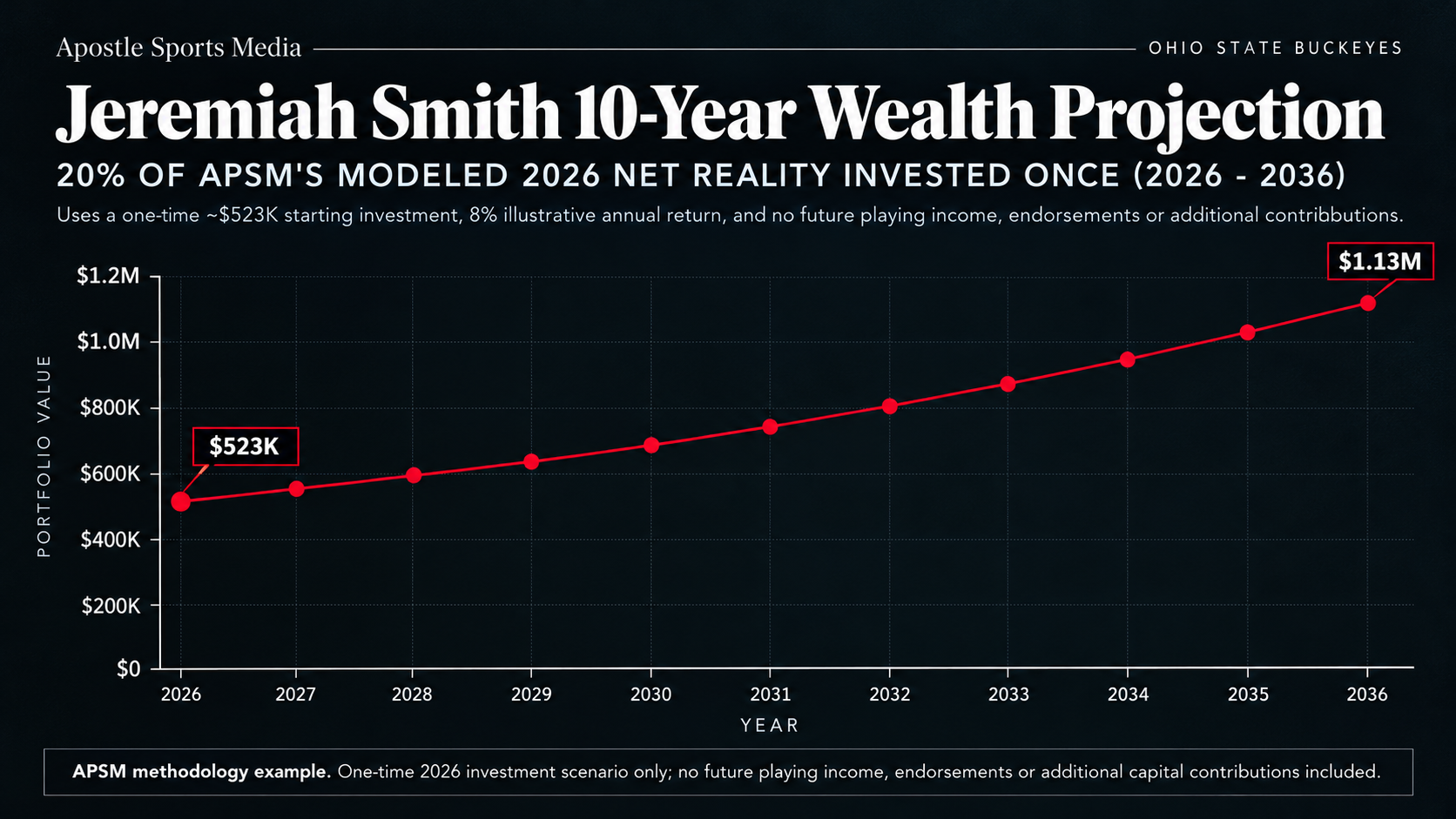
Using the 6% blended representation model, Smith’s estimated 2026 retained capital lands around $2.61 million before individualized expenses.
Twenty percent of that amount is approximately $523,000.
If that one-time amount earned an illustrative 8% annual return and Smith never contributed another dollar, it would grow to approximately $1.13 million by 2036.
- No additional Ohio State NIL income.
- No future endorsement money.
- No NFL contract.
Just one piece of one college earning year allowed to compound.
Smith has already been earning NIL money for multiple seasons.
He has publicly discussed buying his grandmother’s house, and his complete financial position involves far more than the 2026 earning window modeled here. The next question is no longer:
How much can Jeremiah Smith make this year?
It is:
How much of everything he has earned so far could he actually own?
Why Jeremiah Smith’s NIL Structure Matters
Smith is the type of athlete that exposes the biggest flaw in the way college NIL money is usually covered. One outlet publishes $5 million and then the others repeat it and then online social posts call Smith a $5 million player, call it a day, and everybody moves on.
But $5 million can represent market value, contract value, revenue-sharing leverage, collective compensation, commercial opportunity or some blend of all five depending on who published the number.
The athlete still has to turn those agreements into actual gross income.
Then taxes hit.
Then representation hits.
Then operating expenses and personal decisions begin.
That is why APSM separates the headline from the bank balance.
Bottom Line
APSM estimates Jeremiah Smith’s 2026 gross NIL earning power inside a ~$4.8 million–$5.2 million range, with a working midpoint of approximately $5 million.
The public market strongly supports that neighborhood.
What remains private is the exact composition.
APSM models approximately $2 million of potential direct Ohio State compensation based on the school’s revenue-sharing economics and Smith’s share of the football roster’s market value.
Collective and associated-entity money create another substantial layer. His national commercial portfolio adds additional value through Adidas, Red Bull, KeyBank and other national brands.
None of those numbers should be treated like one ordinary NFL salary. At the $5 million midpoint, Smith’s tax-only Player Net Retention Score is approximately 58/100.
Once APSM applies a 6% blended NIL representation assumption, modeled retained capital falls to roughly $2.61 million, or 52.3% of gross, before individualized municipal taxes and personal career expenses.
Smith can be worth $5 million.
Another school can offer him $10 million.
A brand can put him on a national campaign.None of those numbers are the bank balance.
That is the Net Reality.
Jeremiah Smith 2026 NIL FAQs
How much does Jeremiah Smith make from NIL in 2026?
APSM estimates Smith’s 2026 gross NIL earning power inside a ~$4.8 million–$5.2 million range, with a working midpoint around $5 million. Multiple current independent market sources also place his value near $5 million. The exact breakdown of Smith’s private Ohio State, collective and endorsement contracts has not been publicly disclosed.
Is Jeremiah Smith’s $5 million NIL valuation the same as a salary?
No. College-athlete compensation can include direct university revenue sharing, associated-entity or collective contracts, independent brand agreements, licensing and other NIL income. APSM uses approximately $5 million as Smith’s current gross modeling midpoint, not as a claim that Ohio State issued one $5 million paycheck.
How much could Jeremiah Smith pay in Ohio state income tax?
Under APSM’s standardized $5 million tax-only example, Ohio’s 2026 income-tax structure produces approximately $137,000 of modeled state income tax before individualized adjustments. Columbus can separately impose a 2.5% municipal tax on qualifying income, so Smith’s actual local exposure depends on residency, sourcing and the structure of each income stream.
How much can an NIL agent charge a college athlete?
There is no universal college NIL commission identical to an NFL or NBA playing-contract cap. Representation can vary by income type. Lower percentages may apply to school or collective negotiations, while independent endorsement sourcing and one-off brand agreements can move into 10%–15% or higher territory. That is why APSM separates the tax-only Player Net Retention Score from a separate fee-adjusted Net Reality model.
What companies have NIL deals with Jeremiah Smith?
Smith’s publicly disclosed partner history includes adidas, Red Bull, KeyBank, American Eagle, 7-Eleven, Nintendo/Epic Games, Lululemon, Battle Sports and Ricart Automotive, among others. Most individual financial terms are private.
Next Reads
- Ohio State 2026 CFB Roster Valuation: Player NIL Income, Tax Drag and Net Reality
- State Income Tax Explained for NIL & Professional Athletes
- Ohio State Athlete Taxes
- Agent Fees (Athlete Representation)
- APSM Net Income Calculator
Sources & Methodology
APSM’s 2026 Smith estimate aggregates and normalizes multiple current market signals rather than adopting one publisher’s figure as its own.
Primary research inputs include Ohio State Athletics and public athletic-department reporting, On3/Rivals, The NIL Standard, independent NIL valuation datasets, public brand announcements, current Ohio tax law and APSM’s Net Income Calculator methodology.
APSM labels compensation as Confirmed, Reported or APSM Estimate depending on the quality and specificity of the underlying evidence. Private NIL contracts, representation agreements, tax returns and personal expense records are not treated as known facts unless publicly disclosed.
Disclaimer
This article contains general financial information for educational purposes and does not constitute tax, legal, investment, accounting or financial advice. APSM estimates are derived from publicly available reporting, market-value inputs, 2026 tax rules and standardized modeling assumptions.
NIL market value is not guaranteed compensation. Actual earnings and retained capital can vary materially based on contract structure, representation agreements, residency, income sourcing, business expenses, deductions and individual circumstances.