
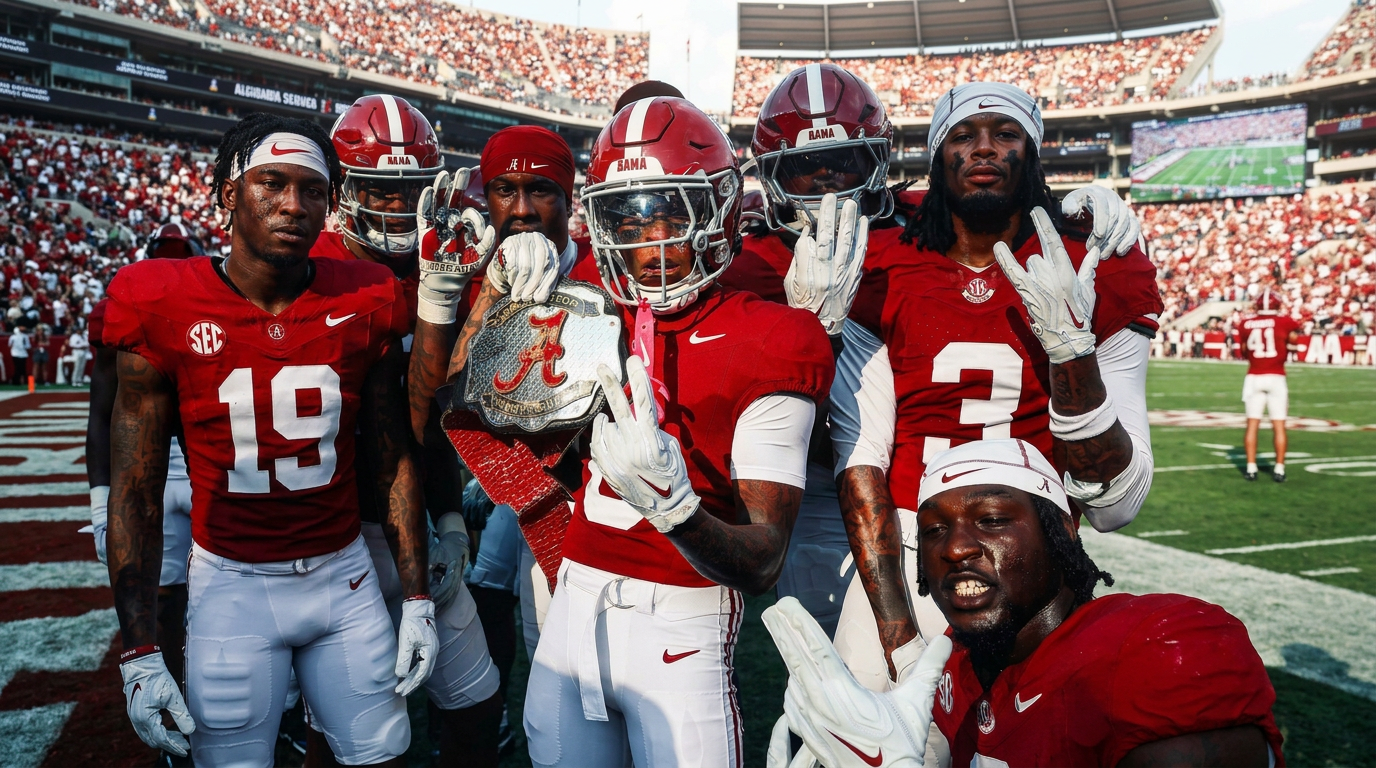
The gold-rush era of NIL collectives and revenue sharing has begun to introduce greater financial parity across college football. Even so, Alabama does not need to entirely rebuild its roster every offseason to remain one of the most expensive collections of talent in college sports.
APSM currently estimates Alabama’s football roster at approximately $31.9 million in open-market player value, placing the Crimson Tide No. 13 nationally and No. 6 in the SE as of the first week of October.
Alabama’s estimated roster value is distributed across three player-acquisition categories:
- 59% retained players — ~$18.8 million
- 22% transfer portal additions — ~$7.0 million
- 19% incoming recruits — ~$6.1 million
That composition separates Alabama from programs attempting to assemble an entire contender through the transfer portal.
The Crimson Tide still rely on transfers, with approximately $7 million in estimated player value coming from portal additions, but their financial advantage remains rooted in the model that established Alabama’s dominance long before NIL:
- recruiting elite talent early
- developing that talent within the program
- retaining enough of its established players to avoid rebuilding through the open market every January.
However, the $31.9 million gross figure should not be mistaken for Alabama’s disclosed football payroll. It represents an estimate of the roster’s aggregate gross open-market value, not the amount players have collectively received in compensation.
Direct university revenue sharing, third-party NIL agreements, sponsorships, licensing, collective funding and the broader operating expenses associated with coaching, facilities, medical support and travel represent separate financial components of the program.
Those components interact, but combining them into a single payroll figure would misrepresent how money moves through college athletics. A university can spend tens of millions supporting its football operation without those expenditures translating directly into athlete earnings.
Even when an athlete realizes compensation equal to his estimated market value, federal and state taxes, applicable employment taxes and representation fees can substantially reduce the amount he ultimately retains (net income).
That difference between headline gross value and retained personal capital is central to APSM’s Net Reality analysis.
Alabama’s $31.9 million 2026 CFB roster valuation establishes the market’s estimated value of its players, but understanding the financial position of those athletes requires examining what they actually earn, what they owe and how much of that income can ultimately become generational wealth.
The current valuation also provides a starting point for examining where Alabama’s roster economics could move over the next decade. The first APSM projection below uses the $31.9 million 2026 valuation as its baseline and applies an illustrative 7% annual growth assumption through 2036, reflecting a scenario in which player-market values continue expanding alongside revenue sharing and demand for elite collegiate talent.
The resulting projection is not a forecast of Alabama’s future payroll or guaranteed athlete compensation. Rather, it illustrates the potential growth of the roster’s aggregate gross market value, establishing the broader financial context for the individual player valuations, tax obligations and wealth-building opportunities examined throughout this analysis.

Alabama’s $31.9 Million Roster Is Still Built Around Retention
The current APSM valuation breaks Alabama’s roster into three major acquisition buckets:
- Retained players: ~$18.8 million | 59%
- Portal additions: ~$7.0 million | 22%
- 2026 recruits: ~$6.1 million | 19%
The balance is more important than any one percentage. Nearly three-fifths of Alabama’s current player value already existed inside the program, meaning Kalen DeBoer is not trying to replace the roster every offseason.
At the same time, the Tide carry meaningful value in both incoming recruits and portal additions, giving the program three different ways to acquire talent instead of relying almost entirely on one market. That matters because the economics of recruiting and the portal are different.
A transfer arrives with college film, production data and a clearer understanding of how he performs against collegiate competition. That generally reduces uncertainty, but proven talent can also demand more money immediately.
A high-school recruit arrives with more projection risk than a “veteran” player, but a program that identifies and develops that athlete before he becomes a premium college asset can potentially create substantial value internally (ROI).
Retention sits in the middle. Once Alabama turns a recruit into a productive player, the school still has to keep him. That has transformed development into an economic cycle:
recruit → develop → increase player value → retain → repeat → remain annual CFP contender
Alabama’s current roster is therefore less a transfer spending spree and more a portfolio constructed through multiple acquisition channels.
Alabama’s Top 5 2026 CFB Player Valuations
The current top five account for approximately $7.0 million, or about 21.9% of Alabama’s entire $31.9 million roster valuation.
| Player | Pos. | Est. 2026 NIL Value | Share of Roster |
|---|---|---|---|
| Keelon Russell | QB | $2,010,705 | 6.3% |
| Ryan Coleman-Williams | WR | $1,800,000 | 5.6% |
| Jayvin James | OT | $1,144,000 | 3.6% |
| Jackson Lloyd | OT | $1,042,039 | 3.3% |
| Desmond Umeozulu | EDGE | $1,001,000 | 3.1% |
Keelon Russell | ~$2.01 Million | Quarterback
Keelon Russell is the financial centerpiece of Alabama’s 2026 roster. The sophomore QB currently carries an estimated value of approximately $2.01 million, making him the most valuable player on the Crimson Tide roster and one of the highest-valued quarterbacks in the SEC.
The interesting part is how quickly the market had to price him. Russell entered 2026 with limited college playing experience before winning the starting quarterback job.
Through Alabama’s early-season run, he has produced more than 1,100 passing yards, eight passing touchdowns and additional rushing production while completing roughly 71% of his attempts. Alabama lists him among the national leaders in several quarterback metrics.
Quarterback valuation can move faster than almost any other position because the athlete affects multiple financial variables simultaneously.
Production changes draft perception.
Winning increases national television exposure.
National exposure creates sponsorship inventory.
And a quarterback succeeding at Alabama carries commercial visibility few college programs can replicate.
Russell is therefore more than Alabama’s starting quarterback. He is the highest-value individual asset inside a $31.9 million roster.

Ryan Coleman-Williams | ~$1.80 Million | Wideout
Ryan Coleman-Williams sits just behind Russell at approximately $1.8 million. Unlike a quarterback valuation, wide-receiver economics generally depend more heavily on a combination of production, target share, explosive-play ability and commercial visibility.
Coleman-Williams already has all four. He entered 2026 as a preseason All-SEC selection and opened the year with 130 receiving yards against East Carolina, immediately reinforcing why his market value sits near the top of Alabama’s roster.
Williams was also selected to Nike’s 2026–27 Blue Ribbon Elite NIL roster, joining a group of Alabama athletes receiving direct access to one of the most recognizable sports brands in the world.
That is exactly why roster value and sponsorship income should not be treated as the same number.
The $1.8 million figure estimates his open-market player value. A Nike relationship exists inside a separate commercial layer that can increase the value of his name, image and likeness without automatically becoming part of a roster valuation.
Jayvin James | ~$1.14 Million | Offensive Tackle
Jayvin James is one of the best examples of why Alabama’s current roster cannot be explained purely through recruiting and retention.
James arrived after previous stops at Akron and Mississippi State and quickly earned Alabama’s starting right-tackle role.
He started every game to begin his Crimson Tide career after allowing only three sacks across 856 snaps at Mississippi State in 2025.
APSM currently values James at approximately $1.144 million, making him Alabama’s third-highest-valued player. That is a meaningful premium for an offensive lineman, but it makes sense financially.
Alabama has more than $2 million invested in the market value of Russell alone. Protecting that quarterback is not a secondary roster expense. It protects the value of the offense. James also represents Alabama’s portal strategy more clearly than a flashy quarterback acquisition would.
The Tide did not use the portal to completely replace their identity. They used it to acquire proven experience at a position where immediate reliability can protect several other assets at once.

Jackson Lloyd | ~$1.04 Million | Offensive Tackle
Jackson Lloyd carries an estimated value of approximately $1.04 million, putting a second offensive tackle inside Alabama’s top four.
That is not an accident.
When two offensive linemen sit near the top of a roster valuation, the money is telling us how the offense has been constructed.
Alabama’s most valuable individual player is a young quarterback. One of its most valuable skill-position players is a receiver.
Surrounding those two assets with premium offensive-line value reduces the risk that the entire offensive investment collapses because protection fails. Lloyd’s market value therefore carries a multiplier effect.
He is not simply worth what he produces individually. His position helps preserve the value of the players operating behind him.
Desmond Umeozulu | ~$1 Million | EDGE
Desmond Umeozulu rounds out Alabama’s current top five at approximately $1 million.
The senior transferred from South Carolina and entered Alabama as a pass-rush threat off the edge. He started early in the season before an injury interrupted his first year in Tuscaloosa.
His presence inside the top five illustrates another part of roster-market economics: premium positions get paid. Quarterbacks matter because they control the offense. Offensive tackles matter because they protect quarterbacks. Edge defenders matter because they destroy that protection.
A seven-figure valuation at edge therefore fits the same roster logic as Alabama placing two offensive tackles near the top of its financial hierarchy.

Alabama’s $31.9 Million Roster Is Separate From Revenue Sharing
The 2026–27 school revenue-sharing cap is approximately $21.58 million per participating institution. That figure increased from the original $20.5 million first-year limit and represents the maximum schoolwide amount participating institutions may distribute directly to athletes under the current House settlement structure.
It should not be added directly to Alabama’s $31.9 million roster valuation and described as a fictional ~$53.5 million football payroll.
They measure different things.
- $31.9 million is APSM’s current estimate of Alabama football player market value.
- $21.58 million is a schoolwide institutional revenue-sharing ceiling across sports.
Third-party NIL exists separately from both. That distinction is exactly why headline spending estimates can become misleading.
A university can allocate enormous amounts of capital toward athlete compensation without every dollar being attributable specifically to Alabama football players.
Alabama Athletics Operates One of College Sports’ Largest Financial Engines
The player roster sits inside a considerably larger enterprise, as Alabama’s all sports university value reported 2025 revenues of approximately $267.4 million in total athletic-department revenue during FY2025, against approximately $234.7 million in expenses, producing an operating surplus of roughly $32.7 million. Football alone generated approximately $147.7 million in operating revenue.
That is why “Alabama has hundreds of millions of dollars” and “Alabama has a $31.9 million roster” are not contradictory statements. The athletic department is the business. The football roster is one collection of assets inside that business.
Football revenue must help cover coaching compensation, scholarships, recruiting, travel, facilities, support staff, nutrition, equipment, medical services, administration and dozens of other costs before anyone can pretend total revenue equals player compensation.
That difference is basic accounting. Revenue is not profit. Program spending is not player value.
Roster valuation is not net income.
Want to calculate your own net reality?
Use the –> APSM Net Income Calculator
Alabama’s NIL Infrastructure Is Becoming a Commercial Platform
Alabama’s athletes also operate inside a commercial system that extends beyond direct university payments. The school continues to work with dedicated NIL infrastructure and brand partners, while Nike’s 2026–27 Blue Ribbon Elite program added 18 Alabama athletes, including several football players such as Russell, Coleman-Williams and Yhonzae Pierre.
That matters because athlete value is no longer generated solely by football production.
An athlete can monetize:
- sponsorships
- licensing
- content
- merchandise
- appearances
- camps
- digital media
- social audiences
- business partnerships
A roster valuation is therefore only one side of the athlete’s financial life. The other side is what the athlete does with the commercial attention created by playing at Alabama.
Kalen DeBoer’s $12.5 Million Salary Is Separate From Player Value
Alabama’s investment in football does not stop with athletes. The university extended Kalen DeBoer through January 2033 in April 2026, adding two years to his agreement. The revised contract keeps him in Tuscaloosa through the 2032 season.
Reported terms put the agreement at roughly $87.5 million over seven years, or approximately $12.5 million annually (base salary).
That money should not be included in Alabama’s $31.9 million roster valuation. It does, however, provide useful context.
Alabama is effectively paying eight figures annually for the executive responsible for managing a player asset base valued at nearly $32 million, while the football operation itself generates close to $148 million in annual operating revenue.
That is not amateur economics. It is a large sports enterprise operating inside a university.
Alabama’s 2026 Tax Environment
Alabama’s state income-tax system looks straightforward on the surface. It is not. The state uses graduated individual rates of 2%, 4% and 5%, with the 5% bracket beginning at relatively low taxable-income levels.
For seven-figure NIL earners, the headline marginal state rate is effectively 5%. But, Alabama has an unusual feature that materially affects the calculation: federal taxes paid can be deducted when calculating Alabama taxable income.
federal income taxes paid can be deducted when calculating Alabama taxable income.
That means simply multiplying a $2 million NIL valuation by 5% would overstate the athlete’s actual Alabama income-tax liability. Federal income tax remains the largest component for a high earner.
Applicable self-employment or employment taxes may also apply depending on how the income is structured. Representation costs reduce usable capital. And athletes earning money across multiple states may create additional filing obligations.
The easiest way to understand Alabama’s financial position is therefore to keep the athlete’s gross income constant and change only the location.

For more information on how income tax drag actually effects collegiate athletes’ net reality Read Our –>
State Income Tax Explained for NIL & Professional Athletes – The States That the Most
Alabama Sales Tax
Alabama’s relatively manageable income-tax structure does not mean the entire tax system is light. The state imposes a 4% general sales tax, while local taxes push the average combined state-and-local sales-tax rate to approximately 9.46%, one of the highest averages in the country.
That matters differently from income tax. Income tax affects what an athlete retains when money is earned. Sales tax affects what happens when retained income is spent.
An athlete earning $2 million can preserve meaningful capital through good tax planning and then still burn through it quickly by consuming aggressively. Cars, clothing, electronics, entertainment and other taxable purchases turn after-tax income into additional tax payments.
That is why earning power and purchasing discipline are separate financial skills.
For more information on Alabama state taxes, cost of living metrics and real estate markets head to the APSM State Athlete Tax Glossary –>
Alabama State Athlete Taxes
Alabama Property Tax
Alabama moves in the opposite direction on residential property taxes.
The state’s effective property-tax rate on owner-occupied housing is approximately 0.37%, among the lowest in the country.
At that statewide effective rate, a hypothetical $1 million owner-occupied property represents roughly $3,700 per year in property tax before local variation and individual assessment differences.
That does not make homeownership free.
Insurance, repairs, utilities, maintenance and transaction costs still exist.
For an athlete considering long-term ownership, Alabama’s property-tax environment can reduce one of the carrying costs attached to real estate.
Tuscaloosa Cost of Living
Tuscaloosa also gives Alabama athletes a relatively low housing-cost base compared with many major sports markets.
As of August 2026, Zillow placed the average Tuscaloosa home value at approximately $245,668, up about 0.9% year-over-year, while average rent was approximately $1,448 per month.
The national typical home value was roughly $368,697 during the same period. That difference matters when a college athlete suddenly begins earning six or seven figures.
A $1 million income in Tuscaloosa does not require the same housing commitment as a $1 million income in Los Angeles, New York or Miami.
The lower housing baseline can leave more capital available for reserves, investments or future opportunities. Again, geography affects wealth through more than one tax rate.
Income tax affects earnings.
Sales tax affects consumption.
Property tax affects ownership.
Housing prices determine how much capital has to be committed to the asset in the first place.
Alabama’s Net Reality
Because private contracts, tax returns and representation agreements are not publicly available, APSM cannot determine the exact take-home income of Alabama’s players from market valuations alone. Instead, APSM applies the same standardized Net Reality framework used throughout these roster valuations.
For the Alabama model, APSM accounts for:
- applicable federal taxation
- Alabama’s state-income-tax structure
- the state deduction for federal income taxes paid
- employment or self-employment/FICA treatment where applicable
- a standard 3% contract-negotiation and representation estimate
- 0% personalized expenses
Personal expenses are intentionally excluded from the standardized article model.
One athlete might spend $30,000 running his business. Another might spend $250,000 across housing, training, travel, family support and lifestyle. Those variables belong inside the APSM Net Income Calculator, not inside a standardized roster article where they would have to be invented.
Using the standardized framework, APSM models approximately 55% retained capital for the high-income Alabama example.
That does not mean every Alabama athlete keeps exactly 55 cents of every dollar. It gives APSM one consistent baseline for comparing athletes, schools and states without changing the methodology every time the uniform changes.
Applied to Alabama’s five highest-valued players, approximately $7.00 million in combined roster value translates to roughly $3.85 million in modeled retained capital. Those figures are not reported salaries or private tax outcomes.
They show the difference between headline player value and potentially usable capital.
| Player | Gross Valuation | Illustrative Deductions | Illustrative Net Capital |
|---|---|---|---|
| Keelon Russell | $2,010,705 | ~$904,817 | ~$1,105,888 |
| Ryan Coleman-Williams | $1,800,000 | ~$810,000 | ~$990,000 |
| Jayvin James | $1,144,000 | ~$514,800 | ~$629,200 |
| Jackson Lloyd | $1,042,039 | ~$468,918 | ~$573,121 |
| Desmond Umeozulu | $1,001,000 | ~$450,450 | ~$550,550 |
Converting Alabama NIL Income Into Long-Term Wealth
The most valuable financial advantage available to a high-earning college athlete may not be the amount earned.
It may be the age at which the money arrives.
Using the standardized model above, Russell’s ~$2.01 million valuation corresponds to approximately $1.11 million in retained capital.
If he invested only 20% of that modeled net amount once, approximately $221,000 would enter productive assets immediately.
No future NIL contribution is required for that first investment to keep working. At an illustrative 8% annual return, the original $221,000 could grow to approximately $478,000 over 10 years.
That does not require a future NFL contract. It does not require another sponsorship. It does not require another dollar to be contributed.
It only requires the original capital to survive long enough to compound.
Tuscaloosa Real Estate
Real estate creates another option. With Tuscaloosa’s average home value around $246,000, a seven-figure athlete could potentially purchase substantial home equity without committing the majority of his available capital to housing.
That does not automatically make buying a property the right decision. The athlete still has to consider financing, liquidity, transaction costs, maintenance, insurance, investment horizon and whether the property is being purchased as a residence or an actual investment.
The important advantage is optionality. High income in a relatively low-cost housing market gives the athlete more choices.
What One Season of Alabama NIL Income Could Become
The cleanest way to measure the long-term value of Alabama’s current NIL market is to remove future success from the equation entirely.
Assume the current 2026 season is the only major football income these players ever receive.
No future Alabama NIL payments.
No additional endorsements.
No NFL contract.
No additional investment contributions.
Under the standardized APSM model, Alabama’s five highest-valued players invest 20% of their modeled 2026 retained in a standard index fund capital once, then allow that money to compound at an illustrative 8% annual return through 2036.
That creates a much more disciplined financial exercise than assuming today’s valuation continues year after year; It answers a simpler question:
What can one major college earning window accomplish by itself? The graphic below uses only the capital generated from the 2026 season. Everything after that comes from compounding.

Why This Data Matters
The projection is not designed to predict Russell, Coleman-Williams or James’ future net worth.
Their real careers may look completely different. The purpose is to measure the value of the starting point. A college athlete who reaches professional football with hundreds of thousands of dollars already invested enters the NFL in a fundamentally different financial position from an athlete beginning with no productive assets.
The rookie contract no longer has to become the beginning of wealth creation. It can become another contribution to wealth that already exists. And for athletes who never reach the NFL, the lesson may be even more important; Temporary athletic income can still create permanent capital.
Financial Implications for Alabama Athletes, Agents and Sponsors
For Athletes
Alabama shows why financial literacy has become part of athlete development.
A seven-figure roster valuation creates opportunity, but the athlete still has to navigate taxes, contract fees, multi-state income, spending and investment decisions before the money can become wealth.
For Agents
The current Alabama roster also shows that representation is no longer simply about negotiating one sponsorship.
Agents increasingly operate across direct institutional compensation, third-party NIL, transfer-market leverage, commercial partnerships and eventually professional contracts.
For Sponsors
Alabama offers a rare combination of national football exposure and increasingly organized athlete-brand infrastructure.
Nike’s Blue Ribbon Elite program demonstrates what happens when a major brand can access athletes who already perform inside one of the most recognizable sports brands in America.
For Alabama
The university’s challenge is allocation. Alabama must fund direct revenue sharing, retain valuable players, acquire transfers, recruit elite high-school talent, pay an eight-figure head coach and operate a football program generating nearly $148 million in annual revenue without pretending all of those dollars belong to the same accounting bucket.
Bottom Line
Alabama’s 2026 football roster carries approximately $31.9 million in estimated open-market player value, with roughly 59% tied to retained athletes, 22% to portal additions and 19% to recruits. That construction explains why Alabama remains financially different from programs attempting to purchase an entirely new roster every offseason.
The Crimson Tide still spend in the portal. They still participate in the expanding NIL marketplace. They still operate inside the $21.58 million revenue-sharing environment; But the foundation remains player development and retention.
Around that roster sits a much larger enterprise:
- ~$267.4 million in annual athletics revenue
- nearly $148 million in football revenue
- an eight-figure coaching contract
- a commercial ecosystem capable of connecting players directly with brands such as Nike.
For the athlete, however, the final lesson is simpler.
$2 million of roster value is not $2 million of wealth. Taxes come first. Representation takes another piece. Lifestyle consumes another.
The capital that survives can either disappear through consumption or begin producing something of its own. That difference is the Net Reality.
And in an era where college athletes can earn life-changing money before their professional careers even begin, understanding what happens after the headline number may matter just as much as earning it in the first place.
Alabama 2026 NIL Roster Value FAQs
What is Alabama football’s 2026 roster worth?
APSM currently estimates Alabama’s 2026 football roster at approximately $31.9 million in open-market player value, based on current player-level market data, official roster information and APSM analysis. The current market dataset ranks Alabama No. 13 nationally and No. 6 in the SEC.
Who is Alabama’s highest-valued football player in 2026?
Quarterback Keelon Russell currently leads Alabama at approximately $2.01 million, followed by Ryan Coleman-Williams at $1.8 million.
Is Alabama’s $31.9 million roster valuation the same as its payroll?
No. The $31.9 million figure estimates the open-market value of Alabama’s players. Direct university revenue sharing, third-party NIL, sponsorships and broader football operating expenses are separate financial categories.
What is Alabama’s state income-tax rate for high-earning athletes?
Alabama has graduated individual rates from 2% to 5%, with high earners generally reaching the 5% marginal rate. Alabama also allows a deduction for federal income taxes paid when calculating state taxable income, making the actual state liability more nuanced than applying 5% directly to gross income.
How much does Kalen DeBoer make at Alabama?
Alabama extended Kalen DeBoer through January 2033 in April 2026. Reported terms value the agreement at approximately $87.5 million over seven years, or about $12.5 million annually.
Next Reads
- Georgia $30.1 Million 2026 CFB Roster Valuation: Player NIL Income, Tax Drag and Net Reality
- Ole Miss $35.5 Million 2026 CFB Roster Valuation: Player NIL Income, Tax Drag & Net Reality
- Ohio State $38 Million 2026 CFB Roster Valuation: Player NIL Income, Tax Drag and Net Reality
- Lane Kiffin Could Earn $1 Million Off Ole Miss’s CFP Run After Leaving for LSU: Inside the Head Coach Postseason Bonus Structure
- Alabama State Athlete Taxes
Disclaimer: This article contains general financial information for educational purposes and does not constitute professional advice. APSM estimates are derived from publicly available information, tax assumptions, finance modeling, and industry-standard fee structures. Actual earnings may vary based on residency elections, private contract provisions, image/media rights agreements, bonuses, and tax filings.


