

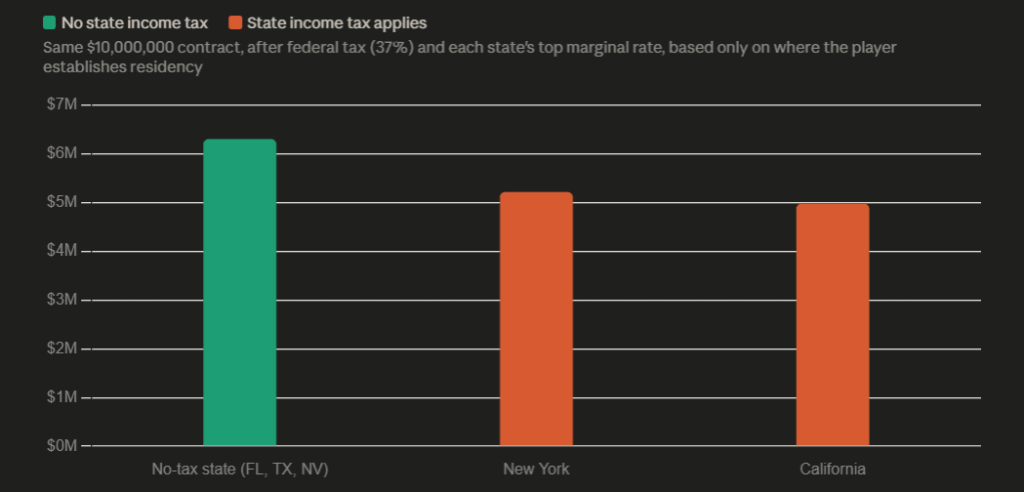
Residency is a major factor in determining net income, and can be the difference of millions for both collegiate and pro athletes. Let’s say that two players in the NBA sign the exact same contract, on the same day. They both even sign to the same team, for the same dollar amount.
However, if one of the athletes’ primary residence is in the state of California and the other in Nevada; One of them ends up keeping hundreds of thousands of dollars more, if not millions, than the other player, and it has nothing to do with performance, signing bonuses or incentive clauses.
It comes down to a single decision most rookies never think to make on purpose, and that is the state they intend to call home and spend a majority of their time in (183 days/year). This is called residency, and it’s one of the highest-leverage financial decisions an athlete makes, often without realizing a decision is even being made.
What Is Residency?
Residency is the legal determination of which state someone is considered to live in for tax, legal, and financial purposes. For most people, this is obvious and automatic, they live where they live or often stay in the state they were born in.
For professional athletes however, it’s genuinely complicated because the job itself involves living, working, and spending real time across a dozen-plus states during the course of a single season. States don’t just take a player’s word for where they claim they spend majority of their time on paper or where they claim their primary address to be.
Residency gets established through a combination of factors, including; where time is actually spent, where a driver’s license and voter registration are held, where the primary home is, where family lives, or where legitimate business ties exist.
No single factor settles it on its own, states look at the full pattern of someone’s life to decide where they actually belong in order to collect taxes.
Why This Is Worth Real Money
This is the part that turns residency from a paperwork detail into one of the biggest financial decisions of a career.
Where a player establishes residency determines which state gets to tax the largest chunks of their income, full season pay, signing bonuses, and offseason earnings like sponsorships.
For NIL era collegiate athletes, that last one, sponsorships, as well as endorsements, are often a majority of their gross income.
A player who properly establishes residency in a state with no state income tax, like Florida, Texas, or Nevada, can avoid state tax entirely on income earned within the borders of those states.
A player who doesn’t think about their residency options at all, and defaults into residency status in a high-tax state (CA, NY, MA, etc.), simply because that’s where the team plays, they can lose a meaningful percentage of the exact same paycheck as their peers to state tax.
Multiply that gap across a multi-year contract, or an entire career, and the number stops being a rounding error. For a high-earning athlete, getting residency right is frequently worth hundreds of thousands of dollars a year, and over a full career, it can be worth millions.
It’s Not Just About Where the Team Plays
This is the misconception that costs people the most. A player doesn’t automatically become a resident of the state their team is based in, and they don’t automatically avoid taxes just because they bought a house somewhere tax-friendly either.
Residency is about intent and action, not just location of employment or property ownership.
This is also why simply owning a vacation-style home in a no-tax state doesn’t, by itself, make someone a resident there.
States that stand to lose tax revenue look closely at whether someone is actually living their life in the state they’re claiming, and they actively audit athletes specifically, because the dollar amounts involved make it worth the state’s time.
The Travel Problem Every Athlete Deals With
Even with residency properly established in a tax-friendly state, that doesn’t mean a player avoids all state taxation.
Most states with an income tax can still tax nonresident athletes on the portion of income earned specifically for time spent working within that state, commonly known as the “jock tax.”
A player based in Florida still files tax paperwork in many of the states their team visits during a season, even though their home-state and offseason income stays protected under their actual residency.
This means residency and road-game taxation are two separate, stacked layers, getting residency right protects the largest share of income, while the jock tax still applies on a smaller, trip-by-trip basis regardless of where someone lives.
Understanding both pieces, rather than assuming one solves the other, is what separates a real tax strategy from a guess.
Why Early Career Decisions Matter Most
The earlier a player establishes residency intentionally, the more it tends to pay off, simply because there’s more career left for it to apply to.
A rookie who sets up residency correctly in year one carries that advantage through every season that follows. A veteran who never thought about it, and has spent years defaulting into residency in whatever state felt automatic, has already paid the cost of that inattention many times over by the time it gets addressed.
This is exactly why residency planning shows up so often in the earliest stages of a career, right alongside the first contract, the first major home purchase, and the first real conversation with a financial advisor. It’s not a problem to solve later. It’s a decision that’s already being made, on purpose or by default, from day one.
The Bottom Line
Residency isn’t paperwork, it’s one of the most financially significant decisions an athlete makes, and it’s frequently made by accident rather than on purpose.
Understanding how residency actually gets determined, how it interacts with road-game taxation, and why the earliest years of a career are the highest-leverage moment in your life to get it right, is the foundation of real financial planning for anyone whose job moves them across state lines.
For a full breakdown of how residency rules apply league by league, NFL, NBA, MLB, NHL, soccer, combat sports, and more:
Visit the APSM Residency Glossary Page
Residency Rules FAQs
Does an athlete automatically become a resident of the state their team plays in?
No. Residency is determined by intent and actual lifestyle, not employer location.
Factors like where time is actually spent, where a driver’s license and voter registration are held, and where family lives matter far more than where a player’s team happens to be based.
Does buying a home in a no-tax state automatically make an athlete a resident there?
No. States look at the full pattern of someone’s life, not a single factor like property ownership. A vacation-style home in a tax-friendly state, with no actual time or life ties there, generally isn’t enough to establish residency on its own.
If a player establishes residency in a no-tax state, do they avoid all state taxes?
Not entirely. The “jock tax” still applies to income earned for games played in other states with an income tax, regardless of where a player officially resides. Residency protects the largest share of income, home-game pay, signing bonuses, and offseason earnings, while road-game income is still taxed on a trip-by-trip basis.
Why does residency matter more early in a career than later?
Because the financial benefit compounds across every remaining season. A rookie who establishes residency intentionally in year one carries that advantage through the rest of their career, while a veteran who never addressed it has already absorbed the cost of default residency for years by the time it’s corrected.
Are states actively checking whether athletes really live where they claim?
Yes. States that stand to lose significant tax revenue specifically audit high-earning athletes, since the dollar amounts involved make enforcement worth the state’s time and resources.
Next Reads
- State Income Tax Explained for Athletes – The States That Cost the Most
- Property Tax Explained for Athletes – Homeownership, Residency & The Real Costs of Buying Real Estate
- Jumbo Loans Explained – Underwriting Mortgages for Professional and NIL Athletes
- Mortgage Qualification Explained for NIL & Professional Athletes – Income Verification, Jumbo Loans & DTI Impact
- Residency (Finance Glossary)
Disclaimer: This article contains general financial information for educational purposes and does not constitute professional advice. APSM estimates are derived from publicly available information, tax assumptions, finance modeling, and industry-standard fee structures. Actual earnings may vary based on residency elections, private contract provisions, image/media rights agreements, bonuses, and tax filings.