

Christian Pulisic owns ~$7.8 million in Florida real estate as of 2026, up from roughly $4.8 million in total purchase price.
His portfolio includes a Jupiter waterfront home and a Wellington equestrian estate, both purchased through LLC structures designed for privacy and tax efficiency.
Christian Pulisic’s been adding properties into a Florida real estate portfolio, quietly, for now six years. While he has just two properties in the state as of 2026, together they represent an appreciation value north of $2 million in just half a decade, showing that the captain is as strategic with his home buying as he is on the pitch.
You can go and read a summary about each home from AI or maybe read two articles about the property details and floorplan, but almost nobody covering his true net worth has connected the two properties into one financial picture. APSM does.
There’s the Jupiter house. There’s the Wellington house. Both Palm Beach County. Both purchased through family-linked LLCs. Both properties are sitting in a tax environment that makes Florida one of the smartest states in America for an athlete who earns the bulk of his income overseas.
Together, they’re worth roughly ~$7 million today, up from a combined purchase price of ~$4.8 million. This is the financial side of the picture, what he bought, what it’s worth now, and whether two Florida houses are actually building wealth or just burning it on upkeep and lifestyle.
How Much of This $3M Gain Does He Actually Keep/Pocket?
While Christian Pulisic has generated ~$3 million in unrealized gains, not all of that becomes spendable wealth. Taxes, maintenance, and transaction costs can significantly reduce actual net profit.
Learn More: Net Income: The Money Athletes Actually Keep
Property One: The Jupiter Waterfront House
Pulisic’s first property is located on the 19000 block of Wilkinson Leas Road, Jupiter, Florida, inside a gated community on the north fork of the Loxahatchee River.
Jupiter sits in northern Palm Beach County, a corridor that’s become a magnet for professional athletes specifically because of no state income tax, and a lifestyle that matches a European footballer’s offseason.
The home was purchased in 2020 for ~$1.8 million, through an LLC named CMP Resolute 2, Pulisic’s initials, structured the way most athletes structure real estate purchases to keep the public record a step removed from the individual.
The home was built on a 4,156 square feet lot, includes four bedrooms, and 3.5 bathrooms. It was built in 1981, but has since been heavily renovated to a more modern standard.
The property also has a private boat dock on the Loxahatchee River, a swimming pool, and a putting green, the kind of property built for an athlete who wants water access and golf practice without leaving the backyard. The dock has shown up in Pulisic’s own Instagram content more than once.

Property Two: The Wellington Equestrian Estate
Wellington, Florida, about 25 miles southwest of Jupiter, in the heart of Palm Beach County’s horse country.
Wellington bills itself as the winter equestrian capital of the world, and the title isn’t marketing fluff. The Winter Equestrian Festival generates a documented $536.2 million in countywide economic impact every season, with participants staying an average of 2.4 months at a time.
The property was purchased in September 2021 through an LLC for ~$3 million, the same family-structured approach as the Jupiter property. Public reporting on exact square footage is limited, but the property is built around equestrian use rather than maximum interior square footage, a different value proposition than a typical luxury home purchase.
This is where the Wellington property differs entirely from Jupiter. It’s an equestrian-oriented estate, horse stables, riding and training facilities, and acreage built for the discipline rather than for entertaining. Pulisic’s sister, Devyn, is a competitive equestrian who runs her own stable operation, Tranquility Stables.
The Wellington purchase reads less like an athlete’s vacation home and more like family infrastructure, a facility built around a family member’s career, not just Christian’s.
That’s worth sitting with for a second, because it’s a different category of real estate decision than most athlete profiles cover. This isn’t “athlete buys mansion.” This is a family deploying soccer income into a sport-specific asset that supports a sibling’s career, equestrian facilities are expensive to access otherwise, and owning one outright in the epicenter of competitive show jumping is a strategic move if Devyn’s career has real trajectory.

Residency: Why Palm Beach County, Specifically
Market Size
Palm Beach County is one of the largest and most expensive housing markets in Florida. Jupiter is anchored by Palm Beach itself, but now stretches through Wellington, and West Palm Beach into a corridor that’s absorbed enormous wealth migration over the past decade.
Average Home Price
Jupiter and Wellington occupy different tiers of that market.
Wellington’s overall median sale price sits around $655,000 – $679,000 as of 2026, but that number undersells the equestrian-specific segment entirely. In Wellington’s dedicated horse-country neighborhoods, communities like Equestrian Club, the median sale price runs closer to $1.5 million, and true equestrian estates with acreage and stables command significantly more.
Jupiter’s waterfront segment, where Pulisic’s property sits, trades well above the broader Jupiter median given direct river access and boat dock infrastructure.
Residency Rules
Florida requires 183 days of physical presence in the state per calendar year to establish tax residency and claim domicile, the standard “more than half the year” test most no-income-tax states use. For an AC Milan player whose season runs through Serie A’s calendar, hitting 183 days in Florida specifically is unlikely during active competition.
Public voter registration records show Pulisic registered to vote using the Jupiter address, which is a meaningful domicile signal independent of the day-count test: voter registration, driver’s license, and primary banking relationships are exactly the kind of secondary evidence states use to establish residency intent even when the day count is ambiguous.
Property Tax Rate
Palm Beach County’s effective property tax rate runs ~0.83%, translating to a median annual bill around $4,240 on the county’s median home value.
On a property valued near $3.8 million like the current Jupiter estimate, that scales to roughly $31,500–$35,000 annually before any homestead exemption. Homestead exemptions require Florida as a primary residence, which complicates things for a player who spends most of the year in Italy.
Cost of Living
Florida’s complete absence of state income tax is the headline driver for every athlete relocation story in this state, and it applies directly to Pulisic.
Florida sits at the most favorable end of the spectrum alongside Texas, zero income tax, period, regardless of how much you earn from AC Milan, USMNT bonuses, or endorsement income that gets routed through a Florida-based entity.
Appreciating Asset or Depreciating Pit?
The Jupiter House: 4% Appreciation Math
- Purchased for $1.8 million in early 2020.
- Current estimated value: ~$3.8 million
That’s a ~111% increase in six years, annualized, that’s roughly 13.4% per year, which is dramatically higher than the standard 4% long-term real estate appreciation benchmark most planners use.
Some of that gain reflects the post-2020 South Florida housing boom broadly, not Pulisic-specific decision-making, Jupiter and the broader Palm Beach corridor saw historic appreciation from 2020 to 2023 as wealth migration accelerated during and after the pandemic.
Even normalizing to a more conservative blended rate, say, 8% annual appreciation reflecting a strong market with some cooling since 2023, the Jupiter house would be worth ~$2.86 million today. The $3.8 million estimate suggests either the specific waterfront/dock location commanded premium appreciation, or the post-purchase renovations Pulisic’s family made added meaningful value beyond pure market movement.
Either read is a win. A $2 million unrealized gain on a $1.8 million purchase, in six years, on a property he actually uses, is a genuinely strong outcome, better than almost any liquid investment alternative over the same window, and with the added benefit of livability that a stock portfolio doesn’t provide.

The Wellington House: A Different Asset Class Entirely
Purchased for $3 million in September 2021. No detailed current valuation has been publicly reported, which is itself worth noting, because equestrian properties don’t trade on the same comp basis as standard residential real estate.
Here’s the appreciation case using Wellington’s broader market data: the overall Wellington market has appreciated roughly 8.3% year-over-year as of early 2026, with median price per square foot up similarly.
Applying a blended 6% annual appreciation rate (conservative, reflecting equestrian property’s somewhat different demand curve than standard residential) across roughly 4.75 years since purchase puts the Wellington property in the $3.95-4.1 million range today, a $950,000-$1.1 million unrealized gain on the $3 million purchase.
Combined Florida real estate value: $3.8M (Jupiter) + ~$4M (Wellington) = ~$7.8 million, against a combined purchase price of $4.8 million. That’s a $3 million unrealized gain across both properties in five to six years.
The strategic beauty of this play? By establishing Florida as his primary domestic baseline, Pulisic entirely eliminates the state-level capital gains tax drag he would otherwise face in high-tax jurisdictions like California, New York, or even Europe as a whole.
While he will still answer to federal capital gains obligations, shielding a $3 million lift from state tax percentages is a massive preservation of wealth.
Pulisic is from the state of Pennsylvania, but he has chosen to have his primary residence in Florida.
This shows he is invested in his financial future and understands the importance of income taxes, capital gains, investment opportunity and keeping the most of your gross earnings as possible.
Not all athletes are financially literate, Pulisic is an example of someone who is, and should be used as a case study for all U.S. athletes to follow.
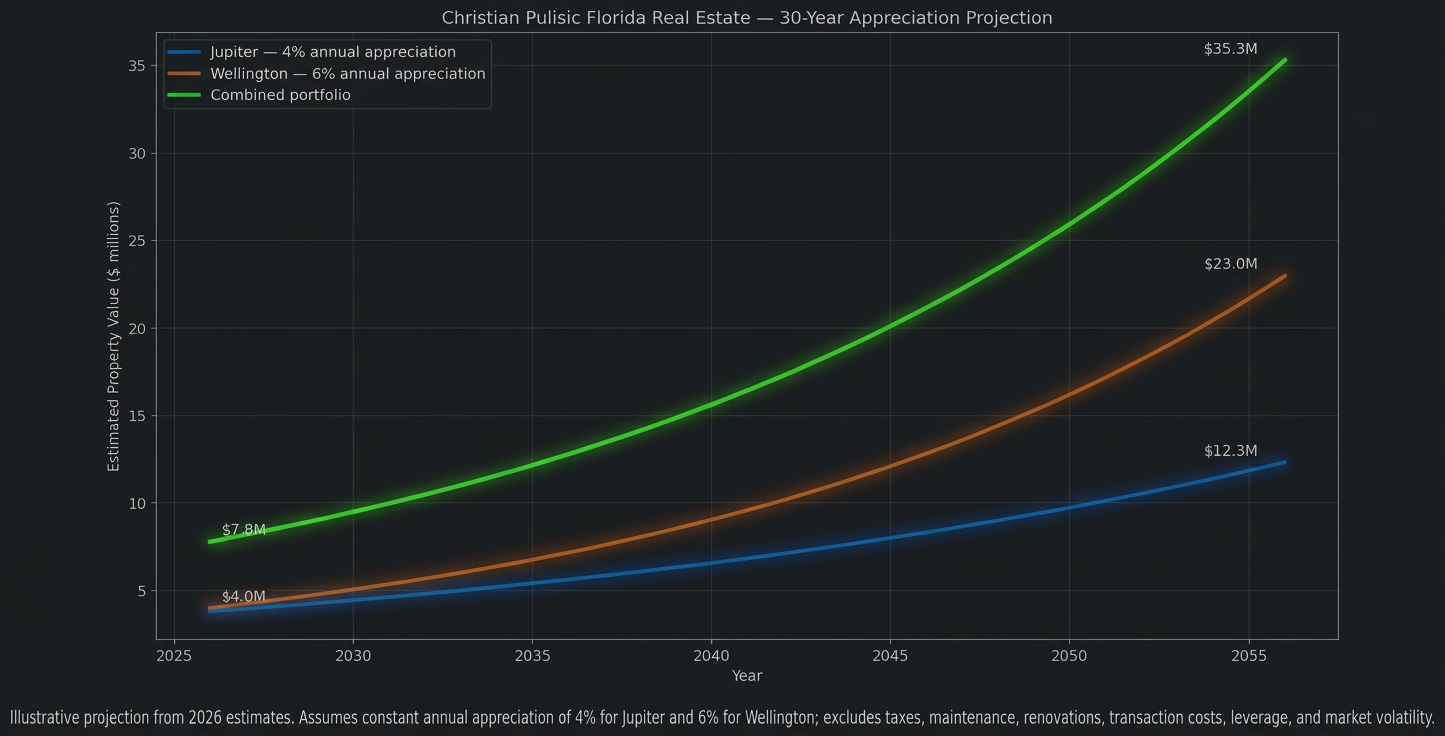
Market Growth Rate or Crash Risk?
Wellington’s equestrian segment has a structural demand floor that most luxury markets don’t, the Winter Equestrian Festival’s $536 million in annual economic impact creates a recurring, predictable demand cycle every winter season that supports property values independent of broader Florida market swings.
Jupiter’s waterfront segment carries more standard luxury-market risk, it benefits from the same no-income-tax migration wave that’s driven all of South Florida, and that wave has shown signs of moderating since the 2021-2022 peak.
The realistic risk isn’t a crash; it’s flattening appreciation back toward the 3-6% range forecasters are now projecting for the broader Jupiter market, rather than the double-digit gains of 2020-2022.
Compared to Renting in the Same Market
Here’s the comparison nobody runs. If Pulisic had rented equivalent properties instead of buying, at roughly 0.5% of property value per month (a reasonable luxury rental yield), the Jupiter house would have cost ~$9,000/month in rent, over $650,000 cumulatively across six years, with zero equity built and zero asset to show for it.
The Wellington property at similar terms would run roughly $15,000/month given the specialized equestrian use case, over $850,000 cumulatively in rent paid with nothing retained.
Combined, renting equivalent properties would have cost the Pulisic family over $1.5 million in pure expense with zero asset value at the end. Instead, they hold $7.8 million in real estate against $4.8 million spent, a swing of roughly $4.5 million in net financial position between the buy-and-hold path they actually took and the rent-everything alternative.
Net Worth Positive?
Both properties are unambiguously net worth positive. The Jupiter house has more than doubled. The Wellington estate is tracking toward a 30%+ unrealized gain while also serving a direct family utility purpose, supporting Devyn Pulisic’s equestrian career, which has its own standalone value that doesn’t show up in a pure appreciation calculation.
For more in-depth analysis of Christian Pulisic’s net worth, read the full APSM breakdown –> Christian Pulisic Net Worth Valuation 2026
The Florida Tax Play Underneath All of It
Every dollar of appreciation on these two properties happens inside a state with zero income tax and below-average effective property tax rates.
Compare that to a player who builds an equivalent real estate position in a state like California (13.3% top income tax) or New Jersey (10.75%), the carrying cost alone of owning $7.8 million in real estate is structurally cheaper in Florida than in almost any other high-net-worth U.S. market, even before accounting for the income tax advantage on Pulisic’s broader career earnings.
For a player whose primary income is taxed under Italian law at AC Milan and whose USMNT and endorsement income gets allocated across multiple jurisdictions, establishing a real, defensible Florida domicile: voter registration, property ownership, family residence, is a meaningful piece of overall tax efficiency, separate from the real estate appreciation conversation entirely.
Check out the APSM Tax Glossary for More Info on state-by-state insights into the net reality of gross contract figures –> APSM State Tax Athlete Glossary
Player Real Estate Portfolio Value Estimation
| Property | Purchase Price | Purchase Year | Current Est. Value | Unrealized Gain | Annualized Return |
|---|---|---|---|---|---|
| Jupiter waterfront house | $1.8M | 2020 | $3.8M | +$2.0M | ~13.4%/yr |
| Wellington equestrian estate | $3.0M | 2021 | ~$4.0M | +~$1.0M | ~6%/yr |
| Combined Florida portfolio value | $4.8M | 2020–2021 | ~$7.8M | ~$3.0M | ~10.5%/yr blended |
Built primarily from AC Milan wages, Chelsea-era earnings, and a growing endorsement portfolio with Puma, Hershey’s, Gatorade, and others, real estate now represents a meaningful and well-performing slice of total assets.
Two properties, one state, one consistent tax strategy, and a $3 million unrealized gain sitting quietly in Palm Beach County while Pulisic captains the U.S. at the World Cup his family’s second home state is helping host.
Why do Athletes Buy Homes in Florida?
Athletes like Christian Pulisic often buy property in Florida because:
- No state income tax
- Lower overall tax burden
- Strong real estate appreciation
- Privacy via LLC ownership
This combination makes Florida one of the most financially efficient places in the U.S. for high-income earners.
Bottom Line
Christian Pulisic’s Florida real estate isn’t flashy. There’s no $20 million Miami penthouse, no Bal Harbor land purchase like Messi’s $26 million move, no Dubai sky mansion.
It’s two mid-size Palm Beach County properties bought five and six years ago, structured through family LLCs, in a tax environment built for exactly this kind of long-term, low-drama wealth accumulation.
The math says it worked. ~$4.8 million deployed, $7.8 million in current value, and zero state-level tax drag on the appreciation. That’s not the most exciting athlete real estate story in this sport;
It might be one of the smartest.
Christian Pulisic Real Estate Portfolio FAQs
Where does Christian Pulisic own real estate?
Pulisic owns two properties in Palm Beach County, Florida, both purchased between 2019 and 2021 and held through family LLC structures. Florida’s no-income-tax environment and strong market appreciation make it one of the most favorable states for long-term property investment.
How much is Christian Pulisic’s real estate portfolio worth?
Based on current Palm Beach County market valuations, Pulisic’s two Florida properties carry a combined estimated value of approximately $7.8 million, up from roughly $4.8 million at purchase, representing a paper gain of approximately $3 million without triggering any state-level capital gains tax under Florida’s zero income tax structure.
Why did Pulisic structure his properties through LLCs?
LLC structuring is standard practice for high-net-worth real estate ownership. It separates the asset from personal liability, provides estate planning flexibility, and in some cases allows for more favorable tax treatment on income generated by the property. For an international athlete with income flowing across multiple countries, entity separation also simplifies accounting and reduces cross-border tax exposure.
Does Pulisic pay U.S. taxes on his AC Milan salary?
Pulisic pays Italian taxes on his Milan salary as a resident of Italy during the season. However, as a U.S. citizen, he is also required to file U.S. federal tax returns on worldwide income regardless of where he lives, with credits available for foreign taxes paid to avoid full double taxation. His Florida real estate and U.S.-based income face no state income tax.
How does Pulisic’s real estate strategy compare to other USMNT players?
Pulisic’s approach prioritizes long-term, low-drama appreciation over headline-grabbing purchases. Players like Messi have made more visible moves, a $26 million Bal Harbor land acquisition being the clearest example, while Pulisic’s portfolio is smaller in scale but structurally cleaner, with no high-tax-state exposure and consistent appreciation in one of Florida’s stronger Palm Beach County submarkets.
Next Reads
- Christian Pulisic Net Worth Valuation 2026 – Career Earnings, Endorsements, Taxes, Investments & Wealth Analysis
- Christian Pulisic AC Milan Salary and Estimated Net Contract Value
- USMNT 2026 World Cup Roster – Annual Payroll & Earnings Valuation
- How Much Boston Spent to Host the 2026 FIFA World Cup
- Pennsylvania State Athlete Taxes
Disclaimer: This article contains general financial information for educational purposes and does not constitute professional advice. APSM estimates are derived from publicly available information, tax assumptions, finance modeling, and industry-standard fee structures. Actual earnings may vary based on residency elections, private contract provisions, image/media rights agreements, bonuses, and tax filings.