
Cooper Jr. Rookie Contract & Residency Overview
| Team | Position | College / Conf. | Age |
| New York Jets (NY/NJ) | Wide Receiver (WR) | Indiana (BIG 10) | 22 |
2026 Estimated Gross Earnings: ~$17.5 million
2026 Estimated Net Earnings: ~$8-11+ million (massive swing)
Omar Cooper Jr., the New York Jets No. 30 overall pick in the 2026 NFL Draft, should NEVER claim residency in the states of New York or New Jersey, if he has the option to choose otherwise (he does).
The former Indiana wideout and reigning national champion enters the league with a ~$17.5 million rookie contract and a ~$9.2 million signing bonus. Before Cooper Jr. goes out for a single route at MetLife (home of the 2026 FIFA World Cup Final), he’s already facing the biggest tax trap in the NFL. If Cooper establishes residency in New York or New Jersey, he could lose nearly $1 million+ on his signing bonus alone, and tens of millions in net losses due to income taxes across his pro career.
APSM breaks down the young man’s real estate and residency options across his new NFL Financial landscape, and suggest where he could establish his primary residence to maximize his net worth:
Cooper Jr.’s NFL Financial Landscape:
- His home/college state (Indiana)
- His drafted state (New York)
- His Stadium Market (New Jersey)
Cooper Jr. Regional Real Estate Matrix
| Target Market | Median Entry Cost | State Income Tax Bracket | Local/City Income Tax | Avg. Annual Appreciation | Property Tax Rate |
| Indianapolis Metro (IN) | ~$240,000 | 3.05% (Flat) | 1.0% – 2.0% (County) | 3.5% – 4.5% | ~0.8% |
| Morristown/Florham (NJ) | ~$750,000 | 10.75% (Top Bracket) | 0% | 5.5% – 6.5% | ~2.2% – 2.5% (Crushing) |
| New York Metro (NY) | ~$820,000 | 10.9% (Top Bracket) | 3.876% (Residents) | 6.0% – 7.5% | ~1.4% – 1.7% |
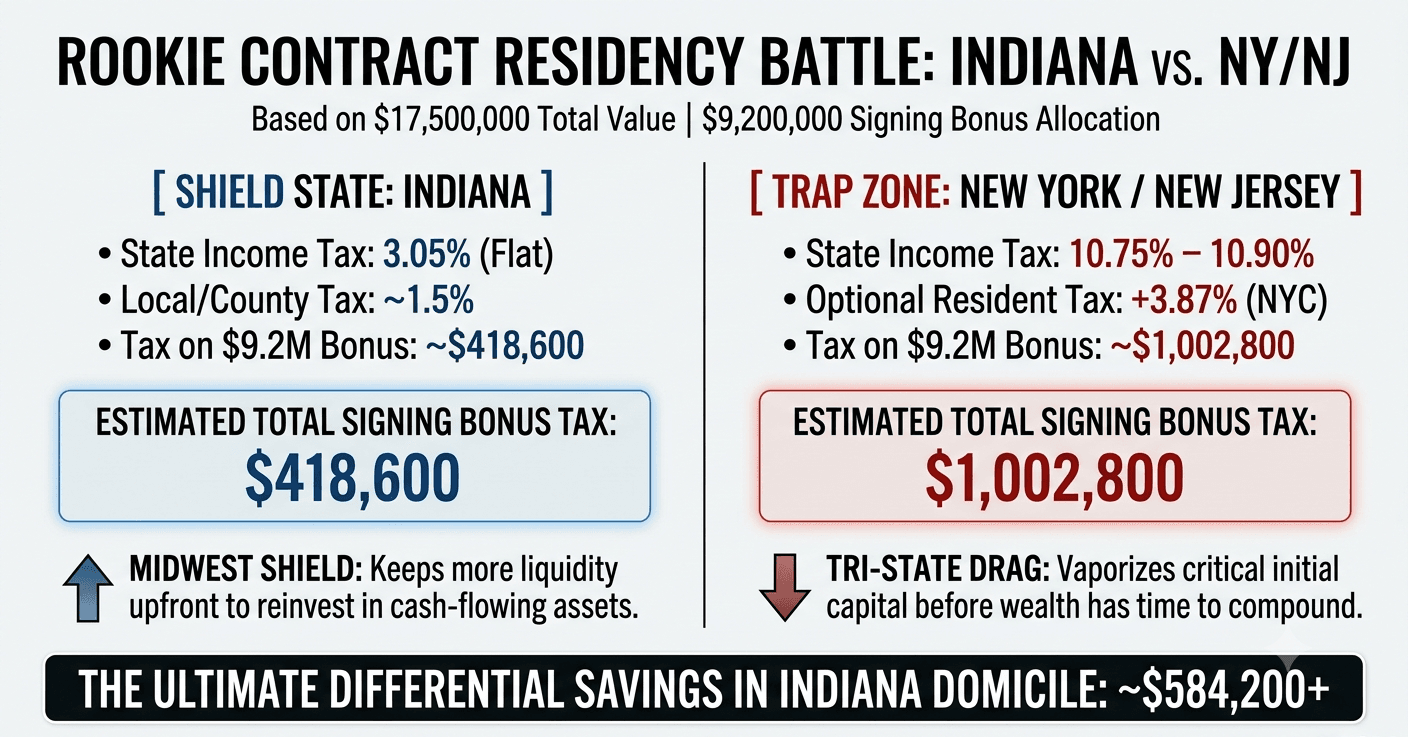
While the New York metro core offers explosive 6.0% to 7.5% annual appreciation in their housing market, establishing legal primary domicile anywhere in New York or New Jersey still exposes Cooper’s ~$9.2 million signing bonus to immediate double-digit state taxation.
By utilizing his native roots to legally anchor his primary residency in Indiana, Cooper can isolate his core off-field distributions under a 3.05% flat rate, effectively preserving nearly seven figures in baseline liquidity and net income.
To see exactly how this multi-state tax battle plays out on a raw balance sheet, APSM modeled the upfront tax divergence between an Indiana legal anchor and the heavy progressive brackets of the New York/New Jersey metro footprint:
Does Omar Cooper Jr. Own Any Property?
Cooper grew up in Indianapolis, starred at Lawrence North High School, and stayed home to play at Indiana University. There are no public records of him owning real estate in Indiana, New York, or New Jersey.
Given his profile:
- Strong Big Ten NIL, but not seven‑figure NIL
- Likely rented in Bloomington
- NIL money probably went to training, family support, savings and finding representation
This Jets rookie deal is the first major wealth event for Cooper Jr., and he could either end up like the over 70% of pro athletes who end up BROKE, or become a counter-part to the highly paid Garrett Wilson.
Market #1: Indiana (Home/College State)
- Median Home Price: ~$250-$300,000
- Property Tax Rate: ~0.85%
- State Income Tax: 2.95%
- Cost of Living: ~10-15% below U.S. average
- Market Trend: 3-5% annual appreciation (Indianapolis suburbs)
Pros
- 3.05% income tax (compared to NY/NJ)
- Affordable housing/long-term investments
- Strong rental demand in Indianapolis
- Familiar environment and support system
Cons
- Not where he plays (would have to spend entire offseason here to meet residency requirements)
- Slower appreciation than coastal markets
Indiana is the clear residency choice, as the Hoosiers state could save Cooper Jr. nearly $1 million on his signing bonus alone and is a better long-term investment market.
Market #2: New York (The Tax Nightmare)
- Median Home Price (NYC metro): $650k-$900k+
- Property Tax Rate: ~1.7% (varies widely)
- State Income Tax: 10.9% + NYC taxes (~4%)
- Cost of Living: Among the highest in the NFL
- Market Trend: 3-5% annual appreciation
Pros
- Branding upside and one of biggest media markets for sports and entertainment
- Massive global market and impact
- Strong rental demand (though expensive)
Cons
- 10.9% income tax, one of the highest in the U.S.
- Extremely high cost of living
- Residency rules are aggressive and complex
Market #3: New Jersey (Stadium State)
- Median Home Price: ~$550,000+
- Property Tax Rate: ~2.2% (highest in the U.S.)
- State Income Tax: 10.75%
- Cost of Living: Among highest in U.S
- Market Trend: 3-5% annual appreciation
Pros
- Close to Jets facilities and slightly better tax environment and COL than New York
- Strong rental markets and appreciation
Cons
- 10.75% income tax
- Highest property taxes in America
- No financial justification for residency
New Jersey is just as dangerous as New York for residency purposes when you could decide to build where you are from and also where you became a national champion for your schools first time.
Best Housing & Rental Markets
Indiana
- Best housing markets: Fishers, Carmel, Westfield, Zionsville
- Best rental markets: Indianapolis metro
- Appreciation: 3-5% annually
New York
- Best housing markets: Long Island, Westchester, Hoboken/Jersey City (NYC‑adjacent)
- Best rental markets: Manhattan, Brooklyn
- Appreciation: 3-5% annually
New Jersey
- Best housing markets: Hoboken, Montclair
- Best rental markets: Hudson County, Newark
- Appreciation: 3-5% annually
Residency Impact on Cooper’s Signing Bonus
- Gross Signing Bonus: $9,200,000
- Federal Tax (37%): $5,796,000
Now compare residency:
| Residency State | State Tax Rate | State Tax on Bonus | Estimated Net Signing Bonus |
|---|---|---|---|
| Indiana | 3.05% | ~$280,600 | ~$5.52M |
| New York | 10.9% | ~$1,002,800 | ~$4.79M |
| New Jersey | 10.75% | ~$989,000 | ~$4.81M |
Indiana could potentially save Cooper ~$720K vs New York residency and ~$708K vs New Jersey. That’s nearly 8% of his entire investable bonus, gone instantly if he picks the wrong state.
Investment Scenario: Turning ~$5.5M Into Generational Wealth
Using the Indiana residency net:
Estimated Net Signing Bonus (Indiana): ~$5,515,400
If he invests that entire amount into index funds, mutual funds or other similar proven vehicles:
| 5‑Year ROI | Projected Value |
|---|---|
| 10% | ~$8.8M |
| 12% | ~$9.7M |
| 15% | ~$11.0M |
| 20% | ~$13.7M |
This is how you turn a rookie contract into 8‑figure wealth before the second deal (extension year).
Jock Tax Considerations
- He’ll pay NY/NJ jock taxes on every home game.
- But jock taxes only apply to games played, not signing bonuses.
- Residency determines where the bonus and investment income are taxed.
APSM Real Estate Verdict
Indiana should be his primary residence.
New York/New Jersey should be avoided for residency.
If Omar Cooper Jr. wants to maximize his rookie earnings, protect his signing bonus, and build long‑term wealth, the APSM suggested move is:
- Keep Indiana residency.
- Rent near Jets facilities.
- Avoid NY/NJ residency traps.
- Invest aggressively from Day 1.
This is one of the clearest tax‑avoidance cases in the entire first round.
Suggested Real Estate Strategy for Cooper Jr.
- Primary residence: Indiana
- Work base: Rent in New Jersey near Jets facilities
- Invest: Majority of signing bonus into index funds + Indiana real estate
- Goal: Turn ~$5.5 million into $9+ million by Year 5
The Bottom Line
Estimated tax savings (signing bonus): ~$700,000+
Top targeted real estate market: Indianapolis
For a first-round wide receiver coming off a national championship run, navigating the tri-state athletic landscape requires elite financial field vision. While Cooper will inevitably pay mandatory out-of-state “jock taxes” for his game days at MetLife and practice reps in Florham Park, he must draw a hard line on his primary residency.
Claiming New York or New Jersey as his legal domicile would subject his entire $9.2 million signing bonus and all incoming national endorsement streams to top-tier state brackets.
By keeping his primary legal anchor tied to Indiana’s friendly flat-tax structure and investing his immediate savings into stable Midwestern real estate, Cooper successfully neutralizes the NFL’s most notorious wealth-vampire jurisdiction before running his first official route.
New York Jets Players Residency & Tax Strategy FAQs
Why should Omar Cooper Jr. avoid establishing legal residency in New York or New Jersey?
New York and New Jersey maintain some of the highest personal income tax brackets in the country, reaching top tiers of 10.9% and 10.75% respectively. If Cooper Jr. registers his primary residence in either state, his entire $9.2 million NFL signing bonus and off-field endorsement income will immediately trigger these aggressive tax rates, resulting in nearly $1 million+ in unnecessary wealth erosion.
How does Indiana’s tax structure benefit a New York Jets rookie?
Indiana features a highly favorable flat state income tax rate of 3.05%. Because Cooper has deep native roots in the state, maintaining his primary domicile in Indiana allows him to shield his signing bonus and global distributions from the double-digit progressive tax brackets found in the Northeast.
What is the “MetLife Stadium Tax Trap” for professional athletes?
The MetLife tax trap stems from the unique geographic split of the New York Jets and Giants. While the team represents New York, their corporate offices, training facilities, and home stadium reside entirely in New Jersey. Players are heavily hit with out-of-state jock taxes on game days, making it statistically vital that they do not compound this loss by establishing their primary residency within these high-tax states.
Where should Omar Cooper Jr. invest in real estate to maximize his portfolio?
The optimal playbook involves a dual-layered property approach. Cooper should secure a functional, short-term rental or luxury lease near the Jets’ training facility in Florham Park, solely for operational convenience during the season. Concurrently, he should deploy his saved tax capital to purchase premium, high-yielding investment properties in the Indianapolis metro area (such as Carmel or Fishers) to serve as stable wealth anchors compounding at favorable property tax rates.
Next Reads
- 2026 NFL Draft: Every 1st Round Contract Details, Net Income & Residency Analysis
- Giants #5 Pick Arvell Reese Is Headed to the Big Apple: Real Estate Suggestions, Residency Analysis and A Multi-Million Dollar Trap Awaiting the Rookie in Manhattan
- Miami is a Financial Gold Mine for Dolphins #12 Pick Kadyn Proctor: 2026 NFL Draft Rookie Real Estate & Residency Analysis
- How Much New York & New Jersey Are Spending to Host the 2026 FIFA World Cup
- New York State Athlete Taxes
Disclaimer: This article contains general financial information for educational purposes and does not constitute professional advice. APSM estimates are derived from publicly available information, tax assumptions, finance modeling, and industry-standard fee structures. Actual earnings may vary based on residency elections, private contract provisions, image/media rights agreements, bonuses, and tax filings.