
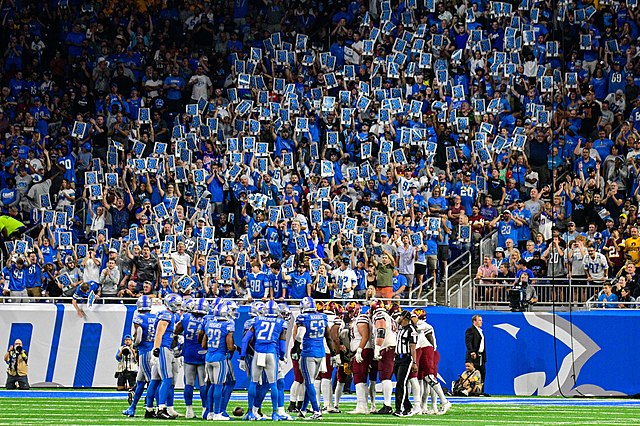
Detroit suffered a critical defensive and structural collapse during the 2025 postseason, falling 45-31 to the rookie-led Washington Commanders.
The scoreboard reflected a tough 14-point playoff exit, but the deeper story was a clear case study in modern NFL salary cap management. The contest served as an illustration of the contrast between heavy long-term financial commitments and the explosive power of rookie contract arbitrage.
While the Lions worked to turn their high-market investments into deep postseason success, Washington utilized their financial flexibility to fuel a historic run into the NFC Championship behind their rookie quarterback.
The Cost of Roster Construction
When evaluating the architecture of the Dan Campbell era, the front office consistently backed its vision with significant financial capital. However, building a sustainable roster requires high asset retention and efficiency:
- The Volatile Secondary Spend: Massive investments like Cameron Sutton’s $33 million contract and C.J. Gardner-Johnson’s deal were designed to solidify the defense. Within a year, neither asset remained on the active roster, creating dead-cap challenges.
- The Premium Skill-Position Premium: The extension for Amon-Ra St. Brown pushed his salary to a striking $25 million annually. While highly productive, premium skill-position contracts require flawless defensive infrastructure to balance out overall team depth.
When a franchise allocates premium market value to its receiver corps and backfield, the margin for error on defense shrinks dramatically. Expensive offenses can actually find themselves struggling to outpace the productivity of younger, leaner rosters built on efficient cost scaling.
The Quarterback Arbitrage: Goff vs. Daniels
The absolute pivot point of this roster audit centers directly on the quarterback position. Jared Goff’s contract extension carried an average annual value of $33.5 million.
While Goff provided a steady, culture-setting presence for the franchise, a high-value veteran contract requires elite, mistake-free execution in the postseason. A three-interception performance on a 23-of-40 passing line highlights the immense pressure placed on a franchise when a significant chunk of the salary cap is tied up in a single veteran quarterback.
On the other side of the ledger stood Jayden Daniels, the 2023 Heisman Trophy winner secured via the 2nd overall pick in the 2024 NFL Draft. Under the NFL’s rookie wage scale, Daniels operated on a fully guaranteed 4-year, $36.2 million contract including a $23.5 million signing bonus.
During the playoff run, Daniels earned ~$9 million, a fraction of the market rate for veteran franchise quarterbacks, while delivering high-level production. By accounting for nearly 300 yards of total offense on the road against a top conference opponent, Daniels demonstrated how a rookie quarterback contract can instantly maximize an organization’s financial return on investment.
The Roster Value Arbitrage Matrix
| Key Franchise Asset | Primary Contract Type | Disclosed Annual Cap Value | Performance Metrics (Playoff Matchup) | Structural Return on Investment (ROI) |
| Jared Goff (DET) | Veteran Franchise Extension | ~$33,500,000 | 23/40 Passing, 3 INTs | Low |
| Jayden Daniels (WAS) | Rookie Scale Arbitrage (Pick #2) | ~$9,050,000 | ~300 Total Yards, 0 INTs | High |
| Amon-Ra St. Brown (DET) | Tier-1 Market Extension | ~$25,000,000 | Low Visual Separation | Moderate |
| Terry McLaurin (WAS) | Veteran Roster Anchor | ~$22,700,000 | 4 Catches, 87 Yards, 1 TD | High |
In the modern salary-cap era, the “Rookie QB Window” serves as the single most powerful team-building tool in professional sports. By locking in an MVP-caliber talent like Jayden Daniels at a fixed rookie wage scale, the Commanders’ front office managed to generate surplus cap space.
Conversely, the Lions’ strategy of extending high-profile internal veterans left them vulnerable when those premium contracts didn’t convert directly into high-leverage postseason efficiency.
Corporate Allocations and Franchising Valuation
The divergent paths of these two franchises also highlight how clean ownership transitions impact on-field assets. Valued at $4.1 billion, the Lions rank squarely in the median of NFL franchise valuations under the ownership of Sheila Ford Hamp. Ownership has shown a strong willingness to invest heavily in personnel, but the structural returns on those investments have faced challenges due to roster turnover.
Conversely, the Washington Commanders, valued at a premium ~$6.1 billion under Josh Harris, maximized their window to move past legacy operational hurdles. Securing an elite, low-cost quarterback asset allowed the new ownership group to aggressively reset their financial blueprint, demonstrating that strategic capital allocation and structural timing matter just as much as raw spending power.
The Bottom Line
- Veteran quarterback cap hit: ~$33,500,000.
- Rookie quarterback salary scaling: ~$9,050,000.
Analyzing historical playoff match-ups through a corporate lens proves that raw spending can rarely match the efficiency of a properly executed rookie contract window. When a franchise relies on high-market extensions for both its passing game and perimeter skill positions, it must achieve near-flawless execution across the rest of the roster.
As teams like the Commanders continue to leverage rookie scale parameters to insulate their depth, front offices must treat cap allocation not just as a tool for collecting talent, but as an exercise in strict structural risk management.
NFL Roster Construction & Cap Arbitrage FAQs
What is rookie contract arbitrage in the NFL and how did it benefit the Commanders?
Rookie contract arbitrage refers to the financial practice of securing elite quarterback production at a fixed, below-market rate determined by the NFL’s rookie wage scale. Because the Commanders had Jayden Daniels locked into an affordable initial four-year framework, they were able to reallocate millions in surplus salary cap space to upgrade their offensive line and veteran defensive depth, creating a more balanced and efficient roster structure.
How do high-value veteran extensions like Jared Goff’s affect a team’s salary cap flexibility?
When a franchise commits over 12% to 15% of its total salary cap to a veteran quarterback, it severely limits its ability to aggressively pursue premium free agents. This structure requires the organization to hit consistently on low-cost draft picks to fill out defensive depth, meaning any high-turnover free-agent classes can create long-term financial drag.
Why does premium spending on wide receivers increase pressure on an NFL defense?
Allocating top-of-market salaries to wide receivers like Amon-Ra St. Brown limits the available liquid cap space needed to shore up the secondary and pass rush. From a system perspective, an expensive offense must control time of possession and operate efficiently, because the defense lacks the premium depth required to absorb high-scoring performance swings from opposing teams.
Next Reads
- Commanders #7 Pick Sonny Styles Real Estate & Residency Analysis: Ohio vs the Nations’ Capital and the 10.75% Tax Trap He Must Avoid
- Inside Washington Commanders’ Stadium Fight
- Trae Young Trade to Wizards Salary & Cap Impact & Long-Term Financial Outlook
- Washington D.C. (U.S. Capital) Athlete Taxes
- Ravens #14 Pick Olaivavega Ioane Is Headed to the DMV: Why Keeping His Residency At Home In Washington Saves the Rookie Millions
Disclaimer: This article contains general financial information for educational purposes and does not constitute professional advice. APSM estimates are derived from publicly available information, tax assumptions, finance modeling, and industry-standard fee structures. Actual earnings may vary based on residency elections, private contract provisions, image/media rights agreements, bonuses, and tax filings.


