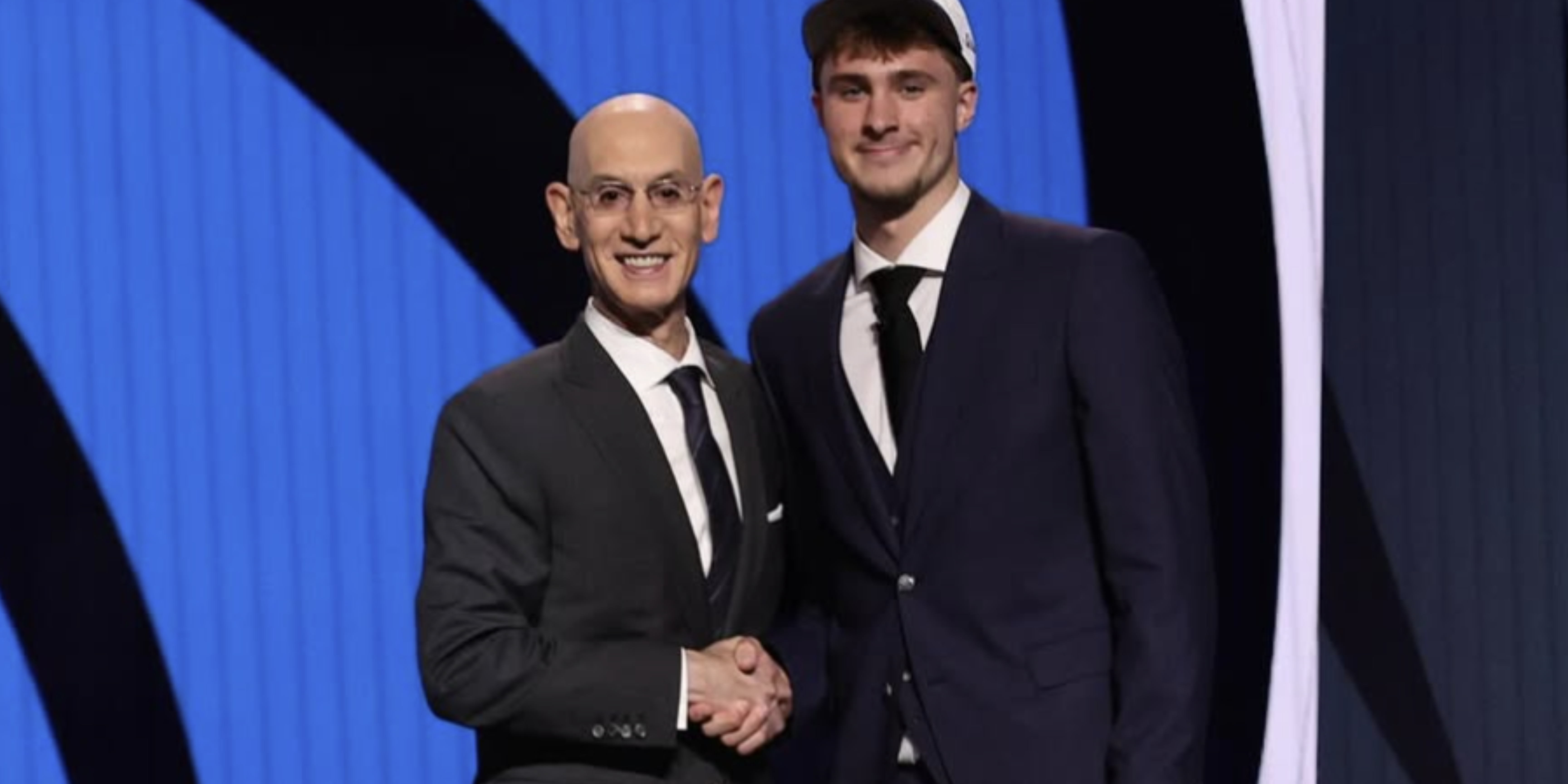
When a prospect walks across the stage on draft night, the media focuses on the jersey swap, the handshakes, and the instant championship projections. But out on the executive floors, an entirely different kind of math is being executed.
The moment Adam Silver calls a name, a rigid, highly calculated financial machinery kicks into gear. Under the collective bargaining agreement, first-round rookie contracts aren’t open-market negotiations, they are locked into a strict, government-like salary scale tethered directly to the league’s overall revenues.
For the 2025–26 league year, with the salary cap officially established at $154.6 million, the financial framework for incoming talent dictates everything from guaranteed generational wealth to the brutal cost of sliding even two spots on the board.
Let’s pull back the curtain on how rookie economics actually work, why every single lottery slot is worth an 8-figure swing, and how smart financial positioning changes a player’s lineage forever.
The Architecture of the Rookie Contracts Scale ($154.6M Cap Framework)
All first-round draft selections enter the league on standardized four-year rookie scale contracts structured as two years of fully guaranteed salary followed by two consecutive team-option years.
Teams possess the unilateral right to sign their draftees anywhere from 80% to 120% of the baseline scale slot. In reality, elite tier-one talent invariably commands the maximum 120% allowable threshold.
2025 NBA Draft: Contract Case Studies
Cooper Flagg and the Billion-Dollar Horizon
When the Dallas Mavericks locked in Cooper Flagg with the No. 1 overall selection, they weren’t just acquiring a franchise cornerstone; they executed a four-year, $62.7 million rookie scale agreement with a first-year payout approaching $13.8 million.
However, the real financial marvel of Flagg’s trajectory lies in compounding velocity. Projections indicate that if he continues on his current athletic and commercial trajectory, compounding index fund investments, global endorsements, and post-rookie max extensions put him on pace to clear $900 million in cumulative earnings by age 32.
By leveraging modern streaming economies, global sports betting integrations, and aggressive equity positioning, Flagg is positioned to shatter historical benchmarks, possibly reaching billionaire status years ahead of predecessors like LeBron James.

The Lottery Penalty: Ace Bailey and the Cost of Sliding
Draft slotting is an unforgiving financial zero-sum game. Consider the economics of Ace Bailey, selected 5th overall by the Utah Jazz. While Bailey secured a massive four-year, $41.2 million rookie deal, pre-draft positioning analysts noted he slipped out of the consensus top three.
That minor slide, refusing pre-workouts with specific suitors notwithstanding, cost him roughly $9 million in gross earnings compared to what a No. 3 selection commanded. In professional sports finance, a three-slot drop isn’t just a minor scouting footnote; it represents an instant, eight-figure contraction of lifetime capital.

The Rich Paul Effect: Manufacturing Leverage in Round 2
On the opposite end of the spectrum sits Yang Hansen, selected 16th overall by the Portland Trail Blazers. Projected by mainstream scouts as a mid-second-round gamble or undrafted international project, Yang’s financial future was completely rewritten by Rich Paul and Klutch Sports.
By weaponizing international broadcast metrics, strict pre-draft workout boundaries, and streaming-era global market appeal, Paul engineered a first-round guarantee worth $21.4 million over four years.
Had Yang slid into the second round into a non-guaranteed or two-way slot, his baseline earnings would have capped out around $3 million. That $18 million delta proves why elite representation isn’t about paperwork, it’s about manufacturing absolute market leverage.

The Survival Zone: Two-Way & Exhibit 10 Economics
For players who miss the first-round safety net, the financial landscape shifts rapidly from guaranteed luxury to survival economics:
Two-Way Contracts Provide a Flat Base Salary (~$500K) Split Across G League Service Time and Active Roster Days
For undrafted players and late second-rounders, two-way deals offer a vital foot in the door while navigating tight economic margins. Players earn a pro-rated flat salary split across their time developing in the G-League and sitting on an NBA bench, requiring disciplined cash-flow management to handle high-tax professional sports hubs.
Exhibit 10 Pacts Deliver One-Year, Non-Guaranteed Training Camp Deals with Incentives Ranging from $50,000 to $75,000
These agreements offer non-guaranteed minimum salaries designed to bring fringe prospects into training camp. If waived before the regular season begins, players can earn crucial financial incentives by reporting directly to the franchise’s G League affiliate, turning a standard camp invite into a secure developmental runway.
Net Reality: The Math Beyond Draft Night
Gross numbers printed across draft night headlines create an instant illusion. When a rookie contract is valued at $41 million or $62.7 million, raw contract figures bear almost no resemblance to true liquid net worth.
Across the entire league, rookie scale earnings face immediate, unavoidable capital leakage before a player ever steps onto an NBA floor. Understanding this gap is the foundation of sports finance.
Taxes Across the US and APSM Methodology
Not all million-dollar checks are created equal. Geography dictates financial survival in professional sports:
The Jurisdiction Penalty
A rookie drafted by a franchise in a zero-state-income-tax market (like Texas or Florida) retains a fundamentally different net baseline than a rookie landing in high-tax jurisdictions like California, New York, or Oregon, where state and local brackets clip nearly 10% to 13% off the top.
The Leakage Formula
Factor in progressive federal tax rates (top rate 37%), the mandatory 10% NBA escrow withholding (partially returned later), and max 4% certified agent fees, and cumulative professional deductions routinely eat 50% to 58% of gross earnings.
The APSM Approach
Under our proprietary tax modeling methodology, we evaluate player contracts strictly through net disposable liquidity rather than headline gross value, a framework standardized in our Tax Glossary.
The 20% Investment Rule & Real Estate Architecture
Wealth in professional sports isn’t defined by what you earn; it’s defined by what you compound during a notoriously short earning window.
Pay Yourself First (The 20% Rule)
Under APSM protocols, rookies must immediately sweep a minimum of 20% of net take-home cash straight into diversified index funds, mutual funds and/or other similar appreciating investment vehicles, and compounding assets before any lifestyle spending occurs.
Real Estate as an Anchor
Housing overhead must be strictly capped at 5% to 10% of gross contract value using low-interest private wealth jumbo loans. Rather than locking up vital liquidity in all-cash real estate purchases, keeping capital deployed in high-yielding equity allows property appreciation (~4% annually) to work for the player.
The Underdog Multiplier
This exact financial discipline explains why a “lesser paid” late-first or second-round pick who lives lean and compounds aggressively can easily out-accumulate a careless lottery pick who falls victim to premature lifestyle inflation.
The Bottom Line
The 2025 rookie scale demonstrates an immutable truth of modern sports economics: financial security is locked in before a player ever steps onto an NBA hardwood.
Whether scaling toward a billion-dollar empire like Cooper Flagg or reclaiming $18 million in lost value through elite representation like Yang Hansen, understanding the underlying contract architecture is the ultimate differentiator between athletes who play for a paycheck and those who build generational dynasties.
2025 NBA Rookie Contracts Economics (FAQs)
How are NBA rookie scale contracts determined?
First-round rookie salaries are rigidly fixed by the NBA Collective Bargaining Agreement, scaling directly alongside annual changes in the league’s overall salary cap (set at $154.6 million for the 2025–26 season). Teams can adjust scale amounts between 80% and 120%, though top picks almost universally receive the maximum 120% slot.
Are NBA rookie contracts fully guaranteed?
Yes. For first-round selections, the first two years of the rookie scale contract are 100% fully guaranteed. Years three and four are governed by team options, giving organizations cost-controlled roster flexibility before restricted free agency.
What financial penalty do players face by sliding in the draft?
Because rookie scale amounts decrease sequentially with every draft slot, sliding even a few picks can cost a prospect millions in guaranteed base salary. For instance, dropping from pick #3 to pick #5 results in a valuation loss of over $9 million across a four-year window.
How do second-round picks differ financially from first-rounders?
Second-round picks do not fall under the mandatory rookie scale framework. Their contracts are individually negotiated and are frequently non-guaranteed, two-way deals (~$500K base), or Exhibit 10 training camp agreements that require players to fight for every dollar.
Next Reads
- USMNT 2026 World Cup Roster: Annual Payroll & Earnings Valuation
- USNMT Matt Turner Contract Breakdown: 2026 Salary, Transfer History & Estimated Net Earnings
- How Much Boston Spent to Host the 2026 FIFA World Cup
- What a SoFi Stadium Strike Could Cost FIFA at the 2026 World Cup
- Pennsylvania State Athlete Taxes
Disclaimer: This article contains general financial information for educational purposes and does not constitute professional advice. APSM estimates are derived from publicly available information, tax assumptions, finance modeling, and industry-standard fee structures. Actual earnings may vary based on residency elections, private contract provisions, image/media rights agreements, bonuses, and tax filings.