The NBA salary cap is one of the most intricate financial structures in all of professional sports. It’s designed to create a level playing field, sure, but what it actually does is shape team strategy, player salaries, and championship windows in ways most fans never think about.
At first glance it looks like a “simple” spending limit when it actually isn’t due to a new rule that has impacted the long-term viability of top-heavy roster construction around the league.
The NBA salary cap is a system that evolves with the league’s revenue, the financial market/impact of the NBA and its partners, and every new round of collective bargaining. It just got significantly more complicated in 2023 when the NBA introduced a second spending threshold, the second apron, that quietly ended an entire era of roster building.
Think about what used to be possible just a decade or so ago. Steph, Klay, KD, and Draymond on one roster. LeBron, D-Wade, and Bosh forming a super-team in Miami. Those teams existed because the cap system of those eras let a franchise stack three or four max-level stars and still field a real bench around them.
That’s not viable anymore in 2026 and depth has rapidly become the new way to win championships, introducing new financial factors for both athletes and fans (bettors) to consider.
The second apron makes it structurally impossible to pay that many stars and still afford the depth needed to actually compete for a title. The result is a league that’s noticeably more balanced than it used to be.
The NBA has had a new Finals champion in eight straight years now, a real shift from the stretch of Warriors-Cavaliers rematches that defined the mid-2010s, and the salary cap system is a direct reason why.
What the new cap structure has done, almost without realizing it, is while it made the leagues top players richer, it also made role players genuinely more valuable financially than in the past.
Teams that can’t afford a third max contract need a $15-20 million role player who fits, defends, and doesn’t need the ball to be effective, and that player now gets paid real money for being exactly that.
You no longer have to be the best player in the league to build serious, compounding wealth playing in it. You just have to understand how the system actually works, and where you fit inside it.
What is the Salary Cap?
The salary cap represents the maximum amount of money a team can spend on player salaries in a given season, but there’s far more than meets the eye. Teams need to navigate a web of exceptions, contract types, and luxury tax rules to build a competitive roster while adhering to these financial limits.
Here, we break down the salary cap, the aprons stacked on top of it, and the strategic maneuvers teams make to maximize flexibility inside a cap-locked world.
Read the APSM Finance Glossary Page for “Salary Cap” to Learn How the Salary Cap Works Across Different Sports Leagues in the U.S.
Cap Mechanics
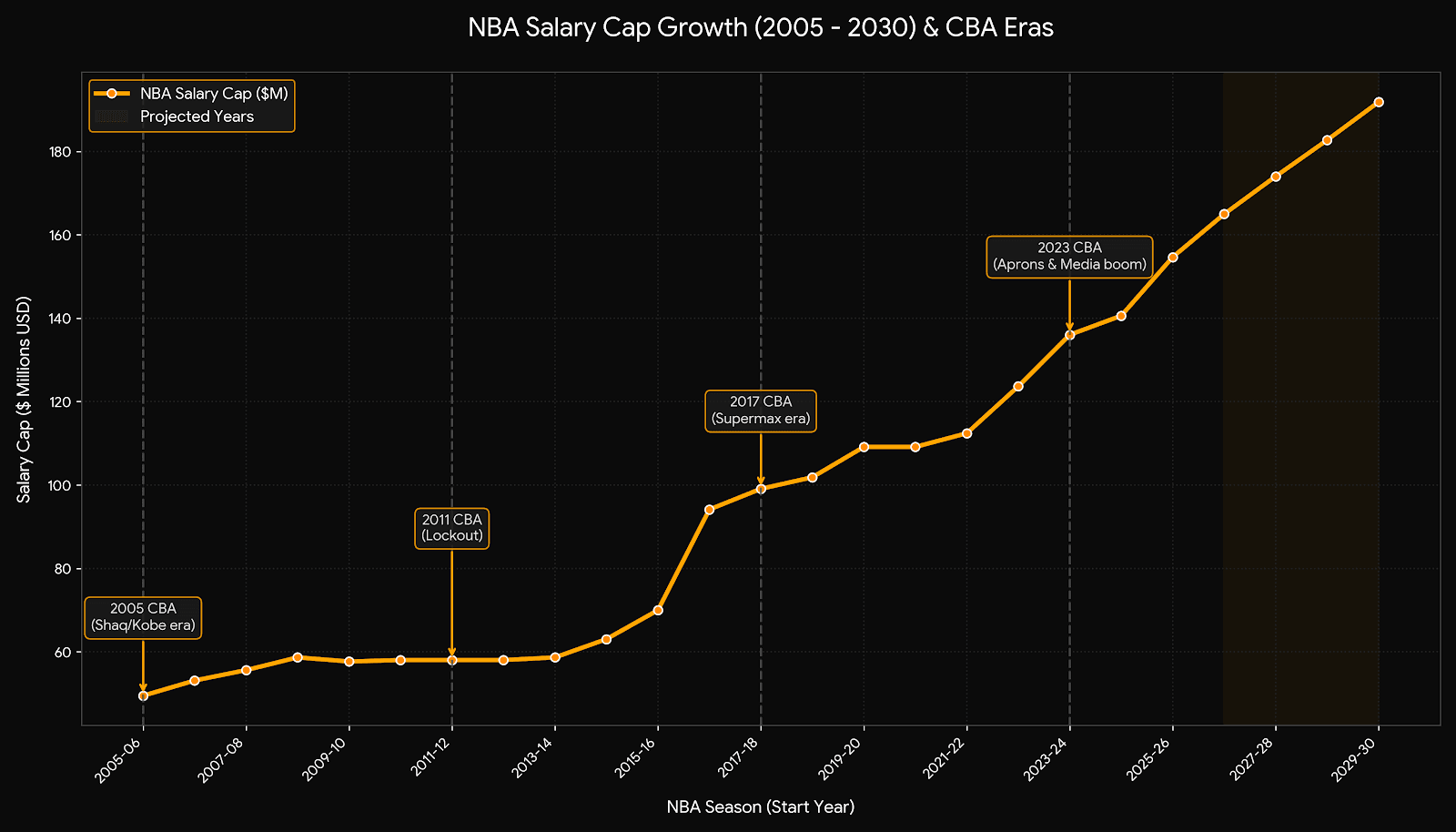
As of the 2026-27 season, the salary cap is set at ~$164.961 million, up roughly 6.7% from last season’s ~$154.647 million. This is a slight decline from the 10% growth the league pushed through the year before, reflecting slightly slower media revenue growth.
The salary floor for this season, (the minimum a team is required to spend), sits at ~$148.465 million. The luxury tax threshold for 2026-27 is ~$200.43 million. Teams that exceed it pay a progressively higher tax rate, which climbs further for teams that stay in the tax multiple years running, the repeater tax.
Teams in large markets, like New York or California, can lean on media rights, endorsement deals, and sponsorships to help balance their books while paying high salaries. Smaller-market teams like the Sacramento Kings or Orlando Magic tend to rely more on draft success and mid-level exceptions to stay competitive against that structural spending gap.
2026-27 NBA Financial Thresholds at a Glance
| Financial Tier / Threshold | 2026-27 Value | Key Restrictions & Rules |
| Salary Floor | ~$148.465M | Minimum spending requirement |
| Salary Cap | ~$164.961M | Baseline spending limit; exceeded using exceptions (Bird Rights, MLE). |
| Luxury Tax Threshold | ~$200.43M | Triggers progressive luxury tax rates and penalties. |
| First Apron | $209.015M | Eliminates Bi-Annual Exception, Taxpayer MLE, and specific trade rules. |
| Second Apron | ~$221.686M | Severe penalties: no contract aggregation, frozen draft picks for repeat offenders. |
Salary Cap Exceptions and the Two Aprons
The salary cap system is filled with exceptions that let teams build rosters without technically violating the cap. These aren’t just technicalities, they’re strategic levers that can make or break a team’s entire roster construction plan. Here’s a look at how the 2023 CBA changed what happens once a team goes past them.
Bird Rights
This exception allows a team to re-sign its own free agents to contracts that exceed the salary cap. Bird Rights are the essential tool that lets them lock up talent without being hamstrung by the cap.
For franchises looking to retain their stars, think Giannis Antetokounmpo in Milwaukee or the Warriors keeping their championship core together.
Mid-Level Exception (MLE)
The MLE is a lifesaver for teams in the luxury tax or otherwise unable to land top-tier free agents. Teams with title aspirations use it to supplement bench depth with veterans who contribute without breaking the bank.
For 2026-27, the non-taxpayer MLE gives cap-constrained teams a real tool to add rotation-caliber talent. The taxpayer version, worth less and off-limits to first- and second-apron teams, was worth $5.6 million in 2025-26.
Supermax Contract
The Supermax is a high-risk, high-reward tool designed to keep franchise players in their current cities, meant to help teams like Oklahoma City retain superstar talent even in a smaller market.
Players can earn up to 35% of a team’s salary cap under a supermax, the mechanism behind Shai Gilgeous-Alexander’s record-setting $285 million extension with the Thunder. Read more –> (SGAs $285M Contract)
What Changed in 2023, and Why It Matters
The cap system now has two additional thresholds stacked above the luxury tax, and crossing them costs teams far more than money.
The first apron sits at ~$209.015 million for 2026-27. Teams above it lose access to the bi-annual exception and the taxpayer mid-level exception, and face real limitations on sign-and-trade transactions.
The second apron sits at ~$221.686 million. This is where things get genuinely restrictive, teams lose nearly every meaningful roster-building tool: no taxpayer mid-level exception, no aggregating multiple contracts in trades, no sending cash in trades.
Cross it in two of any four seasons and your first-round pick gets pushed to the very end of the round in the following draft. For 2025-26, the Cleveland Cavaliers were the only team to cross the second apron, which is why their 2033 first-round pick is currently frozen under the CBA’s restriction rules.
The league’s goal with the second apron specifically was competitive balance, stopping a small handful of high-revenue franchises from simply buying championship-caliber depth every year regardless of cost. Before this system, a team like Golden State could absorb massive tax bills and still functionally out-spend the rest of the league.
The second apron changes that math by making it structurally difficult to build a deep, expensive roster no matter how much ownership is willing to pay, the restrictions aren’t about money anymore, they’re about which tools are even available to use.
Market Implications
The salary cap system is designed to foster competitive balance, but market forces remain an inescapable reality of NBA economics. A closer look at market size, media revenue, and local TV deals reveals why teams in major markets like LA, Chicago, and Miami often have an easier time building championship-caliber rosters than teams in smaller cities.
The Lakers, for example, have a local TV deal worth over $200 million annually. That revenue lets them pay the luxury tax and still make aggressive moves in free agency, something smaller-market teams can rarely afford.
Global icons like LeBron James or Stephen Curry also attract endorsement money that goes well beyond the court, and that financial windfall shapes how teams structure contracts around player marketability and international appeal.
Role of the Luxury Tax
The luxury tax exists to prevent teams from monopolizing talent by spending without limits, and the two-apron system layered on top of it since 2023 sharpens that same goal considerably.
Teams that go over the cap pay a progressively higher tax rate that climbs further for repeat offenders, forcing teams like Brooklyn or Milwaukee into tough calls, letting go of high-paid players or trading them for cap relief.
Golden State has spent over the luxury tax threshold in recent years and absorbed real financial penalties for it. With their global fanbase and endorsement revenue, they can take that hit and still compete. Fewer teams can say the same now that the apron restrictions add a non-financial cost on top of the tax bill itself.
Cap History
- 2005: $49.5 million
- 2024: $140.6 million
- 2025-26: $154.647 million
- 2026-27: $164.961 million
Where the Money Comes From
The 2025-26 season generated approximately $11.68 billion in Basketball-Related Income (BRI) league-wide, with players collectively earning ~$6.27 billion in salaries and benefits, and ~$317 million more than the 49-51% revenue split would have allowed at its upper bound.
That BRI figure is the real engine behind every cap number above it. When national and local media deals grow, BRI grows, and the cap grows with it the following season, which is exactly why the league’s new media rights deals with ESPN, Amazon, and NBC, fully in effect for 2025-26, are the actual explanation for the cap’s aggressive multi-year climb.
Salary Cap Balancing
The real art of the NBA salary cap lies in how teams manage their contracts over the long term. It’s about timing, when to pay your stars, when to gamble on an unproven player, when to clear space for a future free-agent haul.
Teams must be strategic about extending players, trading assets, and negotiating contracts to stay competitive while navigating four separate spending tiers instead of one.
Championship contenders may prioritize short-term spending, leaning on exceptions like the MLE to add pieces, while rebuilding teams focus on draft picks, development, and cap flexibility to set up future success.
Large-market teams can afford to make financial mistakes and recover. Small-market teams have to be meticulous, since every decision now has to account for where it lands relative to the aprons, not just the cap.
Why This Matters Beyond Basketball
For any athlete, agent, or fan actually paying attention to how professional sports finance works, the NBA’s apron system is one of the clearest real-world examples of a salary cap that’s soft on paper but functions like a hard ceiling in practice.
The cap number gets the headlines. The apron restrictions are what actually determine whether a front office can build the roster it wants, and front offices are increasingly making personnel decisions specifically to stay under a threshold rather than just chasing the best available talent.
That’s the same lesson that applies to anyone managing their own money. The headline number rarely tells the whole story. What happens above that number, the taxes, the restrictions, the tools that disappear, is what actually determines the outcome.
Where the Salary Cap Goes From Here
As the NBA continues expanding its global footprint, with growing markets in China, India, and Europe, there’s real potential for the cap to keep climbing in the years ahead.
The league is already projecting another 5.5% increase for 2027-28, which would push the cap past $174 million. That kind of growth has major implications for young players negotiating bigger paydays earlier in their careers, and for front offices trying to plan multiple years ahead against a moving target.
Streaming platforms stepping deeper into sports media, along with continued player empowerment through max contracts, player options, and trade leverage, all point toward a CBA that keeps evolving. The cap system four years from now will likely look meaningfully different from the one governing this season.
Bottom Line
The NBA salary cap climbing to $164.96 million matters less on its own than understanding the four-tier system stacked on top of it. A team’s real spending flexibility isn’t determined by the cap number, it’s determined by which of the four tiers: cap, tax, first apron and second apron, that they’re actually sitting in.
The second apron specifically has become the single most important structural constraint in modern NBA roster construction. Front offices that understand it build sustainable contenders. Front offices that ignore it end up like Cleveland, frozen picks, James Harden, and all.
NBA Salary Cap FAQs
What is the NBA salary cap for the 2026-27 season?
$164.961 million, up roughly 6.7% from the 2025-26 cap of $154.647 million, driven by growth in the league’s Basketball-Related Income from its national and local media deals.
What is the difference between the first and second apron?
The first apron ($209.015M for 2026-27) restricts teams from using the bi-annual exception and taxpayer mid-level exception, plus certain trade tools. The second apron ($221.686M) is far more severe, teams lose nearly every meaningful roster-building exception and face first-round draft pick restrictions if they cross it in multiple seasons.
Can NBA teams spend above the salary cap?
Yes. The NBA uses a soft cap, meaning teams can exceed it using specific exceptions like Bird Rights or the mid-level exception. But spending further into the luxury tax and apron thresholds triggers escalating penalties and real roster-building restrictions.
What happens if a team crosses the second apron?
If a team exceeds the second apron in two of any four seasons, their first-round pick for the following draft moves to the very end of the round, a structural penalty separate from any tax payment, meant to discourage sustained overspending.
How is the NBA salary cap calculated each year?
The cap is set as a percentage of the league’s projected Basketball-Related Income for the coming season, which includes national and local media rights, ticket sales, and sponsorships. As BRI grows through new media deals, the cap grows proportionally the following season.
Next Reads
Disclaimer: This article contains general financial information for educational purposes and does not constitute professional advice. APSM estimates are derived from publicly available information, tax assumptions, finance modeling, and industry-standard fee structures. Actual earnings may vary based on residency elections, private contract provisions, image/media rights agreements, bonuses, and tax filings.