
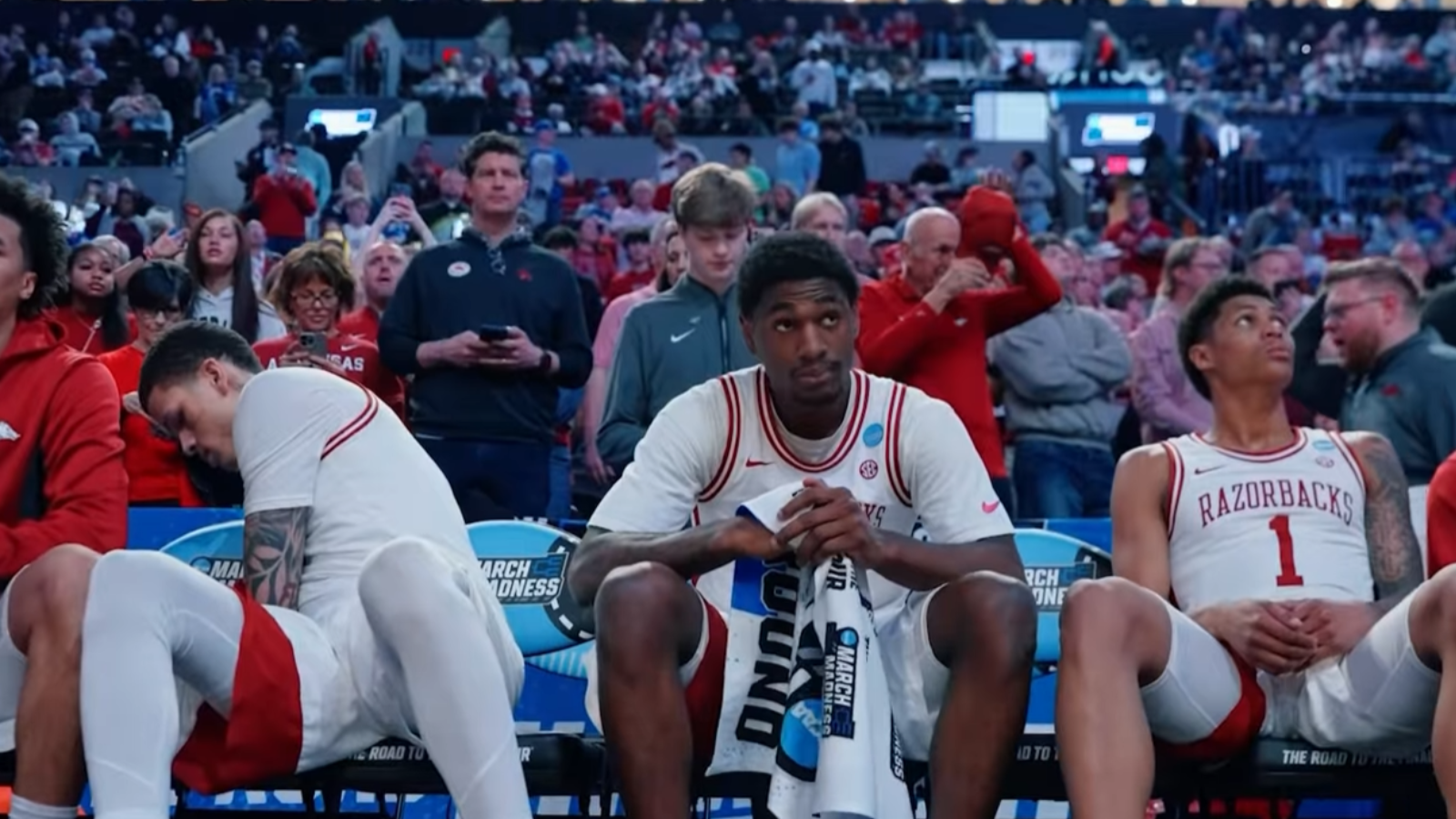
Arkansas is not usually the first team thought about when discussing basketball power schools or teams in the SEC in general, but for the 2025-26 season the Razorbacks went all in on the NIL cash now roster construction method.
Arkansas did not just rely on traditional recruiting and convincing talent they were building something real. In the new era of NIL money, they decided that they were going to lean into the portal, target high‑impact contributors, and in the process built what many analysts called one of the most efficient financial builds in all of NCAAM.
With an estimated ~$11.5 million NIL roster value, the Razorbacks weren’t the top spenders (that title belongs to the Kentucky Wildcats), but they were among the smartest.
Despite a disappointing exit, their March Madness run proved it. They entered the tournament with balance: stars, supporting pieces, and a culture of depth that often separates good teams from deep ones.
Here’s how the money distributed, starting with the Razorbacks top NIL earners for the 2025 year.
Top 3 Highest‑Paid NIL Players (Arkansas)
Unlike some teams that stack dollar signs at the very top, Arkansas’s NIL roster had strategic tiering, making sure that the top talent didn’t overwhelm the bench and that value flowed deeper.
1. Maleek Thomas
Estimated NIL Valuation:
~$2.5-$3 million
2. D.J Wagner
Estimated NIL Valuation:
~$2-$2.2 million
3. Darius Acuff Jr.
Estimated NIL Valuation:
~$1.5-$2 million
Estimated Remainder of Roster Value
(~$6.2 million)
After the top three contributors, Arkansas’s remaining roster brought ~$6.2 million of NIL value, spread across rotation players, key role scorers, and contributors with regional/brand reach.
These valuations typically fell in the $300K – $900K range for players with rotational minutes and marketability.
This tier is where Arkansas’s build earned its ROI, balanced spending across contributors who could actually perform in meaningful minutes.
While the 2025-26 season still had an 8-figure spending amount, the success the Razorbacks tasted in the tournament has made the school hungry for more.
So, for the 2025-26 season the University of Arkansas has greenlit coach Calipari to spend north of $20 million headed into the 2026 offseason.
But, as seen with the Kentucky Wildcats, there is more to winning than just spending tens of millions of dollars on potential talent.
Basketball is still a team sport, so while money can buy talent, it can’t buy connection, vibes, confidence nor court flow.
Coaching & Program Spend
Head Coach: John Calipari
Estimated Salary:
~$8+ million base salary annually:
Includes $1 million signing bonus and can earn an additional $500k annual retention bonus and March Madness performance incentives.
Arkansas’s head coach carries both competitive and NIL currency. Calipari’s profile helped attract transfer talent with exposure, upward mobility, and a structure that tied NIL visibility to genuine court roles.
Coaching spend isn’t counted in NIL totals, but it matters significantly for how that NIL translates to actual performance. This is where Arkansas separated itself from bigger spending teams that faltered early.
How Arkansas Built Its NIL Roster
Arkansas’s financial playbook wasn’t just “spend the most.” It was:
- Targeted high‑impact portal assets
- Deep roster spending (not just #1 salary)
- Balanced NIL distribution for performance continuity
This approach helped them avoid the problem of top‑heavy rosters with minimal depth, something that sank other high spender teams in the tournament. Their roster was financially balanced and performance‑ready, a pairing that becomes rare at the highest NIL levels.
Taxes, Fees & Net NIL Reality
As with all NIL valuations, gross headline figures aren’t true net numbers.
Typical deductions include:
- Federal + Arkansas state income tax liabilities
- Representation/agent fees
- Marketing/business expenses
Estimated net for Arkansas’s top earners:
- Thomas (~$3M) → ~$1.7-$2 million net
- Wagner (~$2.5M) → ~$1.5-$1.8 million net
- Acuff Jr. (~$2M) → ~$1.1-$1.3 million net
Across the roster, about 40–50% of gross NIL value flows into actual net earnings after tax and fees, similar to professional contracts. This is the real money that impacts long‑term financial outcomes.
March Madness: Arkansas 2026 Performance
Arkansas didn’t just make the tournament, they made a statement.
- Seed: Top‑10 seed
- Result: Sweet 16 exit
They handled early competition with efficiency and competitiveness, then ran into a more experienced March squad and bowed out in the second weekend. Their return on NIL investment was strong.
They didn’t quit early, and their spend translated to court performance, even if it didn’t carry them all the way.
Estimated Net Razorbacks Roster Value
Total Gross NIL Value: ~$11.5 million
Estimated Net Distributed: ~$5.8-$6.5 million
That’s the actual estimate of what hit player accounts after federal and other deductions, the number that really matters.
Click to Learn More —) Arkansas State Athlete Taxes
Financial Outcome & Market Implications
For Arkansas
- Smart, balanced NIL spending led to results
- Investment across the roster protected performance continuity
- Their tournament run offered one of the better ROI narratives compared to total spend
For Players
- Significant career earnings before potential pro moves
- Increased exposure and brand value through extended tournament play
For NIL Market
Arkansas became a blueprint for how to spend intelligently, not just max out contracts. They balanced marquee money with meaningful depth, and that alignment correlates with competitive success.
Next Reads
- Inside March Madness’ Wealthiest Rosters of 2026: $20M NIL Teams, Player Earnings & Financial Winners
- Kentucky Wildcats $20+ Million 2025-26 NCAAM NIL Roster Value, Player Earnings & March Madness Impact
- BYU Cougars $13+ Million 2025-26 NCAAM NIL Roster Value, Player Earnings & March Madness Impact
- Duke Blue Devils $12+ Million 2025-26 NCAAM NIL Roster Value, Player Earnings & March Madness Impact
- Arkansas State Athlete Taxes
Credits
Written By: Aidan Anderson
Research & Analysis: Apostle Sports Media LLC
Sources: on3 NIL Valuations, CBS Sports, ESPN, X Feed, Local Utah Collegiate Financial Research, APSM Proprietary Analysis
Featured Image: Public Domain / Instagram


