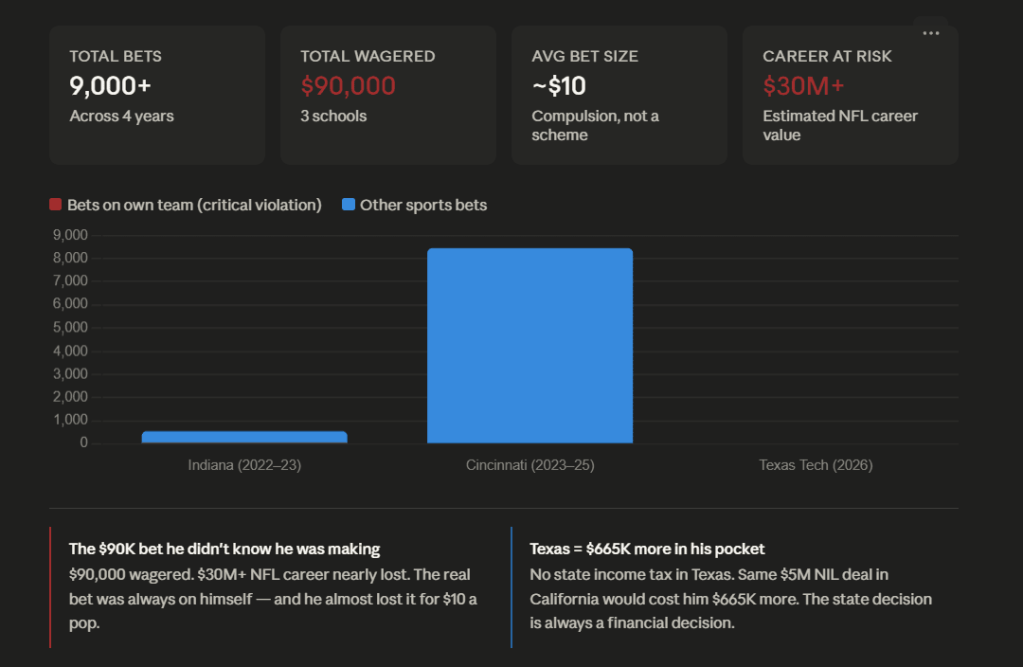
The integrity of college football has been compromised by Texas Tech Red Raiders Senior Quarterback, Brendan Sorsby. The young man was caught placing over 9,000 total bets for a total of $90,000+ wagered, using an account not in his own name.
His gambling case was moved to an injunction in Lubbock County, Texas and until the NCAA appeals the decision and wins, he will only “serve” his 35 days in an Arizona rehab and a two-game suspension, and then be back on the field.
How did the court of Lubbock County allow this, what are the financial implications for Sorsby and most importantly, what is the real story about the money inside this case. This is the most financially loaded eligibility case in college football history, and it seems as if a Lubbock County Judge just rewrote the rules for everyone.
Brendan Sorsby was the top-rated player in the January 2026 transfer portal and chose to stay at Texas Tech after signing a ~$5 million NIL deal, the largest single-season portal contract in college football history. This deal was worth more than most pro athletes make on their rookie contracts after federal taxes and other operational expenses (agent fees, escrow, income tax and other state taxes, training, housing, etc.).
The NCAA declared him permanently ineligible for betting on his own team, which has always been the clearest red line in sports governance.
It’s the same rule that got Pete Rose banned from baseball for life, the same principle that got NFL players suspended with no appeal process, referees in the NBA, NCAAM basketball players, etc.
The rule has always been that if you are caught betting on your own sport while active, especially on your team, that you would be banned from playing the sport forever. This would also likely mean that the athlete would lose tens of millions of dollars in the process, if they were a top prospect such as Sorsby. Permanent ban. Or so it’s supposed to be.
Then a district court judge in Lubbock County, the same county that is home to Texas Tech, granted a temporary injunction blocking the permanent ban from playing on Sorsby.
This isn’t just a feel-good story about a kid who got help and got a second chance. This is a financial earthquake with fault lines running from Lubbock all the way to the NFL Combine, the transfer portal market, and every sponsor, NCAA partner and athletic department that has ever written an NIL check.
APSM runs the full money map, because while the injunction is the headline, the finances are the real story.
The Financial Picture of What Sorsby Did:
Before the implications, let’s cross-off the known facts, because those details matter financially. Sorsby placed over 9,000 bets totaling $90,000 across roughly four years of college football.
He used sportsbook accounts registered to friends and family members, which is itself important, because it means he knew what he was doing violated NCAA rules before he placed a single bet. You don’t log in through someone else’s account if you think you’re allowed to.
The bets spanned three schools, Indiana, Cincinnati, and presumably into his Texas Tech tenure, though sources close to the situation claim that they don’t believe he placed any bets after arriving in Lubbock.
| Financial Item | Amount | Status |
|---|---|---|
| Texas Tech NIL Contract | $5,000,000 | Active under injunction |
| Cincinnati Buyout Lawsuit | $1,000,000 | Pending federal court |
| Total Gambling Wagers | $90,000 | Lost capital |
| Estimated Legal Fees | $150,000+ | Incurred |
| Projected 2027 Rookie Contract Value | $12M – $35M | High risk, depends on season |
The Wagers Included
- At least 40 bets placed on Indiana football during his redshirt freshman year in 2022, when he was a member of the program, the specific violation that triggered permanent ineligibility under NCAA rules.
- Bets on Cincinnati Reds baseball games, including live wagers on individual pitches at as little as $1 or $2.50 per pitch (live action gambling, over 200 bets could potentially be bet per game).
- Wagers ranging from micro-bets to larger single-game stakes across both college and pro-sports.
The $90,000 total across 9,000+ bets averages out to $10 per bet, which tells you this isn’t a high-roller situation, it’s a compulsive behavior pattern. When you are consistently placing small, frequent bets across years, that’s a behavioral finance profile, not a scheme. There’s a meaningful difference, and it matters for how the legal argument played out.
Sorsby was 20 years old when he began placing bets at Indiana in 2022, and was under the legal betting age of 21 in both Indiana and Ohio. This means not only was the betting he did against NCAA rules, but Sorsby also broke state law.
The Stakes of Sorsby’s $5 Million NIL Deal
When you understand what Sorsby was risking financially, the legal fight makes complete sense. Texas Tech’s booster-funded NIL collective paid Sorsby ~$5 million for the 2026 season, a number confirmed by On3, and multiple other outlets. That figure made him the highest-paid transfer portal player in the January 2026 window, beating out offers from LSU, Indiana, and Miami to stay.
Think about that number in context. The NFL rookie minimum salary in 2026 is around $795,000 for a first-year player. A mid-round NFL Draft pick signing his rookie deal might land a four-year contract totaling $6-8 million with a signing bonus around $1-2 million.
Sorsby is set to be making ~$5 million in a single college season, prior to entering the draft in 2027, where first-round selections will be earning ~$10-15 million, the moment they step off the podium.
Because Lubbock is in the state of Texas, where there’s no state income tax, his net take-home on that $5 million is significantly higher than it would be for a player at USC, Ohio State, or Michigan. A $5 million NIL deal in Texas versus California is ~$665,000 difference in state tax alone, a number most people never factor into the college decision.
However after being permanently banned by NCAA for his gambling, every dollar of that deal would become void. Sorsby would not sniff a single cent of the $5 million and the Red Raiders would be without a QB. His NIL deal could not be deferred or reduced if he wasn’t on the field, which would also significantly lower his odds of becoming a high NFL Draft pick, or being selected at all.
No 2026 season means no NFL Combine showcase, no draft stock, no leverage. The NCAA’s ruling didn’t just affect this year’s paycheck. It affected the entire financial arc of his future and professional career.
The judge who granted the injunction acknowledged exactly this, ruling that Sorsby would suffer “probable, imminent and irreparable injury” without the court order. That’s legal language, but what it actually means is: the financial damage of sitting out is not recoverable after the fact.
You can’t un-miss the 2026 season. or rebuild the draft positioning you lose from not playing. The harm is permanent, even if the eligibility isn’t.
How a Lubbock Judge Overruled the NCAA
This is the part that breaks the system, and it’s important to understand why, because it’s unfortunately not the first time, and it won’t be the last. Sorsby sued the NCAA for breach of contract and breach of the duty of good faith and fair dealing. He argued that the NCAA handled his gambling addiction unfairly, treating it not as a medical issue, but rather a disciplinary one. His legal team made three specific arguments:
He never bet in a game he played.
The 40 Indiana bets were placed during his redshirt year when he didn’t actively participate. His lawyers argued no game was ever compromised by his wagering because he had no ability to affect the outcome of games he didn’t play in.
Gambling disorder is a medical diagnosis.
Sorsby completed a 35-day residential treatment program in Arizona and received a formal diagnosis of gambling disorder. His legal team argued that treating a medical condition as a permanent eligibility violation is discriminatory under applicable law.
The NCAA profits from sports gambling too.
Sorsby’s lawsuit explicitly cited the NCAA’s own revenue relationships with sportsbooks and legal gambling operators, pointing out that the organization banning him for gambling is also profiting from gambling’s normalization in American sports culture. That’s not just an irony argument, its contract law argument about inconsistent rules.
A Texas state judge, in Lubbock County, where Texas Tech is located, agreed that Sorsby’s case had enough merit to warrant a temporary injunction, blocking the ban while the underlying lawsuit plays out.
This is not a final ruling. The NCAA has already filed an appeal and the lawsuit remains ongoing. Sorsby could theoretically be pulled from the field mid-season if the appeals process moves fast enough, which would then uncover another litany of money issues, a bridge to be crossed at that time. He is playing on a legal tightrope, and the financial stakes of every game increase the longer the injunction holds.
The Cincinnati Problem: A $1 Million Lawsuit Nobody’s Talking About
When Sorsby left Cincinnati for Texas Tech in January 2026, he had a multi-year NIL revenue-sharing agreement with Cincinnati Athletics, and a specific buyout clause requiring him to pay the school ~$1 million if he transferred before the contract term ended.
He transferred anyway. Cincinnati filed suit in federal court in the Southern District of Ohio, seeking the full $1 million in liquidated damages.
Sorsby’s attorneys filed a motion to dismiss and that case is still pending in 2026. So, the full financial picture for Sorsby right now looks like this:
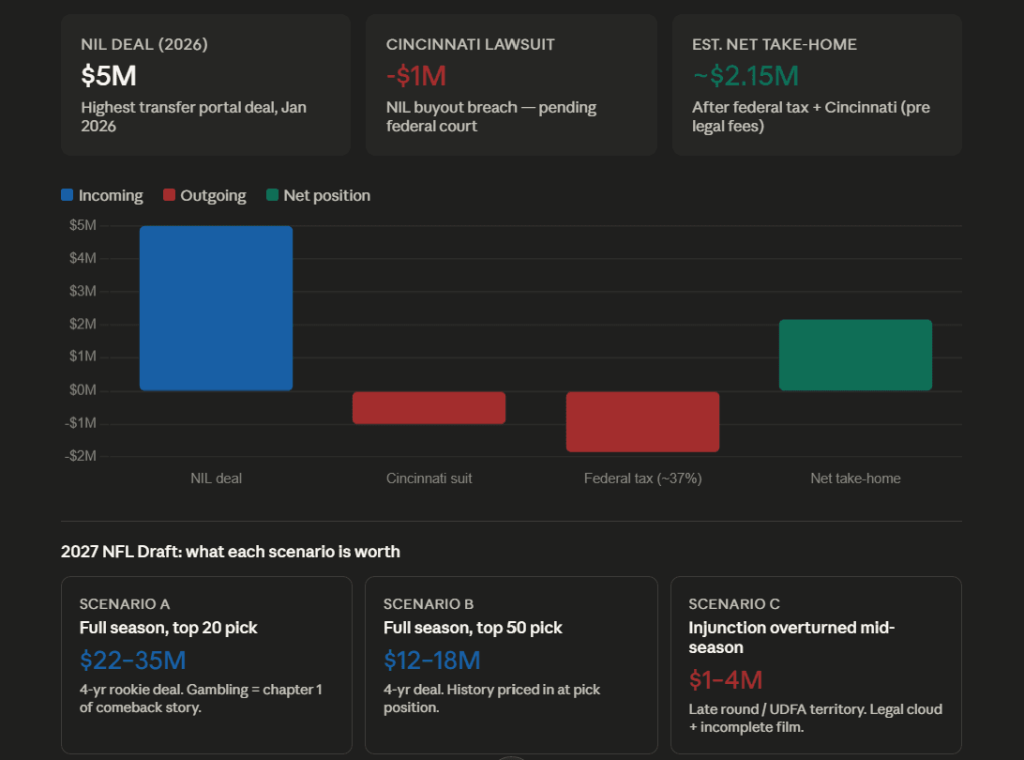
That net figure assumes he plays the full season, wins the NCAA lawsuit, and loses the Cincinnati lawsuit, the reasonable middle-case scenario.
Legal fees for a federal lawsuit and a state court injunction battle are not trivial. The $5 million headline has a very different number underneath it by the time the lawyers, income taxes, and Cincinnati get their cuts.
This is the kind of real-money breakdown that your agent should be doing for you before you make any of these decisions, and that most players, especially 22-year-olds navigating the NIL era for the first time, don’t have the financial literacy to see clearly.
The NFL Draft Angle: What a Full Season Means for His Money
The 2027 NFL Draft is the next major financial milestone for Sorsby, and it’s directly connected to everything happening in Lubbock right now. Coming out of this situation, there are three scenarios for his draft stock, and each one has a very different financial outcome.
Scenario A | Sorsby plays a full season, Texas Tech goes to the CFP, he’s drafted top-50:
A top-50 pick in the 2027 NFL Draft would put Sorsby on a four-year rookie contract in the range of $12-18 million total value with a signing bonus somewhere around $4-8 million. The gambling history becomes a footnote. Teams do their due diligence, value the rehabilitation narrative, and price in the risk with a pick position that reflects the uncertainty.
Scenario B | Sorsby plays but the NCAA wins the appeal mid-season, creating chaos:
If the injunction gets overturned mid-season, which is unlikely but not impossible, the draft positioning collapses. Incomplete film, a legal cloud, a gambling history, and a messy exit from college football combines into a significant draft-day discount. The difference between Scenario A and Scenario B could easily be $8-12 million in gross contract value.
Scenario C | Sorsby dominates, becomes a Heisman contender, goes top-20:
At $5 million NIL already established, a top-20 pick with a clean bill of health post-rehab, teams have drafted players with far more serious off-field histories. A top-20 QB pick earns somewhere in the range of $22-35 million on a four-year rookie deal. The $5 million NIL season becomes the foundation of a $40+ million professional career. The legal fight, the rehab, the two-game suspension, all of it becomes chapter one of the comeback story that sports culture loves to tell.
Why This Matters Beyond Sorsby
This is the part that will haunt athletic directors, compliance offices, and NIL collectives for years. The NCAA’s rules on gambling are the clearest, most consistently enforced rules in the organization’s history.
Betting on your own team is the Pete Rose rule. It doesn’t matter if you’re a superstar, it doesn’t matter if you had a gambling disorder, it doesn’t matter if no game was ever compromised. The rule exists because the perception of potential compromise is itself the damage, and that perception can’t be undone once a bet is placed.
What the Lubbock injunction establishes is that a state court in the jurisdiction where a program is located can override NCAA enforcement while a lawsuit plays out. That’s not a one-time anomaly. That’s a legal pathway that every future athlete facing eligibility sanctions now knows exists.
Big 12 athletic directors are reportedly considering boycotting games against Texas Tech this year, not because Sorsby played on a given team, but because the precedent makes a mockery of the enforcement mechanism. If permanent ineligibility can be suspended by a friendly jurisdiction’s district court judge, the rule doesn’t function as a deterrent.
For NIL contracts specifically it sets the precedent that a player can negotiate a $5 million deal, bet on his team, go to rehab, sue the NCAA, and get reinstated through state court while missing just two games.
What is the actual financial risk of breaking the rule? The answer, post-Lubbock, is “very little if you have good lawyers and a sympathetic jurisdiction.” which changes the calculus for everyone.
What Young Athletes Should Take From This
Sorsby got lucky.
- He got lucky that he had a $5 million NIL deal that made the legal fight worth financing.
- He got lucky that the court is in Lubbock, where Texas Tech’s influence on the local economy is not nothing.
- He got lucky that his lawyers constructed a medical-disorder argument that had enough legal merit to survive a temporary injunction hearing.
- He got lucky that the gambling amounts, while large in volume, averaged $10 a bet rather than looking like an attempt to profit from inside information.
Most players don’t get that lucky. The financial reality of gambling for a college or professional athlete isn’t the $90,000 Sorsby wagered. It’s the career earnings at risk, and at the college level, that means NFL draft positioning, which means lifetime earnings, which means the gap between a $30 million rookie deal and a $1 million undrafted free agent contract, or becoming the General Manager at McDonald’s.
Sorsby’s total gambling losses of ~$90,000 look completely different when framed against the $5-15 million it could have cost him in professional career earnings. What he didn’t realize, is that he was betting on his own career, and he almost lost it. The legal system gave him a window, but the financial lesson is that no second chance is guaranteed, and the players who get reinstated make the news because they’re the exception.
Bottom Line
A Lubbock judge just gave Brendan Sorsby his season back and handed the NCAA its latest courtroom loss. The $5 million NIL deal is intact, for now, and he still has the Cincinnati lawsuit pending.
The NCAA appeal is filed, but will not be heard overnight, if not until after the start of the 2026-27 CFB season, and somewhere in every 2027 draft room, every team’s front office is already running the background check to ensure the ban remains undone.
The money at stake across every layer of this story, the NIL deal, the Cincinnati buyout, the draft slot, the federal lawsuit, the gambling losses themselves, tells you everything about why this fight happened and why it matters beyond one QB in west Texas.
This is what happens when you build a $5 million college sports economy with no financial literacy infrastructure to support the players operating inside it. The bets Sorsby placed were small. The bet he lost was enormous.
Brendan Sorsby Gambling Case FAQs
Is Brendan Sorsby playing college football in 2026?
As of the injunction ruling, yes, temporarily; A Lubbock County district judge granted Sorsby a temporary injunction blocking his NCAA permanent eligibility ban, clearing him to play for Texas Tech after a two-game suspension. However, the NCAA has appealed, the Big 12 filed a separate federal lawsuit, and the situation remains legally active. He could theoretically be pulled from the field if the appeal moves quickly enough before the season ends.
What happened to Brendan Sorsby’s $5 million NIL deal?
The deal is currently intact under the terms of the injunction. Sorsby’s $5 million NIL contract with Texas Tech’s booster collective is contingent on him playing. If the NCAA’s appeal succeeds and the injunction is overturned, the contract becomes void and he loses the full amount. As long as the injunction holds, the deal stands, and every game he plays adds to his draft tape and professional stock.
How much did Brendan Sorsby actually bet and on what?
Court documents confirm Sorsby placed over 9,000 sports bets totaling more than $90,000 across roughly four years. The triggering violation was at least 40 bets placed on Indiana University football while he was a redshirt freshman on the team in 2022, a direct violation of the NCAA’s core gambling prohibition. Additional bets included Cincinnati Reds baseball games, micro-wagers on individual pitches, and various college and professional sports events.
Why is the NCAA investigating Cincinnati over Sorsby?
In July 2026, the NCAA issued a formal letter of inquiry to the University of Cincinnati probing whether coaches or athletic staff had any knowledge of Sorsby’s gambling while he was playing for the Bearcats. The investigation covers an estimated 165 impermissible bets placed during his time in Cincinnati.
What does the Sorsby case mean for future NIL contracts and NCAA eligibility?
It establishes a legal pathway that athletes facing eligibility bans can pursue through state courts in friendly jurisdictions, particularly in cities where the local university is a major economic driver. The precedent is the real damage: the deterrent effect of a permanent ban is meaningfully weakened if a well-represented athlete with enough financial stake can temporarily block enforcement while their case plays out. Athletic directors across the Big 12 are already responding to that reality.
Next Reads
- Inside the House v. NCAA Settlement and Its Impact on College Sports
- College Football Has Entered Its Contract Era: The Financial Fallout of the Demond Williams Jr. Case
- Cowboys #11 Pick Caleb Downs Real Estate & Residency Analysis: Why Dallas Is a Financial Cheat Code
- Scottie Scheffler’s Primary Residence & Real Estate Portfolio Estimate: Dallas, Texas and the Financial Logic Behind It
- Texas State Athlete Taxes
Disclaimer: This article contains general financial information for educational purposes and does not constitute professional financial advice.