
Alaska starts with one of the cleanest tax headlines an athlete can find in the United States: no state individual income tax and no general sales tax.
For a professional athlete, major NIL earner or independent contractor, that matters immediately. A dollar of salary, endorsement income or taxable NIL compensation does not face an additional Alaska income-tax layer simply because the athlete lives in the state.
However, keep in mind: zero state income tax is not the Net Reality.
Alaska is detached from the mainland and remains one of the least densely populated states in the country, yet the Last Frontier still carries one of the highest cost-of-living profiles in the United States.
Housing costs sit well above the national baseline, while property taxes are materially higher than the state’s low-tax headline might lead somebody to assume.
An Alaska resident who competes or earns income in other states can still owe road-game jock tax elsewhere, while NIL and commercial income can still create federal, self-employment and multi-state filing obligations.
The result is a state with an extremely favorable tax headline, but a Net Reality that still depends on where the athlete earns, lives, owns property and spends money.
The combination is what makes Alaska unusual.
The state imposes no personal income tax, while Tax Foundation’s 2026 data places Alaska’s average combined state-and-local sales-tax burden at only 1.82%. At the same time, Alaska’s roughly 0.94% effective property-tax rate and its elevated cost of living keep the state from functioning like a universal low-cost tax haven.
For athletes, that difference matters. Alaska is exceptionally efficient at protecting earned income from state taxation, but keeping more of the paycheck and living cheaply are two different financial questions.

Alaska Income Tax for Athletes
Alaska does not levy a broad-based individual state income tax.
The State of Alaska states that it does not currently impose personal income taxes, and the state’s Office of the State Assessor likewise lists Alaska as having no personal state income tax.
That means salary, bonuses, taxable NIL compensation and ordinary investment income do not pick up an additional Alaska personal-tax burden simply because the athlete is a resident.
For a high earner, that is not a small difference.
A seven-figure athlete living in Alaska starts from the same 0% state individual-income-tax position as an athlete in Florida.
The contrast becomes much more visible against states such as California, Oregon, Idaho or New York, where the same gross income can face a material state-level drag before representation fees, career costs or operational expenses are even considered.
The table is simple because unlike 41 of 50 other states in the nation, Alaska has no progressive individual tax bracket system to climb.
That does not eliminate federal taxes, payroll or self-employment obligations, and it does not prevent another jurisdiction from taxing income properly sourced there. It simply means Alaska does not take an additional percentage from an athlete’s earnings through a personal state levy.
Want the national picture? APSM’s State Income Tax Explained: The States That Cost Athletes the Most breaks down why two athletes can earn the same gross amount and still finish with very different take-home income depending on where they live and work.
Alaska’s Permanent Fund Dividend
Alaska also has a financial feature no other state replicates in quite the same way: the Permanent Fund Dividend.
The Alaska Department of Revenue set the 2026 PFD at $1,200, including a $200 energy-relief payment. For a professional athlete earning seven figures, $1,200 is unlikely to materially change the financial picture.
For a college athlete, lower-earning player or athlete supporting a family, however, it still belongs in the complete household cash-flow picture. More important than the payment itself is what the PFD reveals about Alaska residency.
For the 2026 dividend, the PFD Division requires an applicant to have been an Alaska resident throughout calendar year 2025, intend to remain an Alaska resident indefinitely and satisfy additional physical-presence and residency requirements.
The state also makes clear that physical presence alone is not enough to establish qualifying residency. The PFD remains taxable for federal purposes even though Alaska does not impose its own individual state tax on that income.
For athletes thinking about residency strategically, that distinction matters: an Alaska address is not the same thing as an Alaska domicile, and PFD eligibility has its own documented residency rules.
APSM $1 Million Alaska Tax Benchmark
To keep every jurisdiction in the State Athlete Tax Glossary comparable, APSM uses the same $1 million athlete-income benchmark.
For Alaska, the standardized baseline assumes a single filer earns $1 million of W-2-style compensation in 2026, maintains Alaska residency for the year and carries no agent fee or career-overhead adjustment inside the tax-only benchmark.
This is not intended to recreate an individual athlete’s private return. The purpose is to keep the gross figure constant across all 52 jurisdictions.
The IRS sets the 2026 single-filer standard deduction at $16,100, with the 37% federal bracket beginning above $640,600 of taxable income.
Using the same standardized federal framework applied throughout the APSM glossary, the model produces roughly $320,000 of federal individual income tax on the $1 million gross figure before athlete-specific credits, deductions and planning.
Alaska then adds $0 of individual state income tax.
The important number here is 0% at the Alaska state layer.
Alaska itself does not reduce the standardized $1 million gross figure before the athlete begins accounting for the other costs attached to earning and keeping that money.
Yet: that still is not a complete Net Reality calculation.
The benchmark intentionally isolates federal and Alaska individual taxation. It does not yet subtract self-employment or payroll taxes, road-game jock taxes paid elsewhere, representation fees, career overhead or the athlete’s actual cost of living.
Alaska Jock Tax and Nonresident Athlete Income
Alaska does not impose a personal income tax, so the state does not create a traditional Alaska jock-tax bill for a visiting athlete merely because that athlete performs in Alaska.
That is the opposite of the structure in states such as Hawaii or New York, where a nonresident professional can owe tax on income allocated to work performed inside the jurisdiction. The more important jock-tax issue for an Alaska resident happens outside Alaska.
An athlete who genuinely lives in Alaska can still generate taxable income in every income-tax state where paid work is performed.
An NFL, NBA, MLB or NHL player with Alaska domicile would therefore still face the same road-game sourcing problem as an athlete domiciled in Florida or another zero-income-tax state.
Alaska does not currently host an NFL, NBA, MLB or NHL franchise, so it is not a major recurring road-game tax jurisdiction.
That makes the state unusual from both directions: Alaska residents can avoid a home-state individual income tax, and visiting athletes generally do not pick up an Alaska personal-income-tax filing simply for competing there.
That does not erase multi-state complexity.
A golfer, fighter, hockey player, touring or other athlete earning endorsement income can still generate taxable obligations elsewhere depending on where paid services are performed and how the income is sourced.
For an Alaska resident, the home-state rate can be 0% while the road-state rate is anything but.
Does Alaska Tax NIL Income?
At the Alaska individual-income-tax level, no.
Taxable NIL income, endorsements, sponsorships, appearance fees and other athlete business income do not face an Alaska personal income tax simply because the athlete is domiciled in the state.
That makes Alaska especially interesting for a high-earning creator-athlete or NIL athlete whose commercial activity is not tied entirely to one campus market. The federal side still matters.
NIL compensation may arrive as 1099 income, which can create federal estimated-tax and self-employment-tax obligations even when the state line is zero. An athlete who travels to another state to perform compensated services can also create state-source income there.
So, the useful question for an athlete is not simply whether Alaska taxes NIL income. The better question is:
How much of the NIL dollar actually survives after federal tax, self-employment tax, any out-of-state tax, representation fees and the cost of living in Alaska?
That is where Alaska’s 0% state rate becomes powerful without becoming misleading.
How Alaska Compares With Major Athlete Markets
Alaska does not have a natural in-state Power Four rival or major professional franchise market, but that does not make the tax comparison irrelevant to athletes.
An athlete can still establish Alaska residency while earning NIL, endorsement, contract or business income that originates elsewhere. In that situation, the financial question becomes whether Alaska provides a more efficient home base than another state the athlete could realistically choose.
Washington currently has no individual wage-income tax in 2026, although a new 9.9% tax above $1 million is scheduled to begin in 2028.
Florida also remains at 0%.
The contrast becomes sharper across the rest of the West. Oregon’s top individual rate reaches 9.9%. Idaho uses a 5.3% individual rate. California reaches a 13.3% maximum personal rate once the state’s additional high-income tax is included, while New York’s maximum state rate reaches 10.9%.
Those headline rates do not determine an athlete’s final tax bill by themselves. What they do show is how much geography can change the starting point before representation fees, career expenses and lifestyle enter the equation.
The APSM Net Retention comparison below puts that difference into the same $1 million framework used throughout the glossary.
The headline rates show where each state starts, but the athlete does not deposit a tax rate into a bank account (net income).
APSM applies the same $1 million NIL benchmark across the seven markets with 0% agent fees and 0% career overhead, isolating the tax environment before representation costs or personal spending enter the equation.
That produces a comparable Net Retention Score.
Alaska, Washington and Florida each return a 63 under the current APSM net income calculator benchmark.
Idaho returns 58, New York 57, Oregon 54, and California 53.
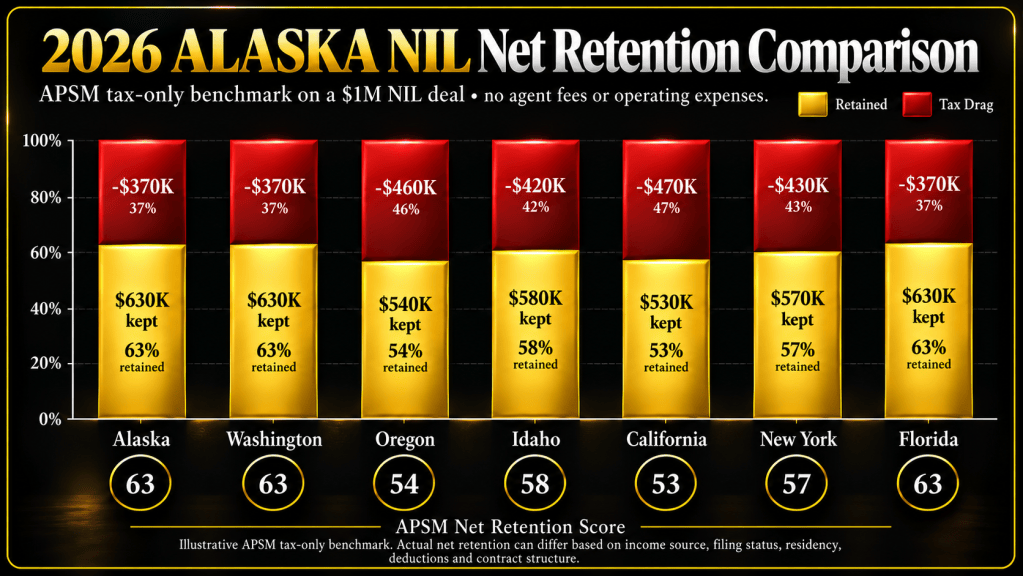
For a recruit, transfer, pro-athlete or creator deciding where to establish a real home base, the point is not that taxes should decide the career. The point is that two athletes can start with the same $1 million gross number and enter the rest of their financial life with very different amounts still intact.
Alaska’s advantage appears immediately because the state adds no individual-income-tax drag of its own. The comparison also shows why that advantage cannot be evaluated without the rest of the page: Alaska protects the income line extremely well, but the cost of housing, utilities, groceries and property ownership is materially higher than many other zero-tax states.
That is the purpose of the APSM Net Retention Score: turn a tax environment into a number an athlete can actually compare.
Alaska Sales Tax and Athlete Spending
Alaska has no statewide general sales tax.
The Alaska Office of the State Assessor explains that sales taxes are imposed locally rather than by the state. Local governments decide whether to levy the tax, what is taxable and what exemptions apply.
That creates an unusual athlete-spending environment.
Tax Foundation’s midyear 2026 dataset places Alaska’s population-weighted average combined sales-tax rate at 1.82%, one of the lowest averages in the country, even though individual local jurisdictions can be materially higher.
The state’s assessor reports that local general-sales-tax rates commonly fall in the 2% to 5% range where imposed. That means a purchase made in one Alaska municipality can carry a different tax cost than the exact same purchase made somewhere else in the state.
For an athlete buying furniture, electronics, equipment or a six-figure vehicle, the practical rule is simple:
the state rate is 0%, but location still matters.
That same point matters going forward. Governor Mike Dunleavy introduced a proposal in 2026 for a seasonal statewide sales tax beginning in 2027, but Alaska’s current 2026 system remains a zero-state-sales-tax system.
For APSM’s 2026 glossary, the current law is what controls.
Alaska Property Tax and Real Estate
Real estate is where Alaska becomes more complicated.
Tax Foundation places Alaska’s effective property-tax rate on owner-occupied housing at approximately 0.94%. That is not extreme nationally, but it is materially higher than somebody might expect after seeing a state with no individual income tax and no statewide sales tax.
Property taxation is also fundamentally local.
The Alaska Office of the State Assessor reports that only a portion of Alaska’s municipalities levy property tax, meaning the recurring cost can change significantly depending on where the athlete actually owns the property.
For an Alaska native, longtime resident or athlete considering the state as a permanent home base, that matters because tax efficiency on income does not automatically make every Alaska market inexpensive to carry.
A player retaining more of a contract because Alaska takes 0% at the state-income-tax level can still give part of that advantage back through a more expensive home, mortgage interest, local property taxes, insurance and the broader cost of maintaining that property.
That is why the housing table and 30-year graphic below sit beside the tax analysis: residency only works financially if the place where the athlete keeps the money is also sustainable to live in.
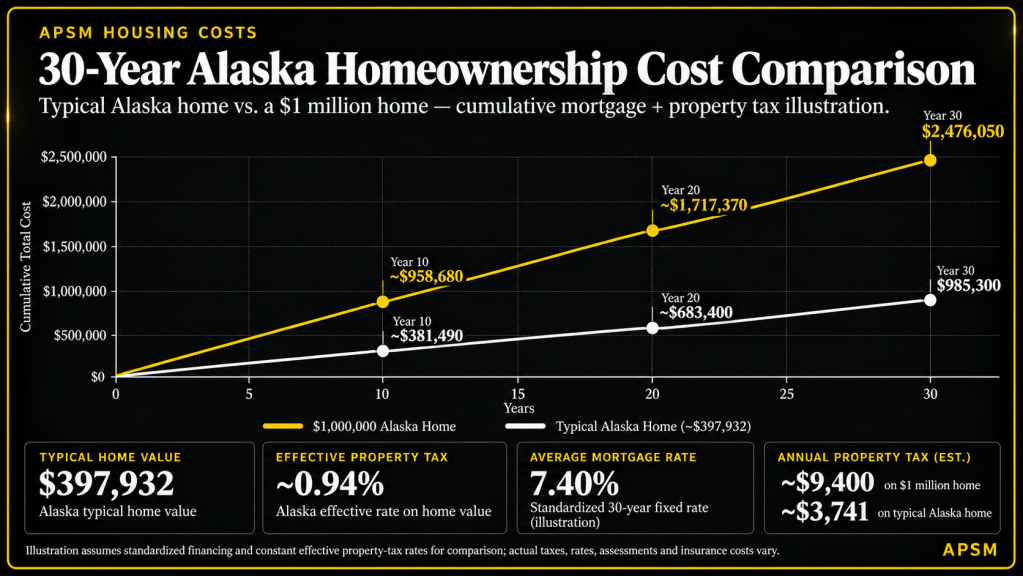
The point is the scale. A typical Alaska home and a $1 million property live under the same tax environment, but they do not create the same long-term financial obligation. Higher purchase prices amplify mortgage interest and recurring property tax at the same time.
An athlete can finish paying the mortgage and still owe property tax every year that the property remains taxable. For somebody trying to build long-term wealth through real estate, that carrying cost matters alongside purchase price, financing, appreciation and eventual capital gains.
Alaska’s lack of state income tax can leave more cash available for a down payment or investment account, but a seven-figure home can redirect a large piece of that retained income back into housing.
Buying real estate with athlete income? APSM’s Property Tax Explained for Athletes and Jumbo Loans Explained go deeper into the recurring tax and financing side of owning high-value property.
Alaska Housing Costs
Alaska’s housing market is not cheap simply because its income-tax rate is zero. Zillow places the typical Alaska home value at approximately $397,932 as of September 30, 2026, up 5.3% over the prior year.
The broader cost data points in the same direction.
MERIC’s second-quarter 2026 state comparison places Alaska’s housing-cost index at 126.7, meaning the participating Alaska markets in the index run materially above the national benchmark. That affects athletes differently depending on where they sit in the income distribution.
A college athlete, minor-league player or lower-earning professional may care most about rent, transportation, utilities and whether the market allows them to keep monthly fixed obligations manageable.
A veteran professional or seven-figure NIL earner may instead be deciding whether to buy a $700,000, $1 million or multi-million-dollar property.
The tax rate is the same starting point.
The capital commitment is not.

Alaska Cost of Living
This is the biggest counterweight to Alaska’s tax advantage.
The Missouri Economic Research and Information Center, using C2ER data, places Alaska’s second-quarter 2026 cost-of-living index at 124.5.
The underlying categories explain why.
Alaska’s grocery index was 125.1, housing 126.7, utilities 148.9, health care 130.6 and miscellaneous costs 122.1. Transportation was closer to the national baseline at 98.6.
That is an important distinction for athlete finance. A $1 million NIL earner may save tens of thousands of dollars relative to an income-tax state, which can more than absorb higher grocery or utility bills.
A college athlete earning $20,000, $40,000 or $75,000 in NIL income may experience the same high living costs without having a large enough tax savings for the math to feel equally powerful.
The tax advantage scales with income. So do lifestyle costs, but not always at the same rate. That is why Alaska can be an excellent net-retention state without automatically being an inexpensive state to live in.
Alaska Residency and Domicile for Athletes
Residency matters because Alaska’s 0% individual-income-tax treatment only becomes strategically relevant when the athlete’s actual facts support Alaska as the genuine home state.
For ordinary domicile analysis, the same broad evidence matters across the country: where the athlete maintains a home, holds a driver’s license, registers vehicles, votes, spends time and demonstrates long-term intent.
Alaska adds another useful lens through the Permanent Fund Dividend program. The PFD Division’s residency guidance states that physical presence alone is not enough. Applicants must establish and maintain customary Alaska residency ties and demonstrate an intent to remain indefinitely.
The practical lesson is the same as it is in every state: paperwork should match reality. An athlete cannot simply route mail through Anchorage, claim a state tax advantage and assume the residency question ends there.
The PFD rules make Alaska especially useful as an educational example because the state explicitly looks for evidence of indefinite residency and ties that go beyond physical presence alone.
For athletes who spend much of the year traveling, training or competing outside Alaska, documenting their genuine home base (183+ days) becomes even more important.
Is Alaska Tax-Friendly for Athletes?
Yes, in a general sense; but the reason is more specific than simply saying “Alaska has no income tax.”
Alaska is extremely favorable at the income-retention layer. It also has no statewide general sales tax and no personal tax on investment income.
The tradeoff is that property taxes are not unusually low, housing runs above the national baseline and the broader cost of living is among the more expensive state environments in the country.
That is why APSM classifies Alaska as Favorable, rather than automatically labeling every zero-income-tax state as optimized.
Alaska Athlete Tax Summary
On a seven-figure contract or NIL package, Alaska’s 0% state rate can preserve a meaningful amount of capital before the athlete makes a single decision about representation, lifestyle or investing.
The state also avoids a statewide general sales tax and does not impose a personal state tax on capital gains or dividends.
But Alaska’s advantage is not free.
Property taxes remain a real carrying cost. Housing is expensive relative to the national baseline. Groceries, utilities and health costs are elevated. An Alaska resident earning money in other income-tax states can still face jock-tax and source-income obligations on the road.
For a high-income athlete, the amount preserved by Alaska’s 0% state rate can outweigh a substantial portion of cost pressure. For a lower-earning athlete, those same costs can consume a much larger share of the advantage.
That distinction is the point of the APSM Net Reality framework. A state can score extremely well at helping an athlete retain the income they earn without being inexpensive when it comes time to deploy that money.
Alaska’s 63 / 100 APSM Net Retention Score captures the first half of that equation. The housing, residency and cost-of-living analysis explains the rest.
Gross tells an athlete what they earned. Alaska shows why Net Reality depends on what survives after both the tax code and the cost of living are finished with it.
That is the Net Reality.
Alaska Athlete Taxes FAQs
What is Alaska’s income-tax rate for athletes?
Alaska’s individual state income-tax rate is 0%. The state currently does not impose a broad-based personal income tax on wages, salary, NIL income or ordinary investment income.
Does Alaska have a jock tax?
Alaska does not impose a traditional state jock tax because it has no personal income tax. However, an athlete domiciled in Alaska can still owe jock tax or nonresident income tax in other states where compensated work is performed.
Does Alaska tax NIL and endorsement income?
Alaska does not impose a personal state income tax on NIL or endorsement income. Federal income tax, self-employment tax and other states’ source-income rules can still apply depending on how and where the income is earned.
What does Alaska residency mean for an athlete?
Residency depends on the athlete’s actual home, physical presence, documentation and intent. Alaska’s PFD program provides an additional example of how the state evaluates residency ties and intent to remain indefinitely, but PFD eligibility is its own statutory test and should not be treated as the only domicile rule.
Is Alaska a good tax state for athletes?
Yes. APSM rates Alaska Favorable because it combines a 0% state individual-income-tax rate with no statewide general sales tax. The tradeoff is above-average property tax, housing and living costs, plus multi-state tax exposure for athletes earning money outside Alaska.
Credits & Sources
APSM prioritizes primary government guidance for statutory tax rates, filing requirements, residency rules and other jurisdiction-specific information. Standardized national datasets are used when comparing states on the same basis.
Alaska tax facts: Alaska Office of the State Assessor
Alaska sales-tax information: Alaska Office of the State Assessor
2026 PFD and eligibility: Alaska Permanent Fund Dividend
Alaska revenue and tax structure: State of Alaska Department of Revenue / Treasury
Federal tax benchmark: Internal Revenue Service
National tax comparisons: Tax Foundation: Alaska Midyear 2026 State Sales-Tax Rates
Cost of living: MERIC / C2ER Cost of Living Data Series
Housing values: Zillow — Alaska Home Values
Mortgage benchmark: Freddie Mac Primary Mortgage Market Survey
Regional and national tax comparison: Washington Department of Revenue, Oregon Department of Revenue, Idaho State Tax Commission, California Franchise Tax Board, New York State Department of Taxation and Finance and Florida Department of Revenue
APSM methodology: Calculations are standardized educational estimates built from publicly available information. They are designed for cross-state comparison and do not represent an individual athlete’s actual tax liability.
Next Athlete State Tax Reads
- Washington Athlete Taxes
- Oregon Athlete Taxes
- Idaho Athlete Taxes
- California Athlete Taxes
- Florida Athlete Taxes
Disclaimer
Disclaimer: The APSM State Athlete Tax Glossary is provided for general educational and informational purposes only and does not constitute tax, legal, accounting, financial, or residency advice. Tax rates, rules, deductions, residency standards and athlete-specific obligations can vary by jurisdiction and individual circumstances and may change over time. APSM uses publicly available tax information, standard assumptions and financial modeling, but actual tax liability may differ based on income source, filing status, residency, jock-tax allocation, deductions, credits, contract structure and professional guidance.