What Are Bird Rights?
Bird Rights are one of the most powerful tools in NBA roster construction; a salary cap exception that allows a team to re-sign its own player even if doing so pushes the team over the salary cap.
Named after Larry Bird, whose contract situation with the Boston Celtics in the early 1980s created the rule’s legacy, Bird Rights give franchises a structural advantage in retaining their own talent that no outside team can match.
In a league where the salary cap would otherwise prevent teams from spending freely, Bird Rights are the mechanism that lets a franchise say “we can always outbid any competitor for our own guy.”
They are the reason dynasties get to stay together, and the reason a team that develops a star has a meaningful financial edge over every team that tries to poach that player in free agency.
Without Bird Rights, the NBA’s salary cap would function as a hard ceiling that made it nearly impossible to retain a homegrown star once their rookie contract expired. With them, the soft cap becomes exactly that; soft, specifically for teams that have earned the right to keep their own players.
How Bird Rights Actually Work
Bird Rights are earned through continuous service time with one team, and they come in three tiers, each with different re-signing power and restrictions. A player who completes the required consecutive seasons with a team earns those rights for that team, and the team can then use them to offer a contract that exceeds the salary cap, offer more years than any outside team could match, and offer larger annual raises than outside teams are not permitted to give to newly acquired free agents.
The key word is consecutive, rights reset or downgrade if a player is waived, traded, or moves to another team, even temporarily.
The Three Types of Bird Rights
Full Bird Rights
A player earns Full Bird Rights after spending three or more consecutive seasons with one team, without being waived or traded.
Luka Doncic is a recent example of a player who got traded prior to signing a supermax deal with Dallas, when he got traded to the Los Angeles Lakers for Anthony Davis in 2025. Doncic presumably lost ~$115+ million the moment he was traded in gross contract earnings, as he was no longer eligible for a supermax extension post-trade.
- Can re-sign for up to 5 years
- Salary can exceed the cap entirely, no ceiling based on available space
- Entitled to the maximum allowable raises (8% annually for Bird Rights re-signs vs. 5% for most outside free agent contracts)
- The most powerful retention tool in the entire NBA Collective Bargaining Agreement (CBA)
Early Bird Rights
A player earns Early Bird Rights after spending two consecutive seasons with one team.
- Can re-sign for minimum 2 years
- Salary is capped at 175% of the player’s previous salary or 104.5% of the league average salary, whichever is greater
- Less powerful than Full Bird Rights, but still allows over-cap signing that no team can match
Non-Bird Rights
A player earns Non-Bird Rights after less than two seasons with one team, but more than one season.
- Allows some over-cap re-signing capacity
- Salary capped at approximately 120% of the player’s previous salary
- Shortest term and most restricted of the three tiers
- Still more valuable than letting a player walk into unrestricted free agency with no retention advantage
Recent, Real NBA Bird Rights Signings Case Studies
Nikola Jokić: Full Bird Rights, Denver Nuggets (2022)
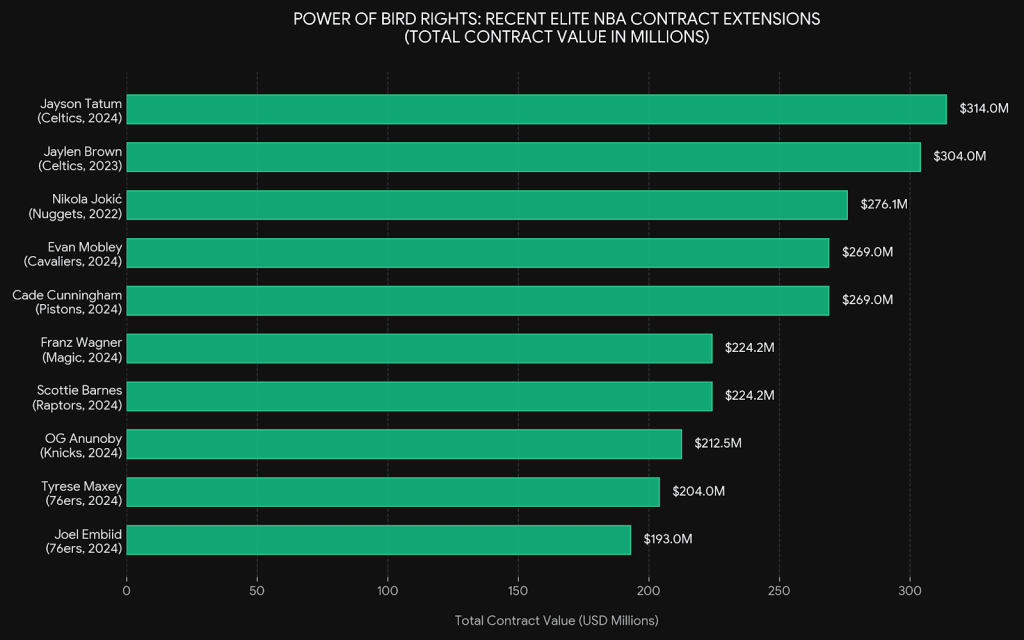
The Denver Nuggets utilized the Designated Veteran Exception, powered entirely by Full Bird Rights, to lock down Jokić to a 5-year, $276 million supermax contract.
As a small-market franchise operating under distinct financial baseline restrictions, Denver used the structural mechanism to completely outbid the open market. By using Bird Rights, the Nuggets guaranteed Jokić the maximum allowable 8% annual salary compounding raises, an economic advantage that outside free-agent suitors are legally prohibited from replicating (capped at 5%).
Jayson Tatum: Full Bird Rights, Boston Celtics (2024)
The absolute pinnacle of Bird Rights leverage in the modern NBA finance era. Following Boston’s 2024 championship run, the Celtics utilized Full Bird Rights to sign Tatum to a historic 5-year, $314 million supermax extension. Because Tatum met the continuous service time requirement, Boston was legally permitted to bypass the rigid constraints of the NBA’s First and Second Luxury Tax Aprons to secure their core asset.
This deal, paired with teammate Jaylen Brown’s $304 million Bird Rights contract, proves how franchises can sustain championship rosters despite a highly punitive, restrictive collective bargaining agreement.
Tyrese Maxey: Full Bird Rights, Philadelphia 76ers (2024)
The 76ers deliberately delayed Maxey’s 5-year, $204 million contract extension to exploit a loophole involving his low “cap hold.”
Because Philadelphia held his Full Bird Rights, they were able to use their active, raw cap space during the 2024 free agency period to sign marquee external free agents like Paul George first. Once their cap room was completely exhausted, the front office then invoked Maxey’s Bird Rights to legally blow past the salary cap ceiling to re-sign him, effectively multiplying their total roster asset wealth.
How Bird Rights Apply Across Sports and Leagues
🎓 NCAA / NIL Athletes
Bird Rights do not exist in college sports or collegiate Basketball, and no equivalent mechanism exists under NCAA rules.
College athletes do not sign professional contracts, operate under no salary cap, and cannot be retained through cap-based exceptions.
NIL-era roster retention works entirely differently, through collective NIL deal structures, multi-year scholarship commitments, and transfer portal regulations; none of which resemble the Bird Rights framework in any structural sense.
An NIL collective offering a player incentives to stay is a market-based arrangement, not a cap exception, and carries entirely different financial and eligibility implications.
🏈 NFL
No true Bird Rights equivalent exists in the NFL. The NFL uses a hard cap rather than the NBA’s soft cap, which fundamentally changes the retention dynamic, there’s no mechanism to go over the cap to keep a player the way the NBA allows.
The NFL’s primary retention tools are the franchise tag and transition tag, which give teams the right to place a one-year tender on a player, preventing them from leaving as an unrestricted free agent.
Franchise tags are blunt, expensive, and structurally different from Bird Rights; they bind a player for one year rather than offering multi-year security, and they generate significant labor friction.
⚾ MLB
MLB uses arbitration and service time as its primary pre-free-agency retention mechanisms, along with qualifying offers for eligible free agents.
None of these are direct Bird Rights equivalents, but the service-time system serves a comparable purpose in the pre-free-agency window, teams control player rights based on years of service before a player reaches unrestricted free agency. Once a player is a true free agent, no retention exception comparable to Bird Rights exists in baseball.
🏒 NHL
The NHL uses Restricted Free Agent (RFA) status and qualifying offers as its retention mechanisms.
An RFA can only leave via an offer sheet from another team, which the original team has the right to match, structurally closer to a Bird Rights concept than the NFL or MLB mechanisms, since it also gives the original team priority in retention.
The key difference is that RFA matching is binary (match or lose), while Bird Rights give teams the ability to exceed cap constraints entirely, which qualifying offer matching in the NHL does not.
⚽ MLS / International Soccer
No Bird Rights equivalent exists in soccer.
MLS uses Homegrown Player designations for academy products, which allow clubs to sign and retain locally developed players without exposing them to the allocation process; a retention mechanism, but one based on player development status rather than service time and cap flexibility.
International soccer uses transfer fees rather than salary cap mechanics, making the framework incompatible with a Bird Rights-style system.
Why Bird Rights Matter for NBA Athletes & Agents to Understand
Bird Rights change the fundamental economics of talent retention in the NBA, and understanding them is essential to understanding why NBA rosters look the way they do:
- They give teams that develop players a structural financial advantage over every outside competitor
- They allow franchises to maintain continuity despite the NBA’s punishing luxury tax structure
- They incentivize players to stay with one team by creating financial terms no outside team can legally replicate
- They’re the primary reason NBA dynasties are possible at all under a salary cap system
- They reward teams for drafting and developing talent rather than simply acquiring established stars in free agency
For agents, understanding which tier of Bird Rights their client has earned, and what the team they’re leaving can legally offer versus what any outside team can offer, is one of the most fundamental pieces of salary negotiation in the entire league.
FAQs
What are Bird Rights in the NBA and why are they called that?
Bird Rights are a salary cap exception that allows NBA teams to re-sign their own players even if doing so exceeds the salary cap.
They’re named after Larry Bird, whose early-1980s contract situation with the Boston Celtics created the rule’s legacy when the NBA first formalized this retention mechanism.
How long does a player need to be with a team to earn Full Bird Rights?
Three consecutive seasons without being waived or traded. If a player is traded or waived at any point during that window, their Bird Rights status resets or downgrades.
Can any team in the NBA use Bird Rights to sign a player?
No. Bird Rights can only be used by the team the player has been continuously with for the required service period. No outside team can use another team’s Bird Rights or offer comparable terms under the cap rules.
Do Bird Rights exist in other Leagues like the NFL, MLB, or NHL?
No direct equivalent. The NFL uses franchise and transition tags, MLB uses arbitration and service time, and the NHL uses restricted free agent qualifying offers. None of these allow a team to exceed the salary cap the way NBA Bird Rights do.
Why do Bird Rights matter for NBA dynasty building?
Because they allow a team to keep its best players regardless of cap position. The Warriors keeping Curry, the Celtics keeping Tatum, and the Bucks keeping Giannis were all made possible by Bird Rights giving those teams financial terms no outside franchise could legally match.
Disclaimer: This article contains general financial information for educational purposes and does not constitute professional advice.