
The 2025 NBA Finals produced one of the craziest “small-market” showdowns in decades. While most of us know how it ended: OKC winning their first championship after an ACL tear from Pacers superstar Tyrese Haliburton in game 6; it also has one strangest financial stories in league history.
The Oklahoma City Thunder took down the Indiana Pacers in a Game 7 that pulled the biggest single-game TV audience in six years. But look closer at the spreadsheet and you’ll find that the full seven-game series averaged just 10.27 million viewers, the least-watched Finals of the century outside the COVID bubble. Two small-market powerhouses meant traditional TV numbers dragged for six straight games before Game 7 completely flipped the script.
That friction, a historically low series baseline colliding with a monster Game 7 ad surge, is where the real story lives. Forget the lazy “small markets kill ratings” narrative; here’s where the actual money came from.
Media Rights & Broadcasting
The NBA enters this new streaming era carrying a ~$76 billion/11-year broadcasting agreement, secured ahead of the 2025-26 season and bringing on Disney (ESPN/ABC), NBC, and Amazon Prime Video, replacing the league’s longtime TNT exclusive broadcasting partnership.
That deal wasn’t fully in effect for the 2025 Finals themselves, but it’s the financial backdrop shaping every projection about what future Finals will be worth to the league and its broadcast partners.
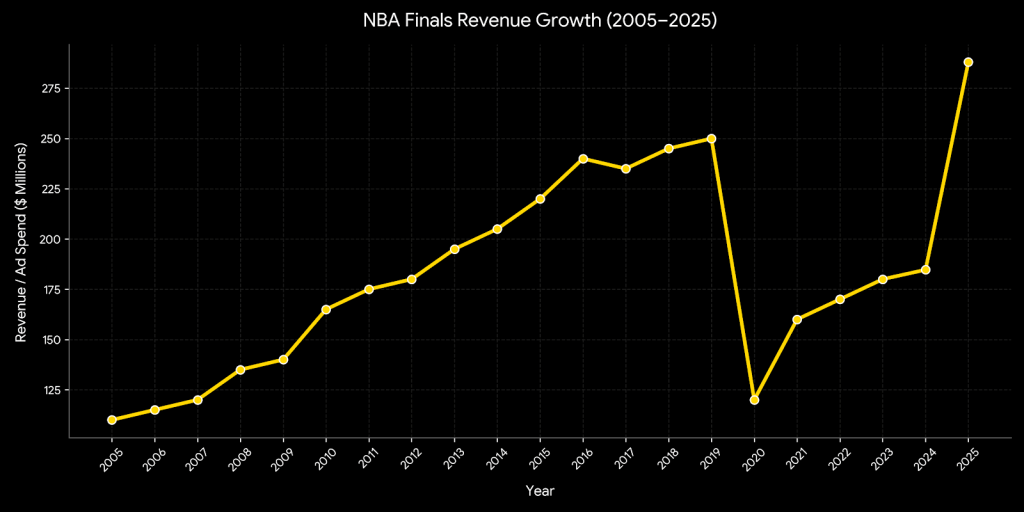
For the 2025 series specifically, the actual sourced number worth paying attention to is narrower and more useful than a vague total. Disney’s in-game advertising revenue for the Finals approached ~$300 million, driven heavily by the Game 7 spike after a series that had underdelivered on ratings through the first six games.
That’s ad revenue for the broadcast specifically, not the league’s total Finals-related income across every stream, but it’s a real, attributed figure, which makes it more useful than a guess.
Game 7 alone averaged ~16.35 million viewers (finalized at ~16.61 million), peaking at ~19.58 million in the closing minutes, the biggest single-game NBA audience in six years. But, the six games before it never crossed 10 million viewers, a genuinely rare stretch for a Finals series.
Combined Indianapolis and Oklahoma City television markets account for barely 1.6% of the national viewing base, which explains the drag on the full-series number even as Game 7 broke out.
One number that did land at record levels regardless of TV ratings: the NBA reported ~5 billion views across social media platforms during the Finals, up 215% year-over-year, a reminder that television ratings increasingly undercount how the league actually reaches fans, especially younger ones consuming clips rather than full broadcasts.
Ticket Sales & Gameday Revenue
Finals tickets can run up to 200% more than regular-season pricing, a significant boost to gameday revenue for both hosting franchises. Specific 2025 Finals ticket figures aren’t publicly disclosed, but teams that reach the Finals reliably see a real spike in both ticket sales and the secondary revenue that comes with it, parking, concessions, premium hospitality packages.
Playoff Bonuses: What the Players Actually Took Home
This is the part that connects directly back to the athletes actually playing the games, and it’s worth being precise about since most coverage rounds the numbers loosely.
The league’s total 2025 playoff bonus pool reached $34.7 million, up from the prior year. Bonuses are distributed based on regular-season seeding and postseason advancement, meaning a team’s payout builds cumulatively the deeper they go.
| Achievement | Bonus |
|---|---|
| Best record in NBA (Thunder) | $869,345 |
| Best record, Western Conference | $761,000 |
| First round participation | $466,000 |
| Conference semifinals | $568,000 |
| Conference finals | $951,000 |
| NBA Finals runner-up (Pacers) | $3,803,000 |
| NBA Finals champion (Thunder) | $8,805,000 |
Stack all of it together and the Thunder’s full playoff run generated a team total north of $12.4 million, working out to roughly $828,000 per player on a standard 15-man roster split. That’s a real, meaningful bonus, and for a player on a rookie-scale or minimum contract, it can functionally double or triple their season’s income in one payout.
Merchandise & Sponsorships
Winning teams typically generate an additional $5-10 million in merchandise sales in the immediate aftermath of a championship, jerseys, hats, and championship gear moving fast while the moment is fresh. The NBA’s overall sponsorship revenue hit a record $1.62 billion for the 2024-25 season, with jersey patch sponsorships now a meaningful contributor to that total, a revenue category that didn’t even exist in the league a decade ago.
Why This Actually Matters Beyond One Series
Here’s the part that connects the media deal, the bonus pool, and the sponsorship number into something worth understanding, not just admiring.
Under the NBA’s Collective Bargaining Agreement, players are guaranteed roughly a 50/50 split of Basketball-Related Income (BRI), the pooled revenue figure that includes media rights, ticket sales, merchandise, and sponsorships.
When Finals revenue climbs, whether through a record ad haul on a Game 7 spike or a growing sponsorship category like jersey patches, BRI climbs with it, and the salary cap the following season climbs proportionally.
That means a rookie entering the league next year is negotiating against a bigger financial pie specifically because this series existed, whether or not the full seven games drew a big television audience.
The Finals aren’t just a basketball event that generates a one-time payday. They’re a direct input into the cap math that determines every young player’s earning power for years afterward.
Bottom Line
The 2025 NBA Finals is a case study in how modern sports revenue doesn’t move in a straight line with ratings anymore. A historically under watched series still generated real, attributed money, Disney’s roughly $300 million in ad revenue, a record 5 billion social views, and a $34.7 million playoff bonus pool, because one dominant Game 7 and a growing digital footprint can outweigh six quiet broadcast nights.
For a young player entering the league, the lesson isn’t about ratings at all. It’s that the NBA’s revenue-sharing structure means the league’s ability to monetize a single event, even an imperfect one, directly shapes the size of every rookie contract and max extension that follows.
Understanding how that money actually moves, not just cheering for the team that wins it, is what separates a fan from someone who understands the business they’re watching.
2025 NBA Finals Revenue FAQs
How much did Disney make from the 2025 NBA Finals?
Disney’s in-game advertising revenue for the Finals broadcast approached $300 million, per Sportico, driven largely by a Game 7 ratings spike that offset a historically quiet first six games of the series.
How much money did the Thunder players earn for winning the championship?
The Thunder’s full playoff run, including their championship bonus, totaled just over $12.4 million in team bonuses, working out to roughly $828,000 per player across a standard 15-man roster.
Was the 2025 NBA Finals actually well-watched?
Mixed. The full seven-game series averaged just 10.27 million viewers, the least-watched Finals series of the century outside the COVID years, but Game 7 specifically drew 16.61 million viewers, the biggest single NBA game audience in six years.
How does NBA Finals revenue affect player salaries league-wide?
Under the NBA’s Collective Bargaining Agreement, players receive roughly 50% of Basketball-Related Income, which includes media rights, ticket sales, merchandise, and sponsorships. When Finals-driven revenue rises, it raises BRI, which raises the salary cap for the following season, directly increasing what every player, including incoming rookies, can be paid.
What’s the NBA’s new media deal worth?
The NBA’s current broadcasting agreement is valued at approximately $76 billion over 11 years, beginning with the 2025-26 season, and includes partnerships with Disney (ESPN/ABC), NBC, and Amazon Prime Video, replacing the league’s prior deal with TNT.
Next Reads
- Inside the Thunder’s NBA Championship Parade
- Shai Gilgeous-Alexander’s $285M Contract: What the NBA’s Highest-Paid Player Actually Pockets
- Clippers-Nuggets 2025 NBA Playoffs Game 7 Generated Record Playoff Revenue
- What NCAA’s New Betting Rules Mean for Future Gambling Revenue
- Canelo vs. Crawford Revenue & Purse Projections
Disclaimer: This article contains general financial information for educational purposes and does not constitute professional advice. APSM estimates are derived from publicly available information, tax assumptions, finance modeling, and industry-standard fee structures. Actual earnings may vary based on residency elections, private contract provisions, image/media rights agreements, bonuses, and tax filings.