

Jayson Tatum signed the largest contract in NBA history in July 2024, a five-year, $314 million supermax extension with the Celtics. Less than a year later, he tore his Achilles during the 2025 playoffs and faced the kind of injury that ends careers, or at minimum forces a complete reset of how a player thinks about their future.
He came back from it in 298 days, one of the fastest Achilles recoveries in NBA history, and returned to the court averaging nearly 20 points a game in his first four contests back this season. That part of the story gets the headlines. The part that doesn’t get nearly enough attention is what he did with the money in between. The answer?
Nothing. He still lives in the same house.
Property Details
Tatum bought this home in 2019, three years into his career, reportedly using endorsement income rather than his NBA salary to fund the purchase, itself a disciplined move most athletes don’t think to make.
He’s lived there ever since, through his first All-NBA seasons, through the 2024 championship run, through signing the richest contract in league history, and through recovering from a torn Achilles.
Primary features of the home include:
- Location: 79 Webster Park, West Newton, Massachusetts
- Purchase Cost: Approximately $2.4 million (2019), now estimated in the $6+ million range
- Square Footage: 4,859 sq ft
- Bedrooms/Bathrooms: 4 bedrooms, 4.5 bathrooms
- Key Features: Gothic architecture built in 1848, wooded half-acre lot, a backyard basketball court, situated in the historic Webster Park district

Residency
Market Size
Unlike flashier luxury enclaves in Miami or Beverly Hills, West Newton operates as a quiet, affluent suburb roughly 10 miles west of Boston, prioritizing long-term privacy and architectural pedigree over superficial flash. Newton’s broader housing market trades well above the Massachusetts state average, with properties in the Webster Park Historic District commanding distinct pricing power due to strict zoning laws and limited inventory of homes for sale.
Average Home Price
Newton’s broader housing market runs well above the Massachusetts state average , with homes in the Webster Park Historic District specifically carrying a premium for the area’s architectural character and lot sizes, with an average property value of ~$1.2 million.
Residency Rules
As a Celtics player, Tatum’s tax home is tied to the state of Massachusetts, which taxes income differently than a no-tax state would, worth understanding in context of what he actually pays.
The state levies a 5% flat state-income-tax rate on its residents, however when you are a million-dollar+ annual earner such as Tatum, the states adds on an additional 4% in surtax. This makes Tatum’s effective income tax rate ~9% annually, on top of the 37% he will pay to the IRS.
Property Tax Rate
Massachusetts carries an effective property tax rate that runs meaningfully higher than the national average (~1.2-1.4%), a real, ongoing cost on a property of this value, even one that’s relatively modest by superstar-athlete standards.
Cost of Living
Greater Boston is one of the more expensive metro areas in the country, but Newton specifically offers a quieter, more private alternative to the kind of ultra-visible luxury enclaves other stars gravitate toward.
Appreciating Asset or Depreciating Pit?
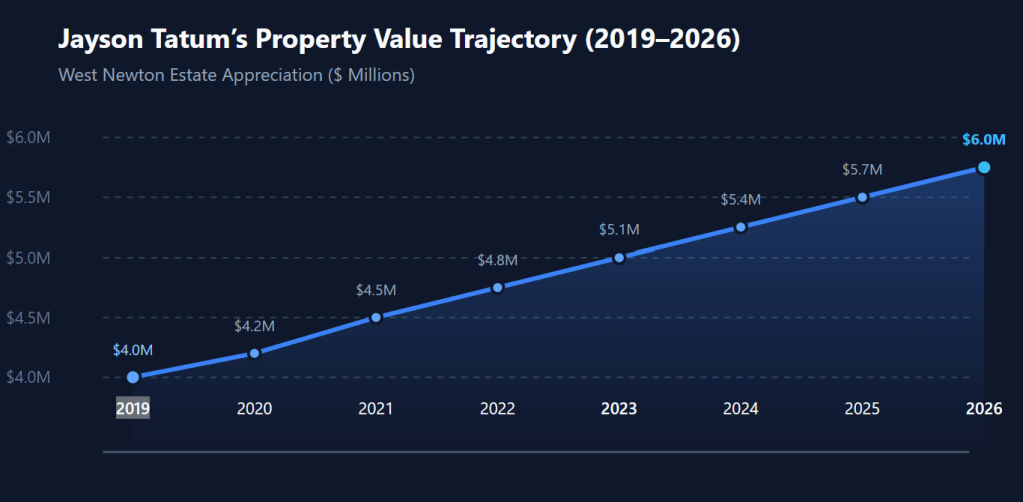
This is where Tatum’s restraint actually pays off financially, not just optically. A $2.4 million purchase in 2019 that’s now valued at ~$6 million represents genuine appreciation, somewhere in the range of 8-10% annually compounded over seven years, solidly in line with strong long-term real estate appreciation rather than a speculative luxury purchase betting on a single hot market cycle.
Compare that to what a $17-20 million trophy property in a market like Beverly Hills or Miami actually returns. Ultra-luxury real estate at that price tier frequently appreciates more slowly in percentage terms than mid-tier luxury homes, carries dramatically higher carrying costs, property tax, insurance, maintenance, security, and is far less liquid if an athlete ever needs to sell.
A $4-6 million home in a stable East Coast suburb has actually outperformed what many flashier athlete real estate purchases deliver once carrying costs are factored in.
Compared to renting in the same market
Renting an equivalent property in Newton would likely run Tatum a meaningful monthly cost with zero equity building, while his 2019 purchase has both appreciated and functioned as his actual home for going on seven years. The math clearly favors ownership here, and has for years.
Net worth positive?
Unambiguously yes. A home that’s roughly doubled in value while serving as a primary residence, with no other real estate debt or scattered luxury purchases dragging down the balance sheet, is about as clean a real estate position as an athlete at Tatum’s earning level could have.
Player Real Estate Portfolio Value Estimation
- Confirmed Real Estate Holdings: ~$4-6 million (single property)
- Estimated Total Net Worth (2026): ~$80 million, driven primarily by NBA earnings and deals with Jordan, Gatorade, Subway, and others
This is a genuinely small real estate allocation relative to a $314 million contract, and that’s exactly the point.
Tatum’s real estate exposure represents roughly just 5-7% of his estimated net worth, a conservative, low-risk allocation compared to athletes who sink a much larger percentage of their wealth into real estate, often across multiple properties in multiple volatile luxury markets.
Why This Matters
The lesson here isn’t “don’t buy nice things.” It’s that real estate discipline, buying one appreciating asset early, staying in it, and not chasing a bigger trophy property every time a new contract lands, is a genuinely underrated wealth-preservation strategy.
Tatum has had every opportunity and every dollar available to buy a $20 million mansion in literally any market in the country since 2024. He hasn’t. That restraint, especially through a career-threatening injury where most people would want to make a major life change, is worth more as a case study than almost any athlete mansion purchase this site could cover.
Bottom Line
Jayson Tatum holds the largest contract in NBA history and still lives in a house he bought for $2.4 million back in 2019. That’s not a lack of ambition, it’s financial discipline most athletes at his income level never demonstrate. A single, appreciating, low-carrying-cost property has outperformed what a scattered luxury portfolio likely would have, and it’s done it without a single headline-grabbing purchase.
Sometimes the smartest real estate move an athlete makes;
is the one they don’t.
Jayson Tatum’s Real Estate FAQs
How much is Jayson Tatum’s house worth?
Purchased in 2019 for approximately $2.4 million, the property is currently estimated between $4 million and $6 million, representing solid, steady appreciation over roughly six years of ownership.
What is Jayson Tatum’s contract worth?
A five-year, $313.9 million supermax extension signed with the Boston Celtics in July 2024, the largest contract in NBA history at the time of signing, running through the 2029-30 season.
How did Jayson Tatum recover from his Achilles injury?
Tatum tore his Achilles during the 2025 NBA Playoffs and returned to play in just 298 days, one of the fastest recovery timelines for that injury in NBA history, averaging nearly 20 points per game across his first four games back.
Why does Jayson Tatum still live in a $4 million house despite his $314 million contract?
By most reporting, it reflects a deliberate, disciplined financial approach rather than a lack of options. Tatum has chosen to keep one meaningful, appreciating asset rather than build out a scattered luxury real estate portfolio, a strategy that’s paid off both financially and in terms of long-term stability through a major career injury.
Next Reads
- Inside Tyrese Haliburton’s $3.2 Million Indianapolis Mansion
- How Much Boston Spent to Host the 2026 FIFA World Cup
- Christian Pulisic Real Estate Portfolio Value
- David Pastrnak Boston Bruins Contract
- Juan Soto Signs the Biggest Contract in MLB History
Disclaimer: This article contains general financial information for educational purposes and does not constitute professional advice. APSM estimates are derived from publicly available information, tax assumptions, finance modeling, and industry-standard fee structures. Actual earnings may vary based on residency elections, private contract provisions, image/media rights agreements, bonuses, and tax filings.