
If you are searching for where your NBA team streams in 2026-27, the answer depends almost entirely on which market you live in.
The more interesting answer is what happened to the money. The NBA entered the 2026-27 season with one of the richest national media packages in American sports and one of the most fragmented local television systems it has ever had.
At the national level, Disney, NBCUniversal and Amazon are in the second season of 11-year agreements reportedly worth approximately $76 billion combined, or close to $6.9 billion per year.
ESPN/ABC, NBC/Peacock and Prime Video now distribute national NBA games across television and streaming through 2035-36.
Locally, the market moved in the opposite direction. Main Street Sports Group, the operator behind the FanDuel Sports Network regional channels, collapsed after the 2025-26 season.
Thirteen NBA teams that had been receiving local rights fees ranging from roughly $11 million to $55 million per year suddenly needed another way to distribute their games.
Some went to DAZN.
Some returned to free over-the-air television.
Atlanta added Prime Video, other mid-market franchises built team-controlled streaming products and the Miami Heat went even further and made their local direct-to-consumer stream free. The result is not one new NBA television model. It is a live experiment involving almost every possible model at once.
While APSM focuses on the economics behind sports, is it not nice to have been brought back to the traditional broadcasting era? Only this time, it’s more complicated, more expensive, the commercials aren’t fun to watch and the overall experience is worse.
The Net Reality of the NBA streaming era is that the biggest guaranteed media-rights payment is no longer automatically the best media deal.
- Reach matters.
- Advertising inventory matters.
- First-party subscriber relationships matter.
- Production costs matter.
- Ticket sales, merchandise, sponsorship exposure and fan acquisition matter.
With the NBA preparing an aggregated local streaming package for as early as the 2027-28 season, several teams appear willing to sacrifice part of today’s local-rights check in exchange for more fans and greater leverage tomorrow.
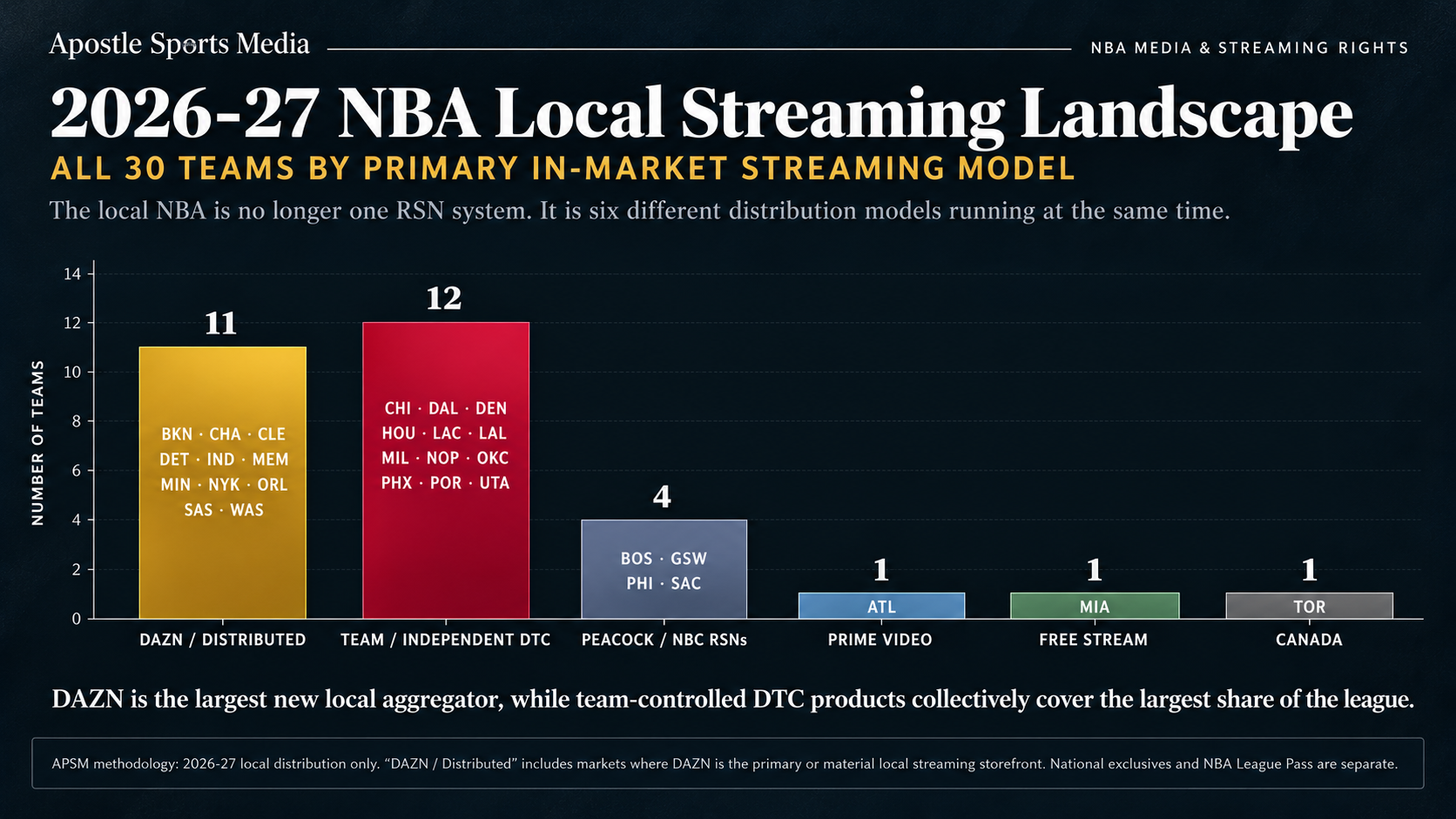
NBA Local Streaming & Broadcast Rights Snapshot
The table below is about local, in-market games.
Games selected as national exclusives on ABC/ESPN, NBC/Peacock or Prime generally supersede the local feed.
NBA League Pass remains primarily the out-of-market product.
| Team | Local Stream | TV / OTA Home | Rights Economics |
|---|---|---|---|
| Atlanta Hawks | Prime Video | WANF / Peachtree Sports Network / Gray | Gray: reported ~$8M–$10M; Prime private |
| Boston Celtics | Peacock + NBC Sports Boston | NBC Sports Boston | Private / legacy RSN model |
| Brooklyn Nets | DAZN / YES | YES Network | Private |
| Charlotte Hornets | DAZN | WSOC 9 / TV64 | Reported ~$7M–$8M OTA + ~$1M–$2M DAZN |
| Chicago Bulls | CHSN+ | Chicago Sports Network | Team-owner / JV economics |
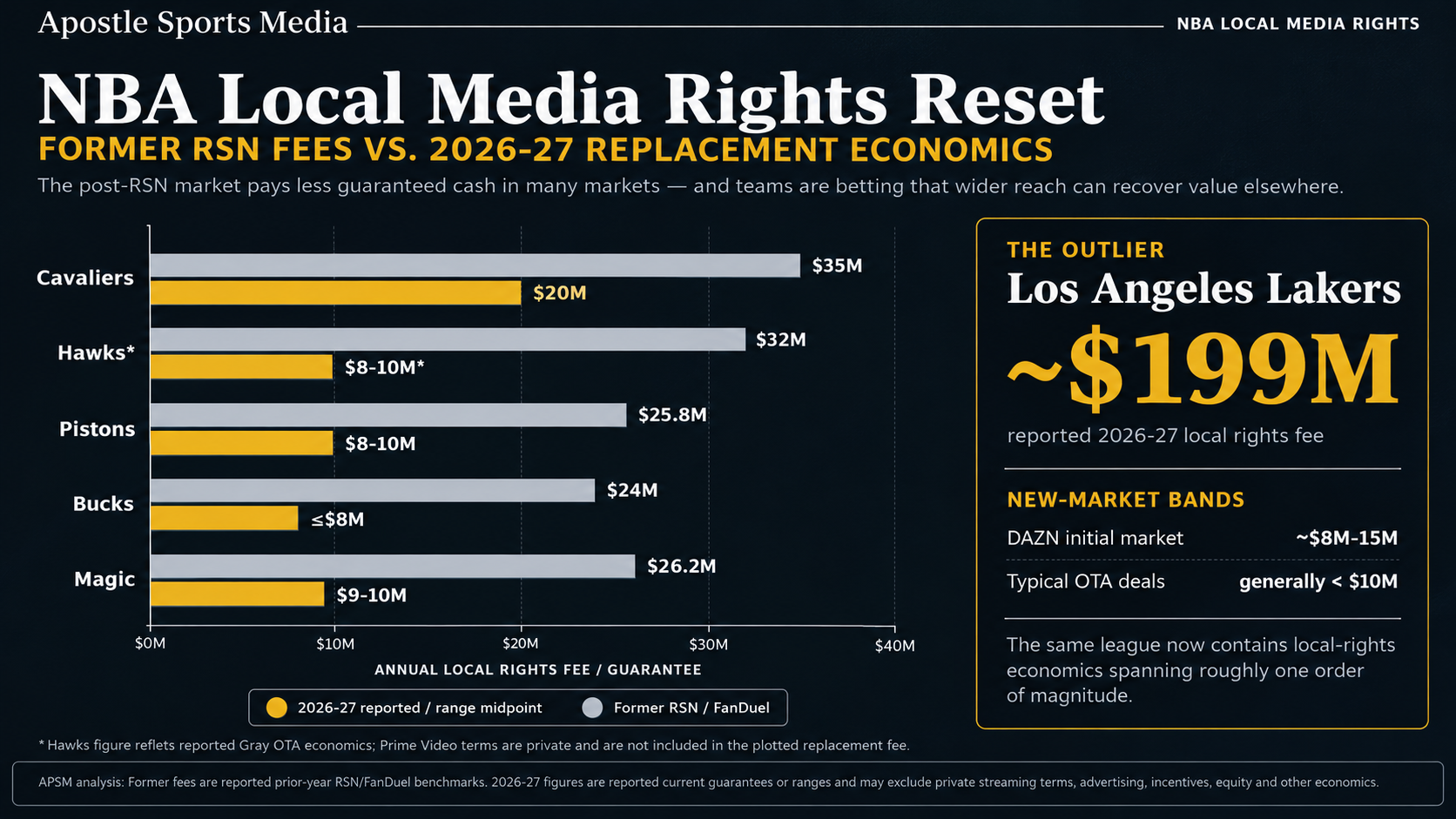
| Cleveland Cavaliers | DAZN | Gray / Rock Entertainment simulcasts | Reported ~$20M annual guarantee |
| Dallas Mavericks | MavsTV+ | KFAA / WFAA / TEGNA | Private |
| Denver Nuggets | Altitude+ | Altitude + 9NEWS / KTVD | KSE-owned media economics |
| Detroit Pistons | DAZN | WMYD Detroit 20 / Scripps | Reported ~$8M–$10M OTA |
| Golden State Warriors | Peacock + NBC Sports Bay Area | NBC Sports Bay Area | Private / legacy RSN model |
| Houston Rockets | SCHN+ | Space City Home Network | Rockets / Astros JV economics |
| Indiana Pacers | DAZN | CBS4 / FOX59 simulcasts | Private; DAZN market benchmark ~$8M–$15M |
| LA Clippers | ClipperVision | MVPD / vMVPD + KTLA | Private; prior FanDuel fee ~$34.6M |
| Los Angeles Lakers | Spectrum SportsNet+ | Spectrum SportsNet | Reported ~$199M rights fee |
| Memphis Grizzlies | DAZN | ABC24 simulcasts | Private; prior FanDuel fee ~$11.4M |
| Miami Heat | Local 10 Plus Platinum | WPLG Local 10 | Undisclosed; reportedly above typical OTA market |
| Milwaukee Bucks | Bucks+ | MY24 + statewide affiliates | Reported at or below typical ~$8M OTA range |
| Minnesota Timberwolves | DAZN | KARE 11 simulcasts | Private; reported high-end DAZN structure |
| New Orleans Pelicans | Pelicans+ | GCSEN / FOX 8 | Private |
| New York Knicks | DAZN / MSG+ | MSG Networks | Private |
| Oklahoma City Thunder | Thunder+ | Griffin Media / KSBI / KQCW | Private; prior FanDuel fee ~$16.7M |
| Orlando Magic | DAZN | MagicTV 27 / WFTV 9 / Cox | Reported ~$8M OTA + ~$1M–$2M DTC |
| Philadelphia 76ers | Peacock + NBC Sports Philadelphia | NBC Sports Philadelphia | Private / legacy RSN model |
| Phoenix Suns | Suns+ | Arizona’s Family | Private |
| Portland Trail Blazers | BlazerVision | Rip City TV / KUNP / KATU | Private |
| Sacramento Kings | Peacock + NBC Sports California | NBC Sports California | Private / legacy RSN model |
| San Antonio Spurs | DAZN | WOAI 4.2 OTA package | Private; prior FanDuel fee ~$19.9M |
| Toronto Raptors | TSN+ / Sportsnet+ | TSN / Sportsnet | Integrated Canadian rights model |
| Utah Jazz | Jazz+ / SEG+ | KJZZ 14 | SEG-controlled media economics |
| Washington Wizards | Monumental+ / DAZN | Monumental Sports Network | MSE-controlled media economics |
Prime Video Local Streaming
Amazon already owns one of the NBA’s three major national packages, and now it has entered the local market too.
Atlanta Hawks | Prime Video + Gray Media
The Hawks became the first NBA team to make Prime Video the exclusive streaming destination for its local broadcasts. Prime members located inside Atlanta’s television territory can stream the team’s locally distributed games without purchasing another team-specific subscription.
The same 74-game regional slate is also distributed through Gray Media’s WANF Atlanta News First, Peachtree Sports Network and affiliates across the Southeast.
The financial terms of Amazon’s piece are private.
Gray’s television agreement has been reported in the approximate $8 million-$10 million gross annual rights fee range, dramatically below the roughly $32 million the Hawks were scheduled to receive from the FanDuel Sports Network system in 2025-26.
That looks like a loss if the only column being measured is guaranteed local media rights. It is not the only column. Gray’s prior Hawks simulcasts generated meaningfully higher local ratings, and the new agreement massively widens the available audience.
Amazon simultaneously puts the stream inside a product millions of households already pay for. The Hawks can attempt to recover part of the lost rights fee through more valuable advertising inventory, sponsorship packages, merchandise, ticketing and fan acquisition.
APSM Media Verdict: Favorable, with upside.
Atlanta is arguably the most important local experiment in the league this season because it combines the reach of OTA with the frictionless scale of a global subscription platform. If Amazon can prove that model commercially, Atlanta will not be its last NBA local property.
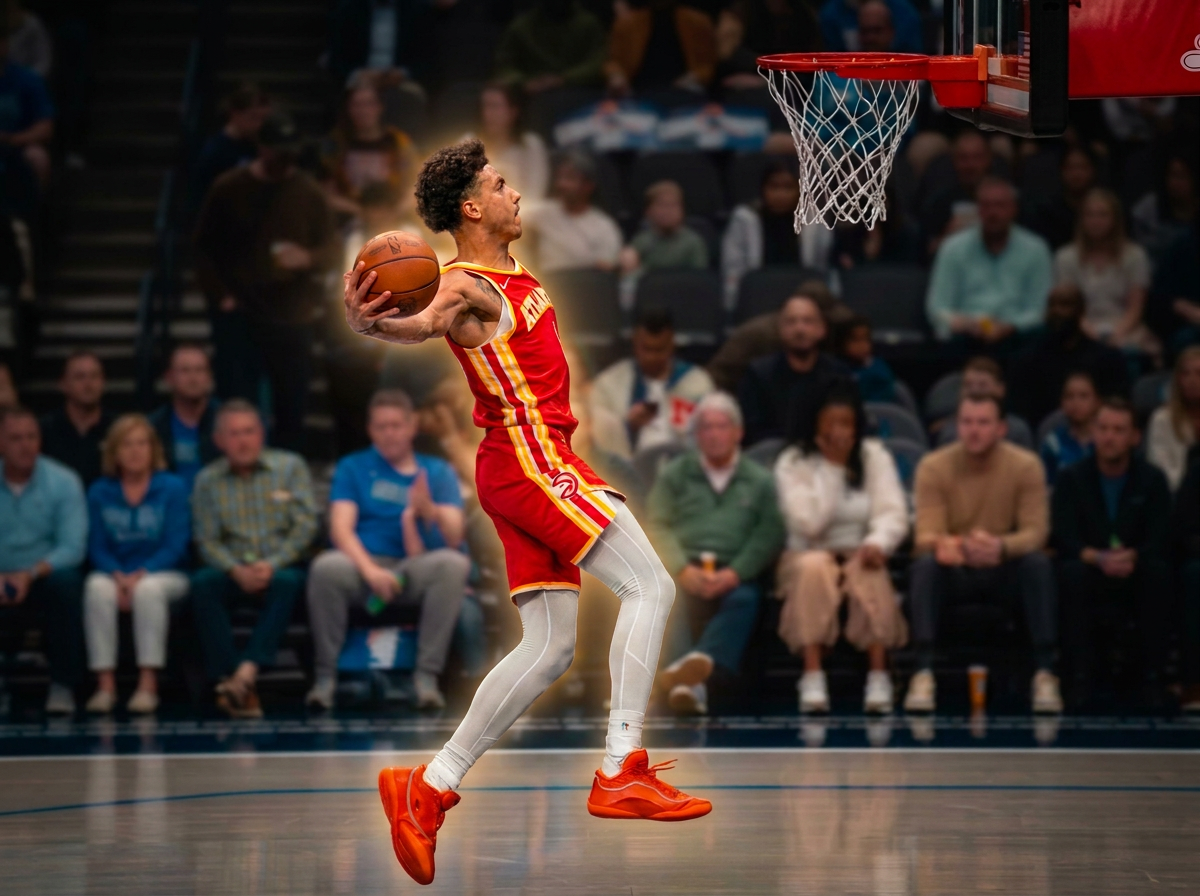
The Hawks are an entirely new team in the post-Trae Young era. Their young core, led by rising star Jalen Johnson, now has a chance to move Atlanta out of rebuild mode and back toward meaningful playoff runs.
DAZN Is Building the NBA’s Largest New Local Streaming Portfolio
DAZN is the biggest immediate winner from Main Street’s collapse. The company entered the offseason pitching former FanDuel Sports Network teams on guarantees generally reported in the $8 million-$15 million annual range.
Those figures are below many of the RSN payments teams were accustomed to, but DAZN offers something the old RSNs increasingly could not: a digital-first product with a direct subscription model and enough capital to guarantee a meaningful rights fee.
There are two distinct DAZN models.
Five teams gave DAZN primary or exclusive local digital rights. Several others use DAZN as their streaming storefront while maintaining separate OTA or RSN relationships.
Those are not financially identical agreements.
Cleveland Cavaliers | DAZN
Cleveland is the strongest public example of the DAZN economics. The Cavaliers entered a multi-year agreement making DAZN their direct-to-fan destination. Fifteen games are available free, while the complete local package is sold at roughly $20 per month or $120 per season.
Sports Business Journal reporting subsequently placed Cleveland’s guaranteed rights fee at approximately $20 million annually. The Cavaliers had previously been receiving roughly $35 million per year from the FanDuel Sports Network structure.
That is a material haircut. It is also apparently better than the generic $8 million-$15 million market DAZN initially floated to teams. Cleveland provides a useful benchmark for what a strong team with leverage can extract from a digital-first buyer.
The Cavs have reloaded around much of the same core and are looking to make another run at the East with better chemistry and continuity. Donovan “Spida” Mitchell and James Harden give Cleveland plenty of star power to sell tickets and streaming packages, but replacing Darius Garland’s production will matter if this team expects to make a legitimate title run.

Memphis Grizzlies | DAZN
Memphis follows the same general architecture as the Cavs and other teams that partnered with DAZN.
DAZN carries the local package, while 15 games are also available on TEGNA-owned ABC24 and are free on DAZN during those simulcasts.
The old Grizzlies rights fee was only about $11.41 million, the lowest of the 13 former Main Street NBA clubs. That means Memphis required less replacement revenue than teams such as Miami, Cleveland or the Clippers.
A DAZN structure around the broader market range could therefore come much closer to preserving Memphis’ old local-media economics than it can for a team that previously received $30 million-$50 million.
In the post-Ja Morant era, Memphis has one of the youngest rosters in basketball. The Grizzlies may not have the NBA’s largest market or biggest collection of stars, but a real youth-development experiment gives fans another reason to follow the team as its next core takes shape.
Indiana Pacers | DAZN
Indiana also moved the regional package to DAZN.
The platform carries the Pacers’ local games, with 22 regular-season games placed in front of the paywall and 15 distributed over the air through CBS4 Indy and FOX59. Full subscriptions start around $20 per month or $120 for the season.
The precise rights fee is private. Indiana’s prior FanDuel payment was approximately $17.47 million in 2025-26. That gives APSM a useful economic boundary even when the new contract remains undisclosed.
Indiana was easy to overlook last season with Tyrese Haliburton sidelined, but his return changes the equation. With their superstar back at the controls, the Pacers enter this season as one of the East’s more interesting candidates to make another push toward the Finals.
Minnesota Timberwolves | DAZN
Minnesota gave DAZN its local direct-to-fan package across a huge territory covering Minnesota, Iowa, Nebraska, North Dakota and South Dakota, with partial coverage elsewhere.
Fifteen games are offered free, while the standard product costs roughly $20 monthly or $120 for the season. Industry reporting described Minnesota’s agreement as carrying a high-end rights fee and possible equity component, although the exact dollar value remains private.
That equity possibility is important.
A streaming agreement can compensate a team with more than an annual check. If ownership participates in the platform’s upside, part of the economic value shifts from current revenue into a longer-term asset. That is a different Net Reality than an ordinary RSN rights payment.
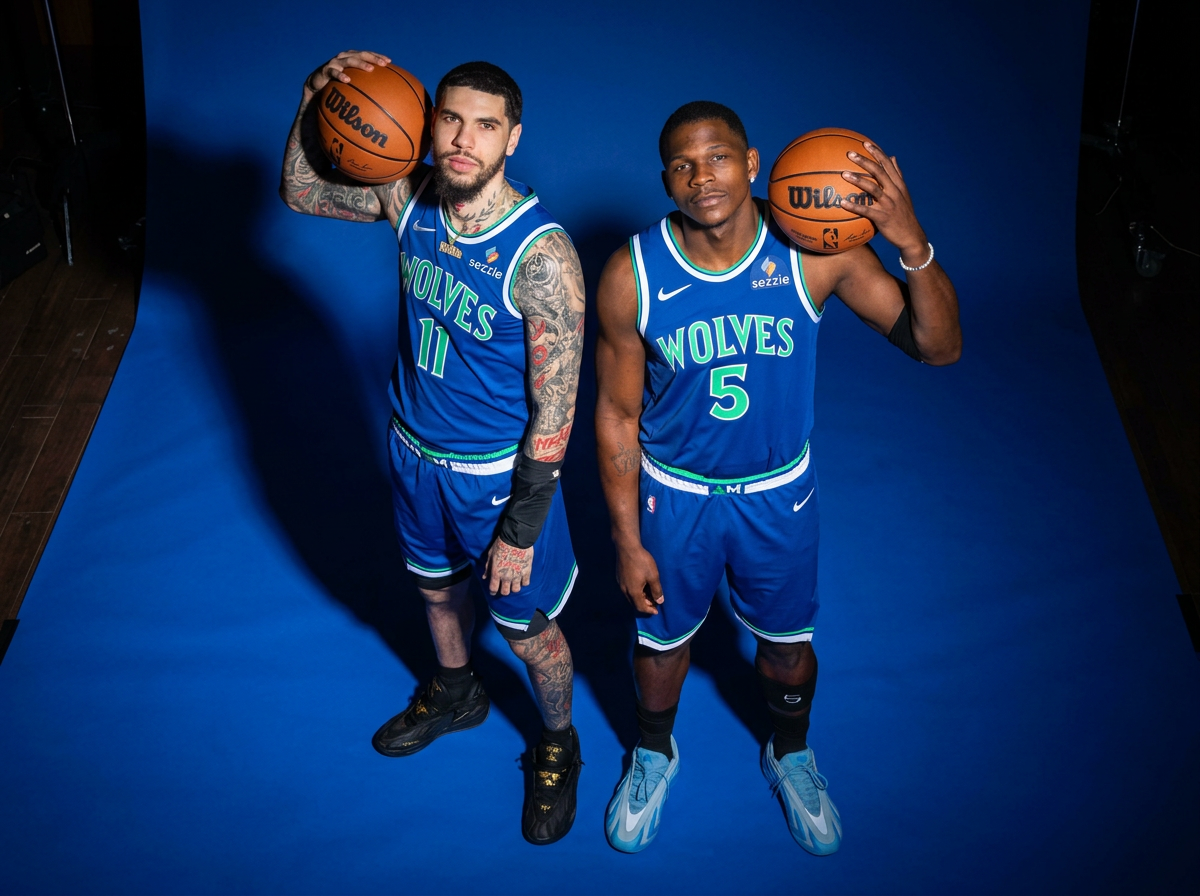
With the additions of LaMelo Ball and Jonathan Kuminga, Minnesota has a very different feel from the gritty underdog teams of recent seasons. The Wolves now have both hype and high-end talent, and that refreshed roster should only help the franchise sell subscriptions and expand interest across its enormous regional footprint.
San Antonio Spurs | DAZN
The Spurs also selected DAZN as their direct-to-fan platform.
DAZN carries the local slate while 22 regular-season games are distributed free through San Antonio television. San Antonio’s prior FanDuel rights fee was approximately $19.92 million.
The precise DAZN guarantee is not public. The Spurs are particularly interesting because Victor Wembanyama gives the franchise national demand beyond the size of its local television market.
That strengthens sponsorship and subscriber economics even if the local guarantee itself does not match the old RSN number.
Orlando Magic | DAZN + Cox Media
The Magic’s structure is one of the easiest to model. Cox Media carries Orlando games free over the air through Magic TV 27 and WFTV 9, while DAZN is the exclusive direct-to-consumer streaming partner.
Industry reporting put the OTA rights fee around $8 million and DAZN’s additional streaming guarantee around $1 million-$2 million.
That suggests roughly $9 million-$10 million in current guaranteed media-rights economics, compared with an old FanDuel payment of approximately $26.19 million.
That is one of the clearest examples of the RSN reset.
Orlando remains a good example of a smaller-market franchise that can create demand by simply putting a good product on the floor. The Paolo Banchero era has not produced a deep playoff run yet, but continued chemistry with Franz Wagner and Desmond Bane could push the Magic into a different tier in the East this season.

Charlotte Hornets | DAZN + Cox Media
Charlotte uses DAZN differently. The Hornets placed their full local television package on WSOC Channel 9 and TV64, while DAZN handles in-market streaming.
Reporting placed the OTA agreement around $7 million-$8 million annually, with DAZN expected to contribute another roughly $1 million-$2 million minimum guarantee for streaming.
That produces an apparent local-rights package somewhere in the neighborhood of $8 million-$10 million before advertising and other commercial benefits.
Charlotte had received approximately $16.57 million from Main Street in 2025-26. Again, guaranteed cash fell. Distribution expanded.
Charlotte traded away its former franchise centerpiece and committed to Brandon Miller as part of its future. After what has felt like a perpetual rebuild, the Hornets eventually have to turn young talent into wins, and OTA distribution gives the franchise a larger audience to win over when that happens.
Detroit Pistons | DAZN + Scripps
Detroit moved all locally available games to Scripps-owned WMYD Detroit 20, returning Pistons basketball to primarily free local television for the first time since 2005.
DAZN supplies the in-market streaming layer. The old Pistons rights fee illustrates how violent the RSN correction has been.
Detroit reportedly earned $39.36 million as recently as 2022-23. That had fallen to approximately $25.78 million by 2025-26. Industry expectations put the new Scripps payment around $8 million-$10 million, likely toward the lower end.
The Pistons are potentially exchanging $15 million-plus in guaranteed annual media cash for vastly broader distribution and a larger advertising opportunity.
That is not automatically good or bad.
It is a different business.
Jalen Duren created plenty of offseason attention after turning down a reported $200 million offer, but the bigger story is what Detroit can become. With Cade Cunningham developing into a legitimate MVP-level centerpiece, the Pistons have a chance to follow the same basic formula that has revived other overlooked teams: build around real basketball players, win games and let demand follow.
Brooklyn Nets | YES Network Through DAZN
Brooklyn has not abandoned its RSN; YES Network remains the Nets’ television home. What changed is the digital storefront. YES’ direct-to-consumer product is now distributed through DAZN, where fans can purchase access to Nets and Yankees programming.
That is less a rights acquisition than a distribution consolidation. DAZN is becoming the storefront through which an existing sports network sells its product.
Washington Wizards | Monumental+ Through DAZN
Monumental Sports Network remains the Wizards’ regional home. Monumental+ is its DTC product, with additional distribution through DAZN. The existing product already showed why first-party streaming matters.
During 2025-26, Monumental+ reportedly increased direct-to-consumer subscribers 141%, while minutes watched increased 124%. That is the kind of value a simple annual rights fee misses.
The team is not only selling games.
It is building a customer relationship.
The Wizards have spent much of the post-John Wall era near the bottom of the league, but Trae Young, Anthony Davis and rookie AJ Dybantsa give Washington something it has lacked for years: real intrigue. If the new group works, Monumental suddenly has a much more compelling product to distribute.

New York Knicks | MSG+ Through DAZN
The Knicks follow the same basic idea.
MSG Networks still controls the regional television product, while MSG+ is now accessible through DAZN. Fans can also purchase a combined MSG+/YES package covering the Knicks, Nets, Yankees and several NHL teams.
For DAZN, that is strategically valuable even if it does not own the underlying Knicks rights. Every additional major market property makes the app more credible as a future home for the NBA’s centralized local platform.
The Knicks reloaded again, with Mitchell Robinson’s departure to Boston and veteran Andre Drummond stepping into the frontcourt mix. New York now has to prove its recent success was the beginning of something sustainable; rather than one great run during the NBA’s parity era.
Peacock and the Surviving NBC Regional Sports Networks
Not every RSN died. NBCUniversal still operates valuable regional networks in several major NBA markets and has integrated direct-to-consumer access through Peacock.
That creates an unusual combination: legacy regional infrastructure plus a national streaming platform.
Boston Celtics | NBC Sports Boston + Peacock
NBC Sports Boston remains the Celtics’ regional television home. In-market streaming is sold as a Peacock add-on rather than a completely separate team application.
The local rights economics are private.
Boston nevertheless represents exactly why the strongest RSNs survived longer than Main Street’s system: large market, premium franchise, durable distributor relationships and corporate ownership with the ability to connect linear television to a national streaming product.
Boston is looking to return to championship contention with Jayson Tatum healthy again after last season’s Achilles injury. For NBC Sports Boston and Peacock, a healthy superstar and another legitimate title chase are about as strong a local-media product as a regional network can ask for.
Golden State Warriors | NBC Sports Bay Area + Peacock
The Warriors remain on NBC Sports Bay Area, with Peacock now supplying the direct-to-consumer path. Financial terms are private.
Golden State’s Bay Area market and decade-plus of elite commercial demand make it difficult to compare directly with smaller-market teams being forced into $8 million OTA deals.
This is still an RSN model. It simply has a streaming exit ramp.
Stephen Curry and Draymond Green are getting older, Jonathan Kuminga is now in Minnesota, and Golden State is no longer the team that once seemed inevitable every spring.
This season will test both fan loyalty and the front office’s ability to build the next era before the remaining pieces of the dynasty disappear.
Philadelphia 76ers | NBC Sports Philadelphia + Peacock
Philadelphia follows the same structure. NBC Sports Philadelphia remains the regional home while Peacock sells the streaming access.
The economics remain private.
Philadelphia also demonstrates why any future NBA local hub will need to offer real money if it wants every club. Large-market RSN teams are not coming from the same financial baseline as Charlotte, Memphis or Orlando.
Philadelphia spent the better part of a decade looking talented enough to contend without ever quite getting over the hump.
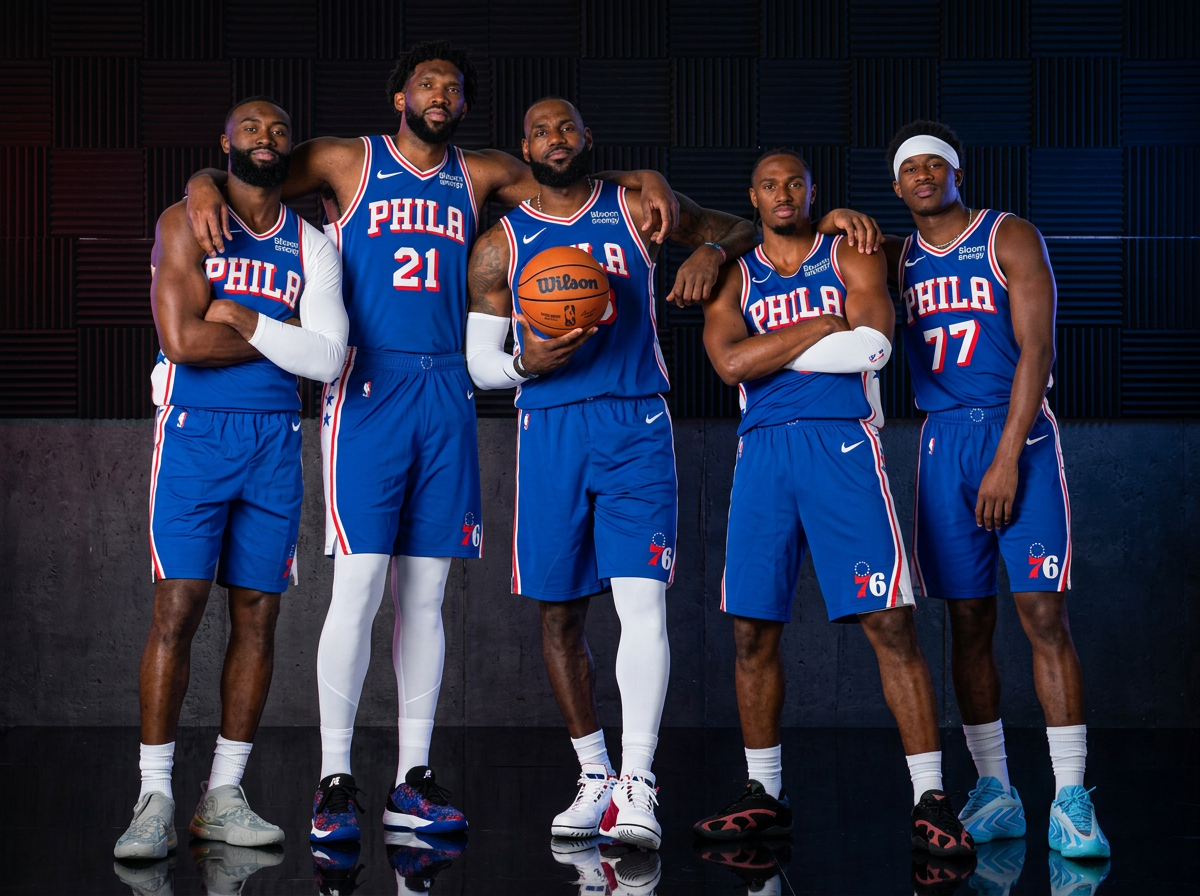
The additions of Jaylen Brown and LeBron James dramatically change both the basketball ceiling and the economics of the new look 76ers: stars at that level do not just improve the product on the floor, they sell tickets, subscriptions, sponsorships and merchandise.
Sacramento Kings | NBC Sports California + Peacock
NBC Sports California continues to carry the Kings, with local digital access sold through Peacock.
Sacramento may eventually make sense inside an aggregated NBA product. For now, the Comcast ecosystem provides an existing linear-plus-streaming solution without forcing the franchise into the short-term media scramble affecting the former Main Street teams.
Sacramento has started to feel like a landing spot for aging contracts rather than a franchise building toward its next great core. In one of the NBA’s smaller markets, that matters financially too. The Kings need a product worth following if they want to maximize the reach and commercial upside of their media platform.
Team-Controlled and Standalone Streaming Platforms
The most important long-term trend may not be DAZN at all. It may be teams taking direct control of the customer. Instead of licensing everything to one RSN, the franchise keeps more control over the product, data, pricing, sponsorship inventory and fan relationship.
Chicago Bulls | CHSN+
The Bulls stream through CHSN+, the digital arm of Chicago Sports Network.
Because CHSN is backed by the ownership groups of the Bulls, Blackhawks and White Sox, this is not a normal third-party rights-fee relationship.
Part of the economic value is internalized through ownership. The club takes more operating responsibility but also keeps more of the upside.
Chicago has not fielded a truly relevant contender in a long time, but the fan base remains enormous and unusually loyal.
That makes the Bulls an interesting test for a team-controlled media model: how much value can a massive sports market create even before the basketball product fully catches up?
Dallas Mavericks | MavsTV+
Dallas uses MavsTV+ alongside free distribution on KFAA, WFAA and additional TEGNA affiliates.
The model has an important strategic advantage: the Mavericks control a branded streaming environment while still placing the game in front of a massive free television audience.
That creates two products from the same game. Free television maximizes reach. MavsTV+ monetizes the customer who wants direct streaming access.
Cooper Flagg has the kind of ceiling that could eventually put him in the conversation for the NBA’s first $1 billion player contract. For that future to become realistic, Dallas has to build a sustainable contender around him; exactly the kind of long-term star power that can make a team-controlled media platform much more valuable.

Denver Nuggets | Altitude+
Denver never really left the regional-network business. Kroenke Sports & Entertainment owns Altitude Sports and supplements the channel with Altitude+, plus a 20-game OTA package on 9NEWS and KTVD.
That vertical integration matters.
The Nuggets’ ownership group controls the team and the media vehicle. There may not be a traditional third-party rights fee to point at because the economic value sits inside the same broader ownership system.
Denver may be a smaller NBA market, but Nikola Jokić and company still carry championship expectations. As long as one of the greatest players of his generation remains in Denver, the Nuggets have a premium basketball product capable of generating demand well beyond the size of the local market.
Houston Rockets | SCHN+
The Rockets and Astros jointly control Space City Home Network. SCHN+ adds the direct-to-consumer layer. Houston therefore resembles Denver more than Cleveland.
Instead of selling the local rights to an outside streamer, ownership participates in the network itself. That increases operational risk but also removes a middleman.
Kevin Durant is still doing Kevin Durant things, while Houston’s younger core continues to develop around him. The Rockets are no longer a team to casually overlook, and sustained contention would make the club’s vertically integrated media model considerably more valuable.
LA Clippers | ClipperVision
The Clippers relaunched ClipperVision as the primary streaming product for their regional games, paired with broader traditional distribution and 10 games on KTLA.
The current economics are private.
The useful benchmark is what disappeared.
Main Street had been scheduled to pay the Clippers roughly $34.59 million in 2025-26. ClipperVision therefore has to be evaluated against more than subscription revenue alone.
Advertising, sponsorship inventory, data ownership and the value of controlling the media product now matter.
Thanks to Kawhi Leanord not actually planting any trees, as well as the front office’s near-sighted mindset, the Clippers were left in an awkward long-term position, but that also creates opportunity for players such as Rui Hachimura and new additions Brandon Ingram and Darius Garland.
Expectations are lower without Kawhi Leonard, which leaves this group with a chance to create its own identity; and perhaps finally give ClipperVision a playoff story that belongs entirely to this era.
Los Angeles Lakers | Spectrum SportsNet+
The Lakers are the outlier that explains why a single NBA local streaming solution is difficult.
Spectrum SportsNet remains the team’s regional home, with direct streaming through SportsNet+. And according to Sports Business Journal, the Lakers are scheduled to receive approximately $199 million in local rights fees in 2026-27, followed by roughly $209 million the next season.
Put that beside the new OTA market.
- Detroit: around $8 million-$10 million.
- Orlando: around $9 million-$10 million between linear and streaming.
- Charlotte: roughly the same neighborhood.
- Milwaukee: around or below $8 million from the OTA component.
- Los Angeles: $199 million.
That is not a difference in streaming technology; that is market power. Any future NBA local hub asking the Lakers to join will have to address that economic gap.
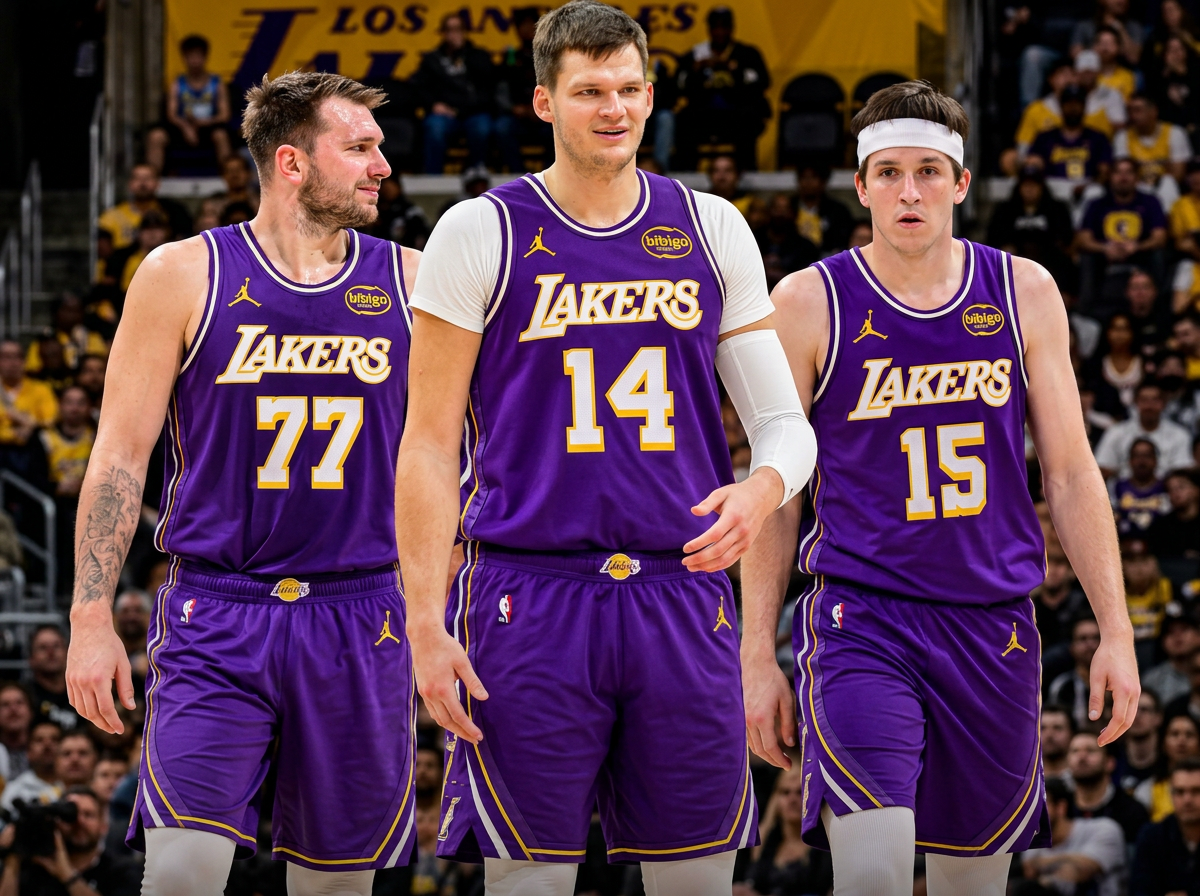
As Shaq dubbed them, the “Snowtime Lakers” are in full effect. Luka Dončić, Walker Kessler and Austin Reaves now represent much of the franchise’s future, marking a rare generational transition for a team accustomed to being led by MVPs and champions. New roster, new era, same enormous Los Angeles media machine.
New Orleans Pelicans | Pelicans+
New Orleans may be the best proof that the broader-reach model can work. The Pelicans distribute games through Gray Media’s Gulf Coast Sports & Entertainment Network and sell local streaming through Pelicans+.
The network now reaches more than 10 million potential viewers across the Gulf South. More importantly, viewership moved. Pelicans broadcasts reportedly rose from roughly a 2.4 local rating to 4.8, effectively doubling year over year as distribution widened.
That does not automatically mean the Pelicans make more media money than they did under an RSN. It does prove the audience was there. The old distribution system was simply keeping part of it outside the building.
Zion Williamson has seemingly entered “the best shape of his life” every offseason for half a decade, but this season the optimism again feels real. New Orleans may never become one of the NBA’s largest markets, but smart drafting, winning basketball and a roster that connects with the culture of the city can still create meaningful commercial growth.
Oklahoma City Thunder | Thunder+
The Thunder created the Thunder Gameday Network with Griffin Media and launched Thunder+ through the NBA App.
The service costs ~$20 monthly or $109 for the season. Sixty-seven local games are carried through Griffin Media’s KSBI/KQCW system, with 10 made freely available over the air.
Oklahoma City’s former FanDuel rights fee was approximately $16.67 million. Terms of the new arrangement are private.
The Thunder’s advantage is that championship-level demand gives the organization more ways to monetize the increased reach even if the local check itself is smaller.
Shai Gilgeous-Alexander and the Thunder are coming off a painful Game 7 Western Conference Finals loss to the Spurs, but expectations have only risen.
OKC enters the new season believing it belongs at the top of the West, and championship-level demand gives Thunder+ a much stronger product to monetize.
Milwaukee Bucks | Bucks+
Milwaukee moved its regional games to MY24 and statewide affiliates while launching Bucks+ through the NBA’s digital infrastructure.
Industry reporting expects the television rights fee to land at or below the normal roughly $8 million OTA range. The Bucks had previously been receiving around $24 million from Main Street. The team gave up a substantial guaranteed check and its return is wider distribution plus the ability to build an owned DTC product.
Giannis Antetokounmpo is no longer in Milwaukee, and while Miami landed the Greek Freak, plenty of observers believe the Bucks extracted substantial value in return. Tyler Herro, Jaime Jaquez Jr. and Myles Turner give Milwaukee the beginning of a new identity; and Bucks+ now gets to document that transition directly for the fan base.

Phoenix Suns | Suns+
Phoenix was ahead of the migration.
The Suns left the traditional RSN structure years earlier and now distribute regional games through Arizona’s Family with Suns+ serving as the DTC product.
The ratings results have been meaningful. During 2025-26, Suns local broadcasts averaged more than 110,000 viewers per game and ranked among the NBA’s top four teams in local household viewership, according to Gray Media.
That is evidence that free distribution can expand the top of the funnel without eliminating a premium streaming option.
Phoenix remains in the Devin Booker era even as it increasingly feels like both sides may eventually be ready for whatever comes next. Until then, Booker remains the franchise’s most bankable attraction, continuing to drive attendance, viewership and commercial value for a Suns media operation that already reaches a large local audience.
Utah Jazz | Jazz+ / SEG+
The Jazz distribute local games through KJZZ while offering Jazz+ and a broader SEG+ bundle.
Like Denver and Houston, this is partly an ownership strategy. Smith Entertainment Group can use one media product across multiple sports properties rather than treating each team’s rights as an isolated licensing transaction.
The economic value therefore includes subscriber retention across the broader SEG portfolio.
Utah has one of the more interesting sleeper rosters in the league, led by new addition Jaren Jackson Jr., league veteran Lauri Markkanen and top-five pick Ace Bailey. If that group becomes competitive faster than expected, SEG has a considerably more compelling product to distribute across Jazz+ and its broader sports portfolio.
Portland Trail Blazers | BlazerVision
Portland may have produced the league’s cleanest local-media turnaround. The Blazers left Root Sports, launched the Rip City Television Network and paired the free broadcast footprint with BlazerVision.
Early in that transition, local viewership increased approximately 68% year over year, and the team’s effective Portland-area television reach moved from roughly 20% under its prior distribution problem to essentially full-market availability.
The franchise’s own media materials later identified the Blazers as the NBA leader in year-over-year household rating growth during the 2024-25 season.
That is the strongest argument for the OTA/DTC model.
An RSN can pay more per viewer.
Free television can create more viewers.
Dame Time is back in Portland, and the basketball universe feels a little more familiar again. Add Ja Morant’s redemption storyline and Deni Avdija’s emergence, and the Blazers suddenly have one of the league’s more interesting underdog groups. Damian Lillard and Morant also give BlazerVision exactly what any local streaming product wants: recognizable stars people will actually tune in to watch.

Free Streaming: Miami’s Different Bet
Miami Heat | Local 10 Plus Platinum
Miami may be running the most aggressive fan-access experiment in the league. WPLG Local 10 carries the Heat’s local television package. The accompanying Local 10 Plus Platinum stream is free.
That is a radical change from the old RSN model.
The Heat received roughly $55 million in local rights fees during their final FanDuel seasons. The new WPLG payment is undisclosed, but reporting indicates it is well above the normal roughly $10 million OTA market while still below Miami’s former RSN number.
Why accept less? Because WPLG had already demonstrated that free distribution could more than double and sometimes triple the audience of the traditional regional feed. That larger audience can be monetized through sponsorships, tickets, merchandise, premium partnerships and advertising.
Miami is effectively saying the fan is worth more over the entire commercial relationship than the television subscription is worth by itself.
APSM Verdict: Optimized reach; cash remains material.
Canada Operates Under a Different Model
Toronto Raptors | TSN+ and Sportsnet+
Toronto is the one NBA market that does not fit neatly into the American regional-rights conversation. Raptors games are split nationally across Canada between TSN and Rogers Sportsnet, with streaming access through TSN+ and Sportsnet+.
Those companies already control major national sports portfolios in Canada. The Raptors therefore function inside a broader integrated Canadian sports-media economy rather than the American RSN-to-OTA migration.
After the strange offseason controversy and a relatively modest penalty, Kawhi Leonard is back in Canada attempting to write another chapter with Toronto. Few players are more naturally connected to the modern Raptors story, and even the possibility of another meaningful Kawhi run gives Sportsnet and TSN a considerably more marketable local product.

Which NBA Platform Pays the Most?
There are two completely different answers.
Nationally: ESPN/Disney
The reported national economics place Disney at roughly $2.6 billion annually, NBCUniversal around $2.5 billion, and Amazon around $1.8 billion as part of the approximately $76 billion, 11-year agreement.
That makes ESPN/Disney the largest annual national rights payer. But those packages are different:
- ESPN retains the NBA Finals.
- NBC gets a larger regular-season inventory and All-Star.
- Amazon gets a significant regular-season package, the NBA Cup knockout rounds, the Play-In Tournament, playoff inventory, rotating conference finals and a major League Pass distribution role.
A simple dollars-per-game calculation would miss the actual asset mix.
Locally: The Lakers Remain in Another Financial Universe
Among currently reported local deals, the Lakers’ approximately $199 million 2026-27 rights fee is in a completely different category from the replacement deals being signed after Main Street’s collapse.
DAZN’s initial NBA market generally sat around $8 million-$15 million per team.
- OTA agreements frequently fall below $10 million.
- Cleveland reportedly pushed DAZN to ~$20 million.
- The Lakers are still approaching $200 million.
- The local NBA is not one media market.
It is 30 different markets sharing a league logo.
Which NBA Platform Gets the Most Viewers?
On the national side, NBC won the first year of the new agreement on average audience.
- NBC/Peacock’s 2025-26 NBA package averaged approximately 2.8 million viewers, including about 3.4 million for Sunday Night Basketball.
- ESPN/ABC averaged around 1.9 million.
- Prime Video averaged roughly 1.0 million across 67 games.
That does not mean Amazon’s package failed. Prime’s audience was substantially younger. Amazon reported a median NBA viewer age below 47, nearly a decade younger than the comparable linear television audience.
The leaguewide result was enormous. ~170 million Americans watched national NBA coverage during the 2025-26 regular season, the league’s largest reach in 24 years.
Part of that growth came from something extremely old-fashioned: broadcast television. The NBA increased its broadcast-network exposure dramatically, and broadcast TV accounted for roughly 32% of national exposure in 2025-26 compared with about 14% the previous year.
broadcast television. The NBA increased its broadcast-network exposure dramatically, and broadcast TV accounted for roughly 32% of national exposure in 2025-26 compared with about 14% the previous year.
The local market is discovering the same thing. Sometimes the streaming revolution works better when it is paired with an antenna.
The NBA Media Rights Net Reality
| Model | Guaranteed Cash | Reach | Strategic Upside | Verdict |
|---|---|---|---|---|
| Legacy Premium RSN | Highest where healthy | Limited by distribution | Lower first-party control | Favorable |
| DAZN Exclusive | Moderate guarantee | Paywall + free windows | Digital scale and future hub position | Moderate |
| OTA + Team DTC | Lower guaranteed fee | Very high | Ads, subscriptions and first-party fan data | Favorable |
| OTA + Prime | Terms still developing | Very high | Massive platform scale with low friction | Optimized |
| Free OTA + Free DTC | Below peak RSN era | Maximum | Advertising, sponsorship and funnel value | Optimized |
| Team-Owned RSN / DTC | No simple outside fee | Varies | Maximum control with higher operating risk | Favorable |
The word ROI needs to be used carefully here.
Amazon reportedly pays around $1.8 billion annually for its national NBA package, while industry estimates placed Prime Video’s 2025-26 regular-season NBA advertising revenue around $280 million.
That does not mean Amazon lost $1.5 billion on basketball. The rights package includes postseason inventory and strategic value beyond regular-season ad sales.
Prime uses live sports to acquire customers, reduce churn, sell advertising across the platform, support League Pass and make the broader Prime membership harder to cancel.
NBC is doing the same thing with Peacock. Team-owned DTC services are doing the same thing at a smaller scale.
Media rights have become customer-acquisition assets. That is the part of sports-media economics that a simple rights-fee table cannot capture.

Why Free Television Is Coming Back During the Streaming Era
That sounds contradictory. It is not. The old RSN model optimized for one thing: extracting the largest possible carriage and subscription economics from a relatively concentrated group of paying households. The new model increasingly optimizes for the entire customer funnel.
Put a game in front of more people
→Turn some into streaming subscribers→Turn others into ticket buyers→Sell sponsors a larger audience→Sell more merchandise→Create more valuable local partnerships→Repeat
Then enter the next negotiation with a demonstrably larger fan base.
- The Pelicans doubled local ratings.
- Portland produced one of the NBA’s largest local viewership increases after leaving Root Sports.
- The Suns are now among the league’s stronger local household audiences.
- Miami had already seen OTA simulcasts double or triple its normal regional audience before committing fully to WPLG.
Those are not isolated coincidences. They show what happens when distribution friction disappears.
The Next NBA Streaming Deal Could Be Worth More Than $1 Billion Per Year
Everything happening in 2026-27 may be temporary. The NBA has been developing a centralized in-market streaming hub for the 2027-28 season.
Sports Business Journal has reported that YouTube has been in advanced discussions for a package initially containing roughly 20 to 25 teams, with potential economics above $1 billion annually.
DAZN, Amazon and ESPN have also been connected to the process. At a hypothetical $1 billion across 25 teams, the average economic value reaches approximately $40 million per club before considering market-specific differences.
That number begins to repair the local-rights collapse. It does not necessarily solve Los Angeles. The Lakers’ current rights economics are still several multiples above that hypothetical average.
But for the Hawks, Hornets, Pistons, Magic, Bucks, Pacers and other clubs currently operating on temporary or lower-fee local structures, a billion-dollar centralized package could restore a significant amount of lost guaranteed revenue without rebuilding the old cable RSN system.
That is probably where this entire transition is heading. One league. One local digital storefront. Different territorial feeds. Individual team economics underneath it.
The 2026-27 season is the bridge.
Why NBA Local Media Rights Matter Beyond Television
A television deal affects more than television revenue.
For a team, wider game distribution can affect:
- sponsorship impressions
- jersey and merchandise sales
- ticket demand
- arena advertising value
- social engagement
- regional brand growth
- youth fan acquisition
- direct subscriber data
- future rights negotiations
- and ultimately franchise valuation
That is why APSM does not treat a $30 million RSN check as automatically superior to an $8 million broadcast deal.
The RSN may pay more today.
The broader model may create more enterprise value tomorrow. The only honest answer requires following the money beyond the rights fee.
Bottom Line
The 2026-27 NBA media landscape is not really a streaming story. It is a distribution and ownership story.
At the national level, the NBA has never been richer. Disney, NBCUniversal and Amazon are paying roughly $6.9 billion per year under the league’s reported $76 billion package, and the first season of those agreements produced the NBA’s largest total U.S. reach in 24 years.
Locally, the old economics broke.
Thirteen teams lost the FanDuel Sports Network structure and were forced to choose between smaller guaranteed rights fees, free television, direct subscriptions and new streaming partners.
- DAZN acquired the largest new portfolio.
- Amazon used Atlanta to make its first NBA local move.
- NBC connected its surviving regional networks to Peacock.
Teams from Portland to Phoenix, Dallas, Utah, Oklahoma City and New Orleans increasingly control their own streaming products. Miami made the stream free.
And the Lakers are still collecting a reported local rights fee approaching $200 million while many other franchises are fighting over deals worth less than $10 million.
That gap explains everything. The next evolution is likely the NBA’s centralized local streaming hub. Until then, 2026-27 is the season in which every team is effectively answering the same question:
Is it better to maximize the check today, or maximize the audience you can monetize tomorrow?
The answer depends on the market.
That is the NBA media rights Net Reality.
2026-27 NBA Streaming & Media Rights FAQs
Where can I stream my local NBA team in 2026-27?
It depends on the team and market. DAZN carries or distributes local streams for a large group of teams; the Hawks use Prime Video; the Celtics, Warriors, 76ers and Kings have Peacock-connected regional networks; many clubs operate branded DTC products such as BlazerVision, Suns+, Thunder+, MavsTV+ and Jazz+; Miami offers its local stream through Local 10 Plus Platinum. National-exclusive games move to ABC/ESPN, NBC/Peacock or Prime Video.
Which NBA teams stream locally on DAZN?
DAZN serves as the primary local digital home for the Cavaliers, Pacers, Grizzlies, Timberwolves and Spurs and also distributes local streaming products involving the Nets, Hornets, Pistons, Knicks, Magic and Wizards. The exact rights relationship differs by team.
Which NBA team has the largest local media rights deal?
Among currently reported figures, the Los Angeles Lakers remain the clear outlier. Sports Business Journal has reported a local rights fee of approximately $199 million for 2026-27 and roughly $209 million the following season under their Spectrum relationship.
Why are NBA teams returning to free over-the-air television?
OTA can dramatically increase local reach compared with a paywalled RSN. Teams may accept a smaller guaranteed media-rights fee while trying to recover value through advertising, sponsorships, ticket sales, merchandise, streaming subscriptions and a larger long-term fan base. Portland, New Orleans and Phoenix have already shown substantial audience gains under broader-distribution models.
Is the NBA creating one streaming service for local games?
The NBA is working toward an aggregated local streaming hub targeted for the 2027-28 season. Reporting has linked YouTube, DAZN, Amazon and ESPN to the process, with an initial package potentially involving roughly 20-25 teams and economics above $1 billion annually. No final leaguewide agreement should be treated as complete until officially announced.
Next Reads
Sources & Methodology
APSM reviewed current 2026-27 distribution information from the NBA, individual NBA teams, DAZN, regional broadcasters and current sports-media reporting. Primary and direct distribution sources include the NBA’s 2026-27 national broadcast guidance, team broadcast pages and announcements from DAZN, Gray Media, Scripps, Cox Media Group, WPLG, Griffin Media and other active local distributors.
Rights-fee figures that are not contractually public are identified as reported figures rather than confirmed contract amounts. Key local-rights reporting used in the analysis includes Sports Business Journal reporting on Main Street Sports Group’s prior NBA obligations, the 2026 OTA replacement market, DAZN’s local-rights strategy, the Lakers’ Spectrum economics and the NBA’s proposed centralized local streaming hub.
APSM does not treat subscription price as team revenue and does not estimate platform profitability from advertising revenue alone. National media-rights values are reported industry estimates. The three national packages contain different regular-season inventories, postseason rights, international rights and strategic assets and therefore should not be compared as simple cost-per-game contracts. When a current local rights fee remains private, APSM says so rather than assigning an unsupported number.
Disclaimer
Apostle Sports Media publishes educational sports-business and financial analysis based on public information, official disclosures, credible reporting and APSM modeling. Private media-rights agreements, advertising revenue, subscriber economics, production costs, revenue-sharing provisions and platform profitability may differ materially from reported or estimated figures. APSM estimates should not be interpreted as audited financial statements or contractual disclosures.