Alabama sits in an interesting middle ground for professional and college athletes. It is not a zero-income tax state like Florida or Texas, but its top individual rate stops at 5%, property taxes are among the lowest in the country, and the cost of living remains well below the national baseline.
The tradeoff shows up elsewhere. Alabama has one of the highest average combined state and local sales tax rates in the United States, while residents remain responsible for Alabama tax on taxable income earned both inside and outside the state.
For an athlete, that makes the 5% headline rate only part of the story.
Residency, federal deductions, Alabama-source income, road-game taxes, housing costs and everyday spending all influence the amount of money that actually survives from gross income into net income.
That complete picture is what APSM defines as the Net Reality.
The combination is what makes Alabama interesting. Tax Foundation midyear 2026 data places Alabama’s 9.46% average combined sales-tax rate fifth-highest nationally, while its roughly 0.37% effective property-tax rate sits near the opposite end of the spectrum.
In other words, Alabama is relatively inexpensive to own a home in and relatively expensive to consume in. That difference matters once an athlete stops looking at taxes as one percentage and starts looking at the full cost of earning, living and building wealth in a state.

Alabama Income Tax for Athletes
Alabama uses a progressive individual income-tax structure; compared to flat rate, ranging from 2% to 5%.
The Alabama Department of Revenue sets the single-filer brackets at 2% on the first $500 of taxable income, 4% on the next $2,500 and 5% above $3,000. Married couples filing jointly reach the 5% bracket above $6,000.
Technically, that makes Alabama a progressive-tax state. For a high-earning athlete, though, it functions closer to a 5% system because almost any meaningful salary or NIL income quickly clears the lower brackets.
That does not mean an athlete simply multiplies every dollar earned by 5%.
A marginal rate applies only to the income inside that tax bracket. Deductions, exemptions and the way taxable income is calculated all influence the final bill.
Alabama residents are generally taxed on taxable income from all sources, while nonresidents are taxed on income sourced to Alabama. That distinction gets important fast in sports because one athlete can receive a base salary, signing bonus, NIL income, endorsements, appearance fees and business income across several jurisdictions in the same year.
Want the national picture? APSM’s State Income Tax for Athletes breaks down why two athletes can earn the same gross amount and still finish with very different take-home income depending on where they live and work.
Alabama’s Federal Income Tax Deduction
Alabama also presents a tax feature that separates it from most states. The state allows qualifying federal income tax liability to be deducted when Alabama taxable income is calculated.
The Alabama Department of Revenue explains that the deductible amount is based on net federal income-tax liability after applicable deductible or refundable credits.
For athletes earning well into the highest federal brackets, that matters.
The published Alabama rate may stop at 5%, but the effective burden on the original gross figure can land materially lower once the federal deduction and other state deductions are incorporated.
That is also why comparing athletes by top tax rate alone misses part of the financial picture. Two players can earn the exact same amount in two states with similar headline rates and still finish the year with different amounts available to save, spend or invest.
APSM $1 Million Alabama Tax Benchmark
To make the State Athlete Tax Glossary comparable from one jurisdiction to another, APSM uses the same $1 million athlete-income benchmark across every state.
For Alabama, the model assumes a single filer earns $1 million of W-2-style compensation during 2026, maintains Alabama residency for the full year, uses the applicable standard deductions and exemptions, and claims no individualized credits or advanced tax strategies.
This is not designed to recreate any athlete’s private tax return. The purpose is to keep the income assumptions constant so that the jurisdiction itself can be compared.
The IRS sets the 2026 standard deduction for a single filer at $16,100, with the 37% top federal bracket beginning above $640,600 of taxable income.
Under those assumptions, federal individual income tax on $1 million of gross W-2 compensation comes to roughly $320,000 before athlete-specific credits, deductions or other adjustments.
At that income level, Alabama’s available standard deduction and $1,500 single-filer personal exemption are then incorporated alongside the state’s federal-income-tax deduction.
The important number here is not simply the 5% top rate.
Under the standardized APSM example, Alabama’s federal-income-tax deduction pulls the modeled state burden down to roughly 3.4% of the original $1 million gross figure.
That still is not a complete Net Reality calculation.
The benchmark intentionally isolates the federal and state individual-income-tax layers so Alabama can be compared fairly against every other jurisdiction. It does not yet subtract payroll taxes, road-game jock taxes, representation fees, career overhead, individualized business expenses or the different tax treatment that can come with “independent-contracting”.
Alabama Jock Tax and Nonresident Athlete Income
The jock tax is not a special Alabama tax bracket created for athletes. It is the state’s normal income-tax system applied to compensation a nonresident earns while physically performing paid work inside Alabama.
For a traditional employee, the basic question is where the work was performed. A nonresident who works partly inside Alabama can therefore have a portion of their compensation treated as Alabama-source income.
Athletes make that rule more complicated because their workplace moves.
An NFL, NBA, MLB or NHL player can generate taxable activity in several jurisdictions from one contract as the schedule moves from city to city. Golfers, fighters, racing drivers and other individual-sport athletes face the same basic issue when prize money, appearance fees or commercial compensation is connected to events held in different states.
Alabama currently has no NFL, NBA, MLB or NHL franchise, so it does not create the same regular road-game exposure as California, New York, Georgia, or Tennessee. That does not make Alabama irrelevant.
An athlete can still compete in the state, make a paid appearance, film sponsored content, attend a commercial event or perform another compensated service within its borders.
There is also a newer Alabama rule that matters specifically because this glossary is written for athletes rather than ordinary traveling employees.
Alabama’s 30-day safe harbor allows certain nonresident employees who work in the state for no more than 30 days to avoid Alabama income-tax and filing requirements. The Alabama Department of Revenue’s safe-harbor guidance specifically excludes professional athletes, professional entertainers and public figures from that protection.
An athlete therefore should not assume that a short stay in Alabama automatically makes Alabama-source earnings irrelevant.
For an Alabama resident, the issue works in the opposite direction.
Alabama generally taxes resident income regardless of where it is earned, while road states can separately tax compensation sourced to work performed there. Credits, allocation rules and the athlete’s individual circumstances then determine how those overlapping obligations are reconciled.
That is why a professional athlete’s tax picture can look completely different from somebody collecting one paycheck while working in one office all year.
Does Alabama Tax NIL Income?
Yes, taxable NIL income can fall within Alabama’s income-tax system, but the more important question a college athlete could ask is:
what kind of income was earned, where the work happened and what the athlete actually keeps afterward.
A quarterback earning seven figures from national endorsements and a reserve athlete earning a few thousand dollars through local appearances technically participate in the same NIL economy.
Financially, they are living in completely different worlds.
Much of modern NIL compensation also looks more like running a small business than receiving a traditional professional-league paycheck. Social-media promotions, autograph sessions, camps, sponsorships and independent commercial work are commonly reported as 1099 income, which may arrive without the automatic withholding an athlete sees on an ordinary employee paycheck.
That means the dollar hitting the bank account may still have future tax obligations attached to it. Legitimate costs connected with producing that income can also receive different treatment from personal spending, which is why understanding business expenses and potential tax write-offs matters early. This applies well beyond the stars.
A top Alabama or Auburn football player may make enough through NIL to retain professional accounting and financial representation. A lower-revenue-sport athlete may instead be balancing a scholarship, stipend, part-time job, smaller sponsorships and occasional paid appearances.
For the second athlete, saving $500 a month on housing or avoiding a surprise tax bill can matter proportionally more than a five-figure difference does to somebody earning millions.
That is where Alabama’s low living costs stop being a generic economic statistic and start becoming part of the NIL conversation.
How Alabama Compares With SEC Rivals
The University of Alabama and Auburn operate under the same state tax system, so switching between those schools does not create a state-income-tax advantage. Crossing state lines changes the equation.
For the 2026 tax year, Georgia uses a 4.99% flat individual rate, Louisiana uses 3%, Mississippi applies 4% to taxable income above its $10,000 threshold, while both Tennessee and Florida do not levy an individual income tax on wages.
That creates a real tax difference inside the SEC.
Alabama and Georgia are relatively close when only the headline rate is considered. LSU’s Louisiana environment creates a larger gap. Tennessee and Florida operate from a completely different starting point because the individual wage-income rate falls to zero.
Alabama’s counterweight is that its published 5% rate does not fully describe the effective burden on a high earner because of the federal-income-tax deduction. Its low property taxes, inexpensive housing and lower living costs can also offset costs that are not visible in the income-tax percentage.
The headline rates show where each state starts, but an athlete does not deposit a tax rate into a bank account. The more useful comparison is what remains after the same amount of income moves through each jurisdiction.
APSM applies the same $1 million NIL benchmark across these markets with 0% agent fees and 0% career overhead, isolating the tax environment before representation costs or personal spending enter the equation.
That turns the rate comparison into a common Net Retention Score and shows how geography alone can change the amount an athlete keeps.
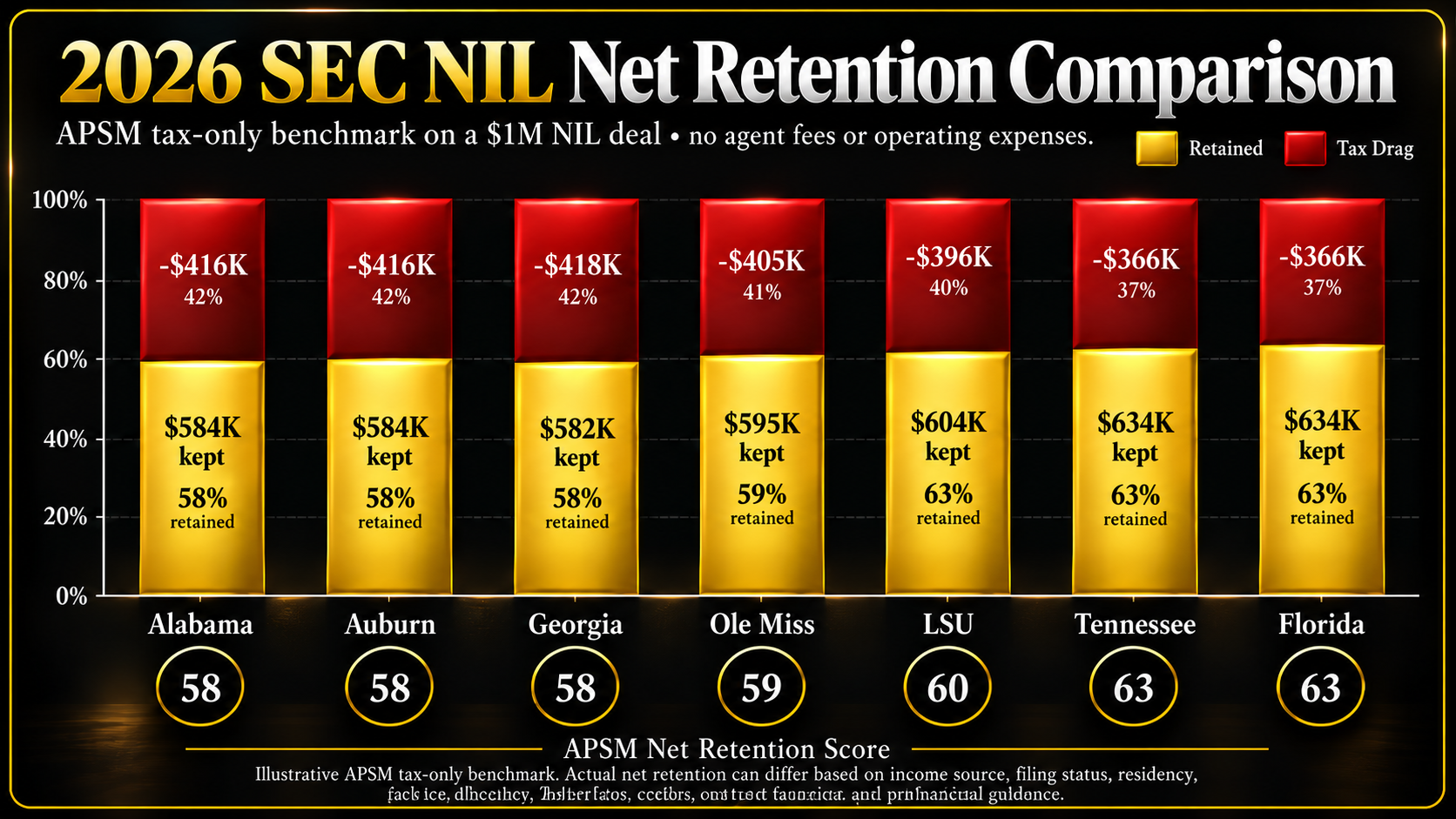
For a recruit, transfer or professional athlete, that does not mean taxes should decide where to play. It means the financial consequences of location should be understood before a decision is made.
Alabama and Auburn share the same state tax environment; crossing into Georgia, Mississippi, Louisiana, Tennessee or Florida changes the starting economics before the athlete changes an agent, spending habits or investment strategy.
That is the purpose of the APSM Net Retention Score: turn a tax environment into a number an athlete can actually compare.
Alabama Sales Tax and Athlete Spending
Alabama’s general statewide sales-tax rate is 4%, but that number understates what consumers actually experience once local taxes are added.
Tax Foundation puts Alabama’s July 2026 population-weighted average combined state and local rate at 9.46%, fifth-highest in the country and well above the national weighted average.
This is where Alabama gives back some of what it saves residents elsewhere.
For a college athlete working with a smaller budget, everyday consumption taxes take a little more out of already-limited disposable income. For a professional or major NIL earner, the same percentage becomes much more noticeable as spending scales into furniture, electronics, jewelry, equipment and other high-dollar purchases.
Vehicles need to be treated separately. Alabama does not simply apply the 4% general state rate to automobiles. The state automotive sales-tax rate is 2%, with local automotive taxes potentially added depending on the jurisdiction.
That distinction matters because applying Alabama’s average general-sales-tax figure to a six-figure vehicle would materially overstate the tax.
On a $150,000 vehicle, the state portion alone at the 2% automotive rate would be approximately $3,000 before applicable local automotive taxes.
Location affects both sides of an athlete’s financial life.
Federal and state taxes, representation fees, operating costs and lifestyle expenses determine how much money survives after it is earned. Sales tax helps determine how efficiently that remaining money can be spent.
Alabama Property Tax and Real Estate
Real estate is where Alabama becomes considerably more attractive.
The state’s effective property-tax rate on owner-occupied housing is approximately 0.37%, placing Alabama among the lowest-property-tax environments in the United States.
For an athlete buying a first home near campus, that can keep one of the recurring costs of ownership relatively manageable. For a veteran professional purchasing seven-figure real estate, the difference becomes much larger because the tax rate is being applied to a substantially more valuable asset.
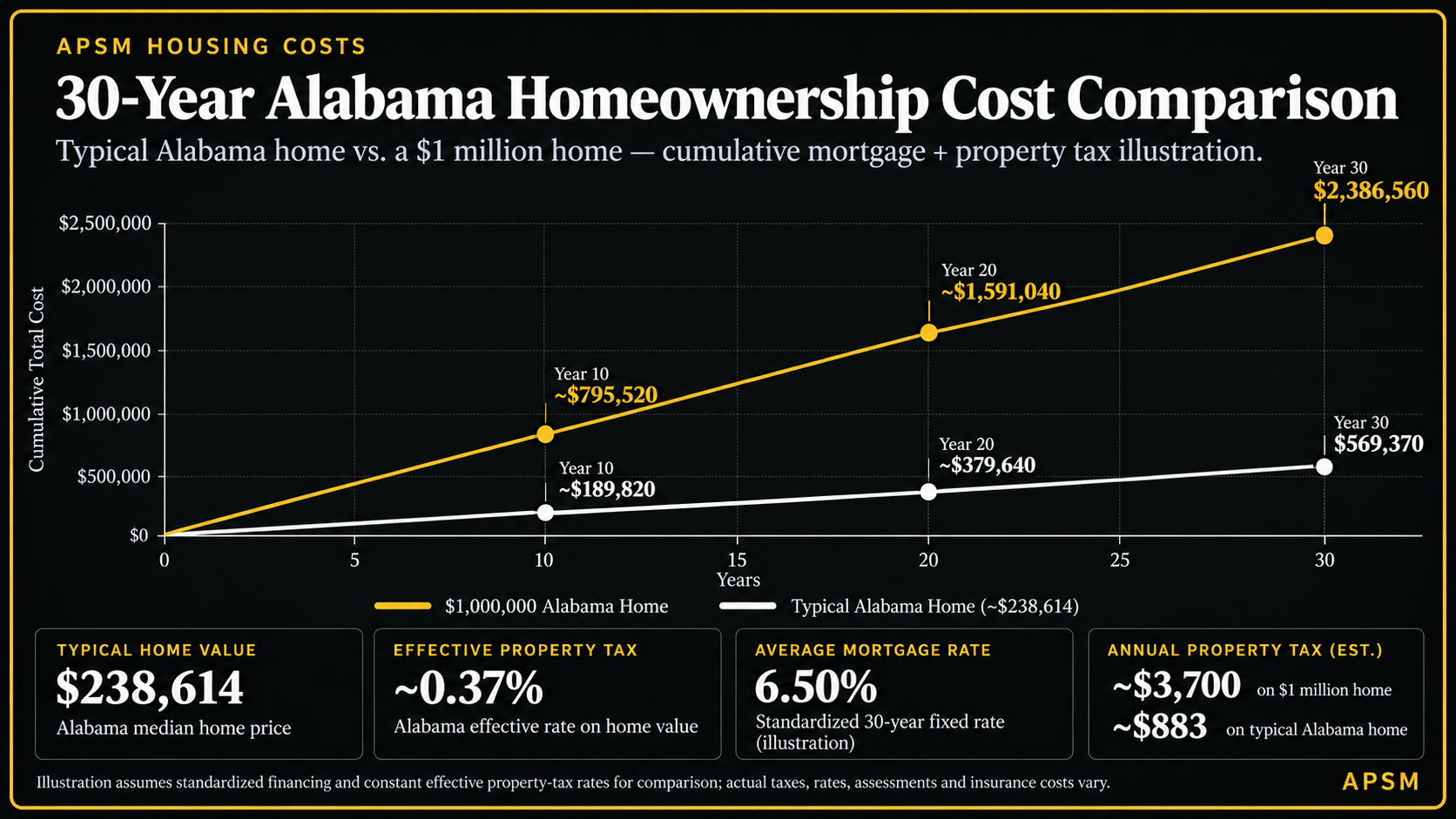
The point is the scale.
The same state can look very different depending on the athlete’s financial position. A college athlete, rookie professional or lower-earning player may care most about the cost of entering the housing market and keeping monthly obligations manageable. A veteran professional, coach or seven-figure NIL earner may be evaluating a much larger property where even a relatively low tax rate is being applied to substantially more capital.
Alabama’s low property-tax environment helps both groups, but for different reasons. The typical-home line represents the statewide housing baseline underneath the athlete economy; the $1 million line shows what happens when income and lifestyle move into the upper tier.
That gap is why APSM looks at housing sustainability alongside headline tax rates rather than evaluating a state’s financial environment through income tax alone.
An athlete can eventually finish paying the mortgage and still owe property tax every year that the property remains taxable. For somebody trying to build long-term wealth through real estate, that recurring carrying cost matters alongside purchase price, financing, appreciation and eventual capital gains.
A lower carrying-cost environment can do more than reduce today’s housing bill. It can affect how much capital remains available to invest elsewhere, how long an athlete can comfortably hold a property and how much of the property’s future value ultimately contributes to long-term wealth.
Buying real estate with athlete income? APSM’s Property Tax for Athletes goes deeper into the recurring tax and long-term financial side of owning high-value property.
Alabama Housing Costs
Alabama’s housing market can provide another advantage for athletes, especially those who are not earning superstar money.
Zillow’s September 2026 Home Value Index puts the typical Alabama home value at roughly $238,614, up 1.9% from the prior year.
That does not mean a starting NFL player, Alabama quarterback or highly paid coach is shopping for a $238,000 house. The statewide figure gives the reader a baseline for the market underneath the luxury tier.
An athlete with a multimillion-dollar contract may look at Alabama and realize that a housing budget capable of buying a fairly ordinary property in Los Angeles or New York can purchase considerably more land and home in the foothills of Alabama.
But the financial effect can be even more important farther down the income ladder. Most collegiate athletes are not earning seven figures.
A softball player with a smaller sponsorship portfolio, a track athlete receiving modest NIL income, a reserve football player, swimmer or athlete working a regular job outside sports still has to pay rent, utilities, transportation and food from whatever money is actually available.
For that athlete, cheaper housing is not a luxury-market talking point. It can be the difference between consistently keeping part of an NIL check and watching almost all of it disappear into regular monthly expenses.
That makes a lower-cost housing market useful at both ends of the athlete spectrum, and potentially provides more opportunities to enter the market.
High earners can purchase more real estate for the same capital. Lower earners can keep fixed housing costs from swallowing as much of their income. And as income rises, financing itself becomes another part of the equation. Athlete contracts and NIL payments do not always fit the income history lenders expect from ordinary salaried borrowers, which is why mortgage structure can matter just as much as the sticker price of the home.
Alabama Cost of Living
Alabama’s broader living-cost numbers reinforce the same point.
MERIC’s second-quarter 2026 Cost of Living Data Series gives Alabama an overall index of 86.0, compared with a national baseline of 100. Alabama ranked second-lowest among the states measured, behind Oklahoma, while its housing component came in even lower at 68.6.
Those numbers are more useful once they are translated back into an athlete’s actual life. For a professional earning millions, Alabama offers the ability to maintain a high standard of living without carrying the same housing and recurring-expense base found in expensive coastal markets.
That leaves more room between income and lifestyle spending, which can ultimately leave more capital available for saving, investing and ownership.
For a six-figure NIL athlete, the same lower-cost structure can make current earnings stretch farther during college, when another major contract or endorsement next season is never guaranteed.
For the much larger population of athletes making smaller amounts, the advantage is simpler. Lower rent, housing and everyday costs reduce how much money has to leave the account every month.
That is why APSM uses standardized cost-of-living data instead of deciding what somebody needs to live “comfortably” or “luxuriously.”
Lifestyle is subjective.
Fixed costs and relative purchasing power can actually be compared.

Alabama Residency and Domicile for Athletes
Owning a house in Alabama does not automatically make Alabama your tax home. Residency and domicile are built from the full set of facts showing where somebody actually maintains their permanent home and intends to remain or return.
Athletes should understand that concept almost like another section of the playbook because it is common to own property in one state, play in another, train somewhere else during the offseason and earn commercial income almost everywhere.
Alabama places the burden of proving a change of domicile on the taxpayer in circumstances where a previous Alabama domicile is being abandoned. Its guidance points to records such as driver’s licenses, vehicle registrations, voter registration, homestead documentation, tax filings and evidence showing where the taxpayer actually lives and earns income.
No single document should be treated as a magic switch. An athlete cannot simply purchase property in Alabama while maintaining every meaningful personal, financial and residential connection elsewhere and assume the house alone creates Alabama domicile.
The primary residence question becomes even more important as income and assets grow. A college athlete may begin with relatively simple ties centered around campus and family. A professional can eventually own several homes, operate businesses in multiple states and spend months of every year traveling.
The more complicated an athlete’s financial life becomes, the more important the documentation behind residency becomes. Just as important, the athlete should understand enough of the concept to know what their CPA, agent, attorney, financial adviser, or likewise is actually doing on their behalf.
That matters in the current NIL and revenue-sharing era because athletes are beginning to handle meaningful money much earlier in life. A school or professional organization may introduce a player to agents, accountants or other financial professionals, but those relationships do not replace the athlete’s own financial literacy.
College careers end. Professional careers end. Injuries happen. Teams change. The financial life built during those years continues.
An athlete does not need to become their own CPA or attorney. They should understand residency, taxes, contracts, and their own assets and liabilities well enough to hire the right people, ask better questions and recognize when advice does not make sense.
The goal is not to manage everything alone. It is to avoid spending four or eight years building assets while learning nothing about how to manage them once sports is no longer doing part of the structure for you.
Go deeper: APSM’s Residency Rules for Athletes explains domicile, multi-state living, audits and why simply owning a home somewhere does not automatically establish residency.
Is Alabama Tax-Friendly for Athletes?
Alabama is not a tax-free state, but the overall structure is more favorable to athlete wealth retention than the 5% headline rate initially suggests.
Alabama loses ground on direct state income taxation compared with Florida, Tennessee and other zero-income-tax jurisdictions. Its 5% marginal ceiling also sits above Louisiana’s current 3% flat rate and Mississippi’s 4% rate above its threshold.
However, the headline rate and the Net Reality of an athlete’s total financial environment are not the same thing once the entire balance sheet is considered.
Alabama’s federal-income-tax deduction can lower the effective state burden for high earners. Property taxes are extremely low. That can make owning real estate less expensive on a recurring basis than in many surrounding or competing markets, although lower carrying costs do not automatically mean the underlying property will appreciate faster than real estate in larger coastal markets.
Housing is also inexpensive by national standards. Athletes at Alabama, Auburn and other programs around the state can benefit from a relatively low cost base while they are on campus, whether they are earning millions through football or simply trying to stretch a scholarship, stipend, job income and smaller NIL opportunities.
If that athlete later reaches the professional level, staying in Alabama becomes a different tradeoff. They may willingly accept a state-income-tax burden in exchange for remaining close to family, purchasing more property for the same capital and maintaining lower offseason housing and lifestyle expenses.
The weakness is consumption.
Alabama residents can retain money efficiently through housing and property ownership, then encounter one of the country’s highest average combined sales-tax environments when they actually spend that money.
Taken together, Alabama earns an APSM Favorable classification. It is not an optimized zero-income-tax environment, but it can provide an efficient base for controlling fixed expenses and converting income into longer-term assets.
Alabama Athlete Tax Summary
Alabama is a good example of why one tax rate should never be used to describe an athlete’s entire financial environment.
The 5% top individual-income-tax rate is real, but so is Alabama’s federal-income-tax deduction. The state taxes income while carrying one of the country’s lowest property-tax burdens and one of its lowest measured costs of living. On the other side, high combined sales taxes increase the cost of spending the money that survives.
The effect also changes depending on who the athlete is.
For a multimillion-dollar professional, Alabama can provide inexpensive real estate and relatively moderate effective state taxation while leaving more capital available for investments and long-term ownership.
For a high-level NIL athlete, the same environment can allow endorsement and revenue-sharing income to stretch farther during college. For a lower-income athlete, the biggest advantage may simply be that rent and everyday housing costs consume less of a limited budget.
That is why APSM does not treat an athlete’s financial life as a headline salary, NIL valuation or top tax bracket. What matters is what survives; what the athlete actually has in their pockets after the entire system is applied and what the athlete does with the money that remains.
That is the Net Reality.
Alabama Athlete Taxes FAQs
What is Alabama’s income-tax rate for athletes?
Alabama uses a progressive individual-income-tax structure ranging from 2% to 5%. Single filers reach the top 5% marginal bracket once taxable income exceeds $3,000, meaning most high-earning professional and NIL athletes quickly have the majority of their Alabama taxable income inside the highest bracket.
Does Alabama have a jock tax?
Alabama can tax nonresidents on compensation attributable to services performed inside the state. Professional athletes are also specifically excluded from Alabama’s 30-day safe harbor for qualifying nonresident workers.
Does Alabama tax NIL and endorsement income?
Taxable NIL and endorsement income can be subject to Alabama income tax. Treatment depends on factors including the athlete’s residency, where the compensated work was performed and whether the income is paid as employee compensation or independent-contractor income.
What does Alabama residency mean for an athlete?
Alabama residency and domicile depend on the athlete’s actual circumstances rather than one document or property purchase. Primary residence, physical presence, licenses, registrations, tax filings and demonstrated intent can all help establish where an athlete’s permanent tax home actually exists.
Is Alabama a good tax state for athletes?
Alabama is not a zero-income-tax state, but its 5% maximum marginal rate, federal-income-tax deduction, very low property-tax burden, inexpensive housing and low cost of living create a relatively favorable environment for athlete wealth retention. High combined sales taxes are the largest offsetting cost.
Credits & Sources
APSM prioritizes primary government guidance for statutory tax rates, filing requirements, residency rules and other jurisdiction-specific information.
Standardized national datasets are used when comparing states.
Alabama tax law and filing rules: Alabama Department of Revenue
Alabama nonresident and 30-day safe harbor rules: Alabama Department of Revenue
Federal tax benchmark: Internal Revenue Service
National tax comparisons: Tax Foundation
Cost of living: MERIC / C2ER Cost of Living Data Series
Housing values: Zillow Home Value Index
Regional tax comparison: Georgia Department of Revenue, Louisiana Department of Revenue, Mississippi Department of Revenue, Tennessee Department of Revenue and Florida Department of Revenue
APSM methodology: calculations are standardized educational estimates built from publicly available information. They are designed for cross-state comparison and do not represent an individual’s actual tax liability.
Next Athlete State Tax Reads
- Georgia Athlete Taxes
- Florida Athlete Taxes
- Tennessee Athlete Taxes
- Mississippi Athlete Taxes
- Texas Athlete Taxes
Disclaimer
Disclaimer: The APSM State Athlete Tax Glossary is provided for general educational and informational purposes only and does not constitute tax, legal, accounting, financial, or residency advice. Tax rates, rules, deductions, residency standards and athlete-specific obligations can vary by jurisdiction and individual circumstances and may change over time. APSM uses publicly available tax information, standard assumptions and financial modeling, but actual tax liability may differ based on income source, filing status, residency, jock-tax allocation, deductions, credits, contract structure and professional guidance.