
The Detroit Tigers’ recent resurgence is more than a baseball story, it is a sports finance case study. For years, professional sports has created an easy narrative about winning that if you spend more money than other teams, acquire bigger stars, and build a roster so deep that your hopes that the investment produces championships becomes expectation.
The Los Angeles Dodgers have certainly demonstrated how powerful that strategy can be. But Detroit offers a different lesson. The Tigers have increasingly built around something that matters to a franchise, a business owner and even a young athlete receiving their first major paycheck; capital allocation.
- Where does the money go?
- What does the organization get in return?
- Which assets should be developed internally?
- When should a team spend?
- When should it wait?
And, perhaps most importantly, when does an asset become more valuable to sell than to keep? A professional athlete can earn millions of dollars and still make poor financial decisions. A franchise can generate hundreds of millions in revenue and still destroy its flexibility through bad contracts.
Money creates opportunity. Allocation determines what happens next.
The Tigers Didn’t Become Competitive by Simply Spending More Like the Dodgers
Detroit’s financial strategy is often described as “small-market” or “mid-market” discipline, but that description can be misleading.
The Tigers are not operating with a tiny payroll. Spotrac’s 2025 figures put Detroit’s projected cash payroll at roughly $179 million, while its projected tax payroll was approximately $170 million.
That ranked Detroit well below baseball’s highest-spending organizations, but it was hardly a shoestring operation. That distinction matters.
Detroit combined young, cost-controlled talent with selected veteran spending, trades and player development. In 2025, MLB noted that Detroit’s playoff roster was heavily homegrown; 12 players had been signed and developed by the organization, one of the highest totals among the postseason teams.
That is where the financial advantage begins. If a player produces at an All-Star level while still earning a relatively modest salary, the organization has created something far more valuable than simply a good player. It has created financial flexibility. Flexibility that can then be used as leverage somewhere else.
Player Development Is a Financial Strategy
A farm system is not just a baseball operation, it’s an investment portfolio. Every draft pick, international signing and prospect represents capital that may eventually produce major-league value.
The ideal outcome is obvious; develop a player internally, receive years of productive performance while the player remains relatively inexpensive, and use the money saved elsewhere on the roster.
MLB’s salary structure makes this particularly important. Players entering their first seasons are generally subject to MLB’s minimum salary structure, while arbitration and free agency gradually increase a player’s earning power.
The system is more complicated than a simple “three cheap years, three arbitration years” formula, because service-time rules and Super Two eligibility can change the timing, but the underlying economic principle remains. Young production is often cheaper than veteran-production.
Rather than attempting to purchase every solution on the open market, the Tigers have invested heavily in development and then supplemented that core with outside additions. If a player contributes $20 million worth of on-field production while costing significantly less than that in salary, the difference gives the organization room to improve elsewhere.
For a young athlete, the equivalent is learning how to turn income into assets. You don’t need every dollar to produce a lifestyle upgrade. Some of your money should produce future money and with the right mindset and diversification strategy of investments, business ownership, real estate, education or another asset appropriate to your situation you can build wealth across a multitude of lanes that begin to compound with time.
Don’t pocket watch, method watch.
Detroit’s Payroll Flexibility Strategy
One of the most misunderstood concepts in sports finance is that a high payroll is automatically bad. It isn’t, a bad contract is bad. Spending aggressively on the right player at the right time can be one of the best investments a franchise makes.
Detroit has experienced both sides of this equation. The organization has carried expensive veteran commitments, including the long-term Javier Báez contract, while simultaneously developing younger players who provide production at much lower costs.
That creates an important financial tension. A franchise doesn’t evaluate a contract only by asking:
“Is this player good?”
It has to ask:
“Is this player worth this contract compared with what else we could do with the money?”
That is capital allocation, and is the same question an athlete should ask before making a major purchase. A $150,000 car might be affordable on a $2 million contract. But that doesn’t mean it is a good use of $150,000.
- Could that capital create more value somewhere else?
- Could it be invested?
- Could it purchase an asset?
- Could it fund a business?
- Could it provide a financial cushion that protects your future?
Analytics Changed More Than Player Evaluation
Modern baseball analytics are often discussed as though they exist solely to identify better players. Analytics can help teams estimate whether a player’s production is sustainable, identify undervalued skills, evaluate injury risk and determine whether the expected performance justifies the expected salary. That turns data into a financial tool.
Detroit’s front office has emphasized information, player development and flexibility as part of its roster-building process. President of baseball operations Scott Harris has repeatedly described a willingness to pursue players when the organization has conviction that the talent fits, whether the acquisition costs money, prospects or both.
The Skubal Trade Changed the Financial Story
Then came the decision that turned Detroit’s financial philosophy into a much more interesting case study.
Tarik Skubal was traded to the Los Angeles Dodgers on August 2, 2026.
The Dodgers acquired the two-time American League Cy Young Award winner in exchange for outfielder Zyhir Hope and right-handed pitchers River Ryan and Brady Smith. Hope and Ryan were both ranked among MLB Pipeline’s Top 100 prospects at the time of the deal.
Skubal was 29 and was set to become a free agent after the 2026 season. For Detroit, that created a classic asset-management decision. Keep one of the best pitchers in baseball and potentially benefit from his production for the remainder of the season, while facing the possibility of losing him in free agency. Or convert a highly valuable, short-term asset into multiple pieces that could contribute to the organization’s future.
Detroit chose the second option. Detroit wasn’t just selling a high player salary to get it off their books. It was selling an asset at what they deemed to be their highest ROI-window and when another organization valued Skubal the most.
The Dodgers weren’t buying a cheap pitcher. They were buying elite performance for a championship push. Detroit, meanwhile, received multiple players whose value is tied to future production rather than one veteran contract. That is asset allocation.
MLB reported that Hope entered the deal as the Dodgers’ No. 5 prospect and No. 25 overall prospect, while Ryan was No. 7 in the Dodgers’ system and No. 68 overall. Brady Smith was ranked No. 17 in the Dodgers’ system.
Asset Harvesting As a Concept, for Athletes
The Skubal trade offers one of the best athlete-finance lessons in the entire article. Imagine you are a young athlete:
- You have spent years building your value.
- Your performance improves.
- Your reputation grows.
- Your marketability increases.
Eventually, your earning power reaches a peak. What do you do with that value? Most people think the answer is simple and that the Tigers should spend, spend and spend like the Dodgers in order to win.
However, a sports organization thinks differently, it thinks about their bottom line today, as well as their projected value in the future if they make certain financial decisions to maximize their valuation and growth.
An organization doesn’t think, a board of rich directors asks – How do we convert today’s value into tomorrow’s value?
That’s what Detroit did with Skubal.
For an athlete, “asset harvesting” could mean something completely different. It might mean turning endorsement income into investment capital. It might mean using a strong playing career to build a business.
It might mean buying an income-producing asset instead of another depreciating luxury. It might mean taking advantage of a high-income season to establish financial security before the next injury, contract dispute or roster move arrives.
The goal isn’t to stop enjoying your money. The goal is to make sure some of your money survives the career that created it.
Detroit’s Rising Franchise Value
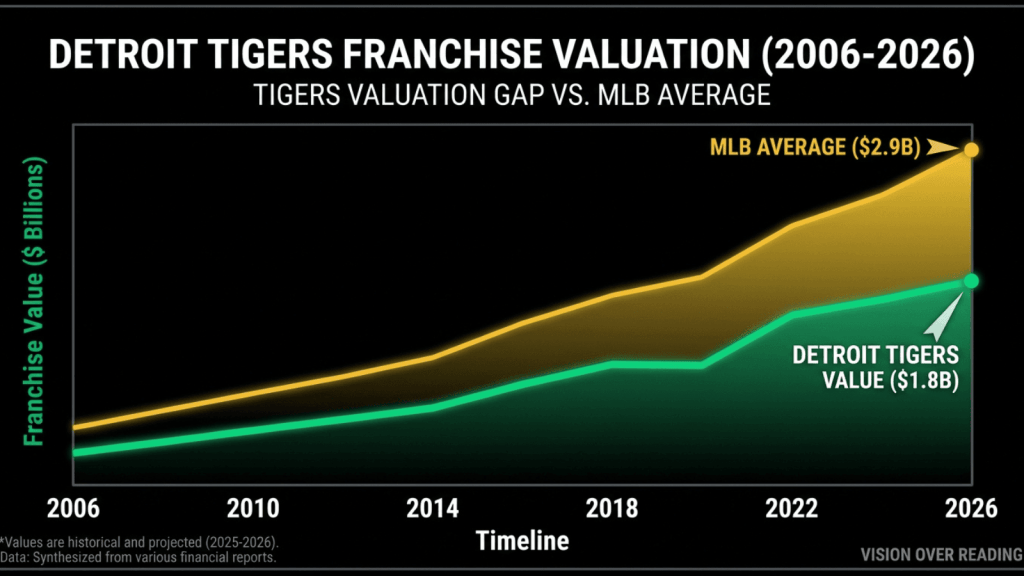
The Tigers’ financial rebuild becomes even more interesting when viewed through franchise valuation. According to Forbes’ MLB valuation data, Detroit was valued at approximately $1.2 billion in 2017.
By 2026, that figure had reached ~$1.8 billion. That’s a roughly 50% increase in estimated franchise value over the period. Forbes’ historical figures also show the franchise moving from $1.3 billion in 2021 to $1.5 billion in 2023 and $1.6 billion in 2025 before reaching $1.8 billion in 2026.
Detroit Tigers Franchise Valuation (Since 2017)
| Year | Estimated Franchise Value |
|---|---|
| 2017 | $1.2B |
| 2019 | $1.3B |
| 2021 | $1.3B |
| 2022 | $1.4B |
| 2023 | $1.5B |
| 2024 | $1.5B |
| 2025 | $1.6B |
| 2026 | $1.8B |
The increase isn’t attributable to one thing. Franchise value reflects many variables, including market economics, media rights, stadium economics, revenue, brand strength, league-wide economics and investor expectations.
Its the trajectory that matters. In 2026, Forbes estimated Detroit’s franchise value at $1.8 billion, with $363 million in revenue and $27 million in operating income for the 2025 season. Forbes also estimated player expenses at $187 million.
A sports franchise is an asset. Its value can grow even when the organization isn’t spending like the richest team in the league.
That’s the bigger financial lesson.
Winning Also Creates Revenue
There is another side of the equation that young athletes should pay attention to. Success creates monetization opportunities. The Tigers drew approximately 2.41 million fans in 2025, their highest attendance since 2016 and a significant increase from roughly 1.86 million in 2024.
- More winning can create more demand.
- More demand can create more ticket sales.
- More attention can create stronger sponsorship opportunities.
- More star players can increase merchandise interest.
- More relevance can create more media value.
And the cycle can reinforce itself. This is why sports finance cannot be separated from entertainment. Fans aren’t buying a balance sheet, they’re buying an experience. Access to a team they care about and represents where they are from, reside or have deep familial ties too.
They’re also the people buying the jerseys, tickets, food, premium seating and memories. The franchise that wins consistently has more opportunities to monetize attention.
For athletes, the same principle applies. Your performance creates attention. Your attention creates opportunities. Your ability to convert those opportunities into sustainable income determines whether your career creates long-term wealth.
The Tigers’ Biggest Financial Advantage
There is a temptation to look at Detroit’s strategy and conclude that the lesson is simply: “Small-market teams should spend less.”
Detroit can develop players internally.
- It can trade prospects.
- It can acquire veterans.
- It can extend players.
- It can sell players.
- It can shift resources as the competitive window changes.
The more of those options a franchise has, the more leverage its front office possesses. That is why bad contracts hurt so much. They don’t just cost money, they eliminate options.
A contract can prevent a team from acquiring another player. A bloated payroll can force a team to avoid a trade. An aging roster can consume resources without creating future value. Financial flexibility is therefore an asset by itself. That concept is incredibly important for young athletes.
The Athlete Version of the Tigers’ Strategy
Imagine an 18-year-old college athlete signs their first major NIL agreement. They receive $100,000. Their absolute first internal question should not be what cool car they can cash-out on or what chain to buy, but rather it should be with the mindset of multiplication via:
What can this $100,000 become?
That’s the difference between consumption and capital allocation. A car may provide transportation and enjoyment.
- An investment may provide future income.
- A business may create additional revenue.
Education may increase future earning potential.
- A tax reserve may prevent a financial crisis.
- Insurance may protect future earnings.
None of those decisions are automatically right for every athlete. But they all require the same mindset: Don’t judge money by what it can buy today. Judge it by what it can produce tomorrow. That’s what makes the Tigers’ valuation story relevant far beyond baseball.
Detroit’s Financial Formula
The Tigers haven’t discovered a magical formula that guarantees championships. No franchise has. What Detroit has demonstrated is a framework that can create sustainable competitive advantages:
- Develop talent.
- Value players intelligently.
- Control costs where possible.
- Spend when the expected return justifies it.
- Preserve flexibility.
Build revenue around winning and attention. Convert valuable assets into future opportunities when the timing makes sense. That is not just baseball strategy. It’s business strategy.
The Money Lesson
The biggest mistake athletes make when they study sports finance is focusing exclusively on the biggest contracts. That’s backwards. The more important question is what happens after the money arrives.
The Tigers don’t ask whether they can afford something simply because they have the revenue. They evaluate the opportunity cost.
An athlete should do the same. If you spend $200,000, that $200,000 can’t simultaneously be invested somewhere else. If you sign an expensive long-term obligation, you may be reducing your future flexibility. If you refuse to spend, when spending could create significant value, you can also miss an opportunity. That is the heart of sports finance.
Bottom Line
The Detroit Tigers’ financial rebuild is not a story about avoiding money. It’s a story about understanding money. Detroit has shown how player development can create inexpensive production, how analytics can improve talent valuation, how payroll flexibility can create options and how valuable assets can be converted into future organizational opportunities.
The Tarik Skubal trade is the newest chapter in that story. Detroit could have kept its ace and continued betting on the current roster. Instead, the organization decided that Skubal’s value as an expiring superstar was significant enough to exchange for multiple future assets.
Whether those prospects ultimately justify the trade will take years to determine. That’s exactly why the deal is interesting from a finance perspective. Good asset management is not about knowing the future.
It’s about making decisions that give you a better position regardless of what the future brings. For a young athlete, that might mean saving before spending. It might mean investing before upgrading your lifestyle.
The Tigers’ story ultimately comes down to one principle: It isn’t about how much money you have. It’s about what you do with it. That is a lesson that works far beyond baseball.
Detroit Tigers Financial Rebuild FAQs
How did the Detroit Tigers build a competitive roster without MLB’s largest payroll?
Detroit combined player development, cost-controlled young talent, selective veteran spending, trades and data-driven evaluation rather than relying exclusively on expensive free agents. The Tigers’ 2025 postseason roster included 12 players signed and developed by the organization, highlighting the financial value of internal development.
Why did the Tigers trade Tarik Skubal to the Dodgers?
Skubal was a two-time American League Cy Young Award winner and was scheduled to become a free agent after the 2026 season. Detroit traded him to Los Angeles on August 2, 2026, receiving prospects Zyhir Hope, River Ryan and Brady Smith. The move converted a short-term superstar asset into multiple future assets for Detroit’s organization.
How much are the Detroit Tigers worth in 2026?
Forbes estimated the Detroit Tigers’ franchise value at $1.8 billion in 2026, up from approximately $1.6 billion in 2025. Forbes also estimated $363 million in 2025-season revenue and $27 million in operating income.
Are the Detroit Tigers considered a small-market MLB team?
Detroit is better described as a mid-market franchise rather than one of MLB’s smallest markets. The Tigers operate with significantly more financial resources than the league’s smallest-revenue organizations but do not generally compete with the spending power of teams such as the Dodgers and Yankees.
Next Reads
- Highest-Paid MLB Players of 2025
- Should MLB Introduce a Salary Cap
- Why the Seattle Mariners Remain a Small-Market Team
- Top 5 Most Valuable MLB Cards Ever Sold
- Michigan State Athlete Taxes
Disclaimer: This article contains general financial information for educational purposes and does not constitute professional advice. APSM estimates are derived from publicly available information, tax assumptions, finance modeling, and industry-standard fee structures. Actual earnings may vary based on residency elections, private contract provisions, image/media rights agreements, bonuses, and tax filings.