
The biggest and possibly most shocking trade in NBA history has been finalized. The Dallas Mavericks officially traded their 5-Time All-NBA 1st-team & 25-year-old Superstar Luka Dončić to the Los Angeles Lakers, for a return of Anthony Davis, Max Christie and a 1st round draft pick.
This is the first time in NBA league history, that two All-Pro players were traded for one another during the middle of a season.
While fans debate who won the trade however, the story isn’t only on the floor. It is also the financial impact that this trade for the league itself. From salary cap gymnastics, supermax extensions out the window, and massive tax implications, this deal has layers that go beyond the three-point line.
The Trade Breakdown
Los Angeles Lakers Haul
- Luka Dončić (5 years, $215.2M)
- Maxi Kleber (3 years, $33M)
- Markieff Morris (1 year, $3.2M)
Dallas Mavericks Receive
- Anthony Davis (3 years, $186M)
- Max Christie (3 years, $5.2M)
- Lakers’ 2029 first-round pick (Unprotected)
This move not only reshapes two franchises on the floor. It shifts the financial outlook for Dončić, Davis, both teams involved and the NBA in its entirety.

How Luka Dončić Forfeited Over $115 Million
Before the trade, Luka Dončić was on track to sign a $345 million supermax extension with the Dallas Mavericks next summer, which would have been the largest contract in NBA history. (Until SGA’s Extension).
Under collective bargaining agreement (CBA) rules, designated veteran supermax extensions are strictly reserved for players who remain with the franchise that drafted them or were acquired via trade while still on their rookie contract.
By accepting a trade to Los Angeles, Dončić forfeited his supermax eligibility. Supermax deals are only available to players who stay with their original team, or a team that acquir ed them when they were still on their rookie contract.
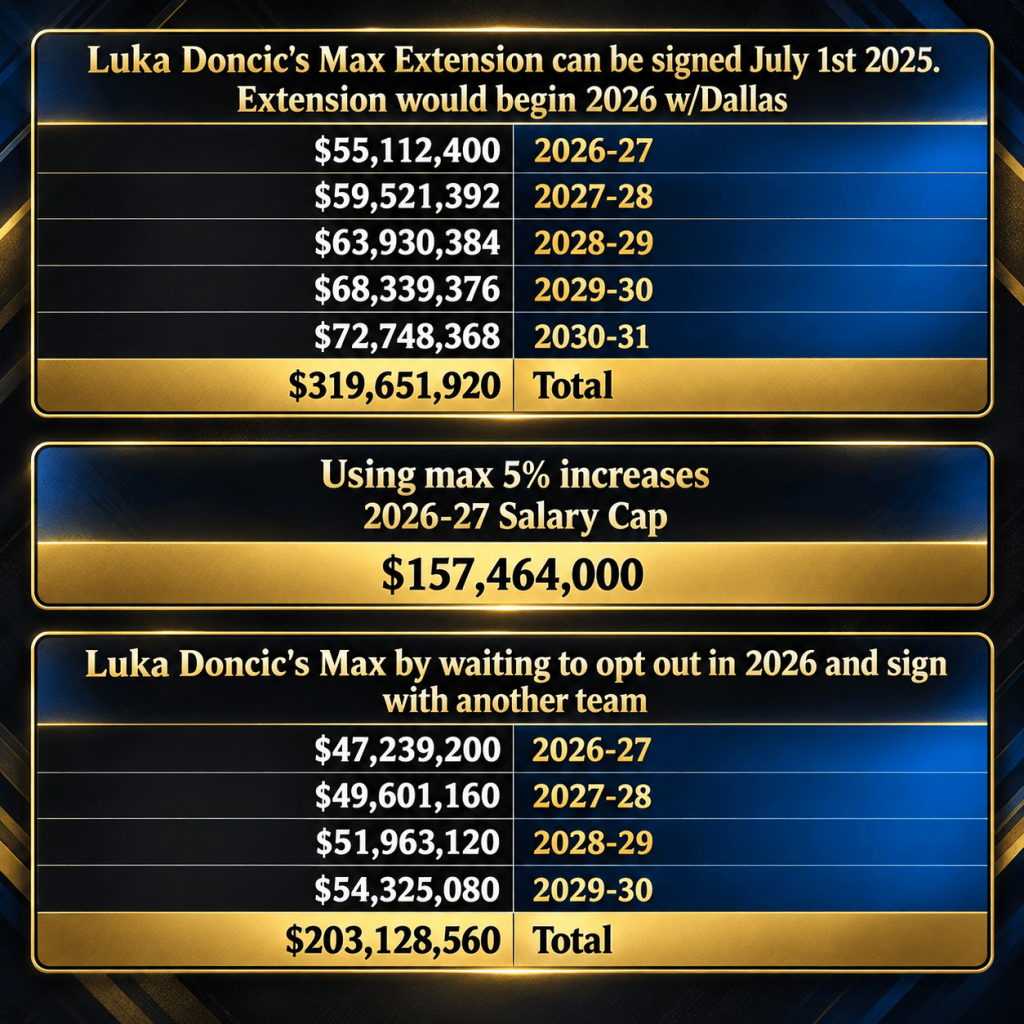
Now that he’s in Los Angeles, Dončić is no longer eligible. Instead, the most he can sign for in the 2025 NBA off-season is a four-year, $230 million max extension, representing a drop of over $115 million in contract value from a Dallas supermax.
That’s not all
- Texas has no state income tax.
- California has a 13.3% income tax.
So, on Dončić’ $46M+ base salary, Luka will now pay an extra $6.1M per year in state taxes alone to California. Over the next four years, Luka will lose $24.4M lost to California.
Factor in federal tax rates and the high cost of living in Los Angeles as well, and Luka Dončić may be losing out on close to $150 million or more, due to the impact of this trade.
However, the five-time 1st team All-Pro also lands himself in one of the biggest revenue generating markets in the world for both sports & entertainment, Los Angeles. A market that potentially opens doors to other lucrative endorsement and investment opportunities for the perennial Superstar.
So, while the initial financial loss is certainly impactful, Luka will likely have other financial connections that he may not have had in Dallas. Connections that may allow him to make some of, if not all of that money back that he will lose due to the trade, in “The City of Angels.”
Dallas Supermax vs. L.A. Max Extension Comparison
| Extension Category | Dallas Mavericks (Supermax) | L.A. Lakers (Veteran Max) | Total Difference |
| Max Contract Duration | 5 Years | 4 Years | -1 Year |
| Total Contract Value | ~$345.0 Million | ~$230.0 Million | -$115.0 Million |
| Average Annual Value (AAV) | ~$69.0 Million | ~$57.5 Million | -$11.5 Million / Year |
State Tax Math: Texas vs. California Net Take-Home Pay
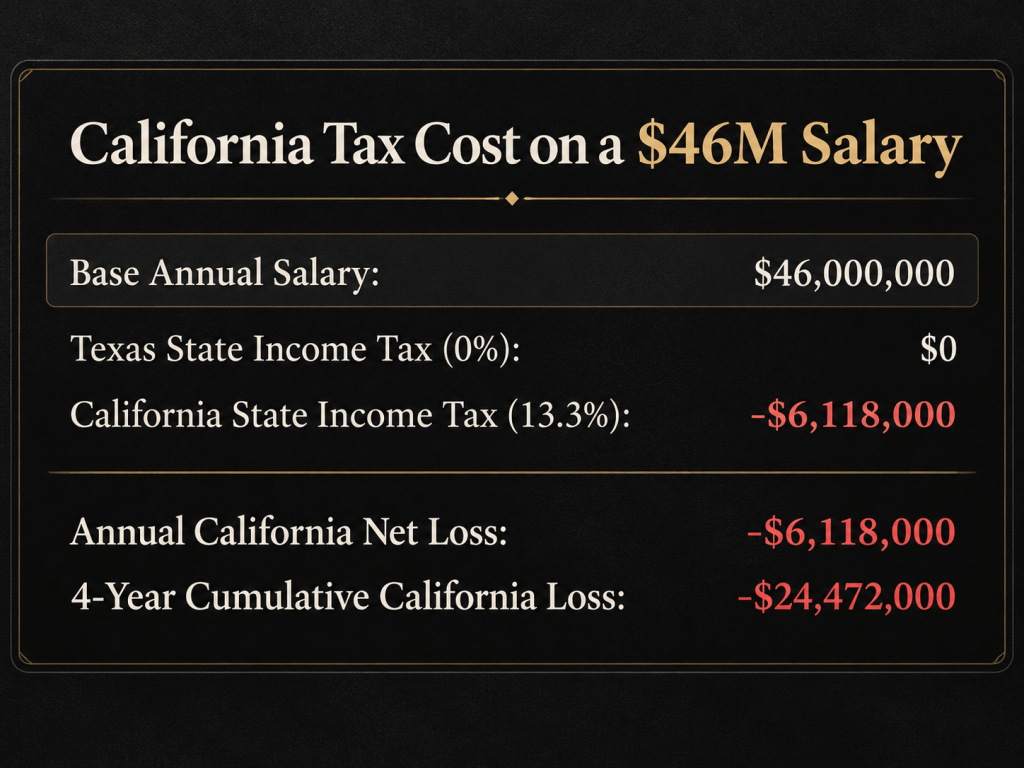
Beyond losing supermax eligibility, Dončić faces significant state income tax increases by relocating his primary work location from Texas to California.
- Texas State Income Tax Rate: 0.0%
- California State Income Tax Rate: 13.3%
Annual State Tax Comparison on a $46 Million Base Salary
When factoring in top-bracket federal taxes (37%), jock taxes, agent fees (4%), and California’s high cost of living, Doncic’s effective take-home pay is reduced significantly compared to his previous earning structure in Dallas. However, relocating to Los Angeles exposes Dončić to significantly larger global brand partnerships, media equity, and venture capital opportunities that can offset these tax losses over time.
Anthony Davis: The True Financial Winner of the Trade
While Dončić incurs a tax increase, Anthony Davis gains an immediate effective pay raise simply by shifting his tax residency from California to Texas. Davis is currently playing under a three-year, $186 million contract extension averaging $62 million per year.
Anthony Davis Net Income Savings in Texas

By moving to Dallas, Davis retains an additional $24.7 million in net spendable income over the remaining duration of his deal without taking a pay cut on his gross salary.
This however, abruptly came to an end when he was traded to the Wizards, and now plays in the DMV region, one of the highest tax levying regions in the nation outside of California and other coastal states like Massachusetts or Connecticut. Margin allows the front office to absorb luxury tax penalties that would paralyze small-market franchises.
How This Impacts Each Team’s Salary Cap
Los Angeles Lakers
Luka’s Dončić’ contract puts the Lakers even deeper into the luxury tax. LA is projected to pay over $50M in tax penalties next season if they don’t move other contracts. This also raises questions about LeBron James’ future in Los Angeles.
The Lakers have almost no cap flexibility to add another star. Without depth that can compete with other rising western rosters like the OKC Thunder or Houston Rockets, the Lakers will need to shed tens of million in salaries and quick.
The Luka situation that owner Rob Pelinka has found himself seemingly gives the Los Angeles Lakers front office two options.
Option 1
Shed a significant amount of role player contracts over the summer and go all in on Luka, Lebron and either trade for, or sign another impactful star in Free Agency. Attempting to go all in for Lebron James’ last few runs at a title and worrying about their future after his eventual retirement.
Option 2
Decide that Luka Dončić is the future in the City of Angels and trade Lebron out of town before the trade deadline, February 6th, 2025 or in the early off-season. Considering that Lebron is currently earning roughly $50M per season on his current veteran-max deal, this seems like the obvious choice for the Lakers.
However, it is yet to be seen how Lebron and Luka will mesh on the court and if they end up being a dominant force and serious threat after all. The decision for the Lakers both roster wise and financially will only continue to become harder to make.
Dallas Mavericks
Anthony Davis’ contract is still massive, but it lowers Dallas’ future financial commitments compared to a Luka $345 supermax. The Mavericks have more flexibility for moves around Davis and Kyrie Irving, as the trade provides Dallas with more cap flexibility.
While Davis is set to earn around $40M per season, his deal expires in 2028, giving the Mavericks an earlier window to reset their books. From a financial perspective, the trade sheds long-term risk for Dallas.
Luka’s contract would have locked them into a five-year supermax structure, limiting their ability to build a contending roster. By pivoting to Anthony Davis, the Mavs lower their future salary cap burden, allowing them to pursue additional roster upgrades around Kyrie Irving and other potential free-agent targets. (Kevin Durant?)
Beyond immediate cap relief, Dallas also gains an extra 2029 first-round pick, which could become a key trade asset if used accordingly. With Davis, the Mavs still have an All-NBA talent, but without the long-term financial constraints that come with keeping a 25-year-old generational superstar like Luka. However. the question remains: Can Davis stay healthy enough long-term to justify the shift? (Now he is in Washington, on the Wizards)
NBA Franchise Revenue Context
To understand why Los Angeles absorbed Dončić’s contract despite heavy luxury tax penalties, look at gross annual revenue generated across major market franchises:
| NBA Franchise | Gross Annual Revenue (2023-2024) |
| Golden State Warriors | $800 Million |
| New York Knicks | $543 Million |
| Los Angeles Lakers | $522 Million |
| Boston Celtics | $457 Million |
| Dallas Mavericks | $437 Million |
The Lakers generate over $520 million in gross annual revenue, backed by a local TV deal with Spectrum SportsNet paying upwards of $184 million annually.
How Did This Trade Even Get Approved?
Unlike the Chris Paul fiasco, the NBA couldn’t block this deal even if it wanted to. This is where NBA fans start screaming: How was this mind boggling transaction allowed when the Chris Paul-to-Lakers trade got vetoed in 2011?.
Quick refresher: The NBA blocked the CP3-to-Lakers deal because the league technically owned the New Orleans Hornets at the time and argued that the transaction wasn’t in the best interest of the association. The infamous veto, led by then-commissioner David Stern, was framed as a basketball decision but was truly about league optics, small-market competitiveness, and ownership concerns.
For the groundbreaking & historic Anthony Davis x Luka Doncic trade, both teams are independently making their own moves under the current CBA. This means that the majority owner(s) of the Lakers and Mavs were entirely in control of the trade. In the NBA’s financial landscape, the CBA actually makes blockbuster trades like this easier to execute, not harder.
The CBA Has Shifted Blockbuster Trades
The second apron penalties haven’t kicked in yet
Under the NBA’s new tax rules, teams exceeding the dreaded “second apron” face severe restrictions on trades, sign-and-trades, and roster flexibility. However, those penalties don’t fully activate until the 2025-26 season, giving teams like the Lakers and Mavericks a small window to make big moves before they start feeling the weight of the newly imposed restrictions.
New extension rules changed how Luka’s deal could be structured
Before the 2023 CBA, a player of Luka’s caliber would’ve had fewer options for restructuring their deal mid-contract. However, updated extension rules allowed more flexibility for long-term planning.
Dallas found an actual pathway to move his contract without triggering financial turmoil. On paper, it was purely a business decision that the Dallas Mavericks just didn’t want to cut the $345M check for the 25-year old Superstar this upcoming summer.
The NBA wants superstars in big markets
The league thrives on marquee names in major cities. While they won’t publicly admit it, having Luka in Los Angeles and Anthony Davis in Dallas makes for prime-time drama, the rebirth of elite ratings, and more international branding opportunities.
2023-2024 NBA Franchise Generated Revenue Rankings:
| NBA Teams Ranked by Revenue 2023-2024 (in millions USD) | Revenue (in millions USD) |
|---|---|
| Golden State Warriors | $800 million |
| New York Knicks | $543 million |
| Los Angeles Lakers | $522 million |
| Boston Celtics | $457 million |
| Dallas Mavericks | $437 million |
| Houston Rockets | $416 million |
| Chicago Bulls | $414 million |
| Philadelphia 76ers | $396 million |
| Cleveland Cavaliers | $391 million |
| Brooklyn Nets | $381 million |
| Miami Heat | $373 million |
| Phoenix Suns | $369 million |
| San Antonio Spurs | $363 million |
| Washington Wizards | $362 million |
| Denver Nuggets | $356 million |
| Atlanta Hawks | $353 million |
| Los Angeles Clippers | $341 million |
| Toronto Raptors | $335 million |
| Portland Trail Blazers | $333 million |
| Milwaukee Bucks | $320 million |
| Indiana Pacers | $320 million |
| Oklahoma City Thunder | $320 million |
| Sacramento Kings | $320 million |
| Utah Jazz | $318 million |
| Charlotte Hornets | $308 million |
| Detroit Pistons | $305 million |
| Minnesota Timberwolves | $305 million |
| Memphis Grizzlies | $291 million |
| Orlando Magic | $285 million |
| New Orleans Pelicans | $272 million |
What Happens Next?
- Lakers go all in: Luka Dončić’ is officially LeBron’s successor, but with their cap in the red, can they afford to build a real contender around him?
- Mavericks’ high-risk, high-reward move: Anthony Davis is still an elite two-way force, but his health is the multi-million-dollar question: Will his play elevate Dallas, or will this trade blow up in their face?
- Luka’s financial decision looms: Even without a supermax, the Lakers are betting on the facts that LA’s market power and brand appeal are enough to keep him long-term.
- The question here: Now that the supermax is off the table, what does Dončić want for his legacy and remainder of his career and Hall of Fame trajectory?
- Is Lebron on the move next?
One thing is certain:
The Anthony Davis for Luka Dončić deal has changed the entirety of the NBA landscape forever, both on the court and financially.
The Bottom Line
The trade sending Luka Dončić to the Los Angeles Lakers in exchange for Anthony Davis represents a seismic shift in NBA business history. Dončić trades a potential $345 million supermax in tax-free Texas for a $230 million max contract and a 13.3% income tax rate in California, relying on L.A.’s media power to make up the difference.
Meanwhile, Anthony Davis quietly secures a $24.7 million tax savings gain by moving to Dallas, proving that in modern pro sports, location dictates wealth just as much as contract size.
Luka Doncic Trade to Lakers FAQs
Why is Luka Dončić no longer eligible for a $345 million supermax contract?
Under the NBA collective bargaining agreement (CBA), designated veteran supermax extensions (worth 35% of the salary cap) can only be offered by the team that drafted the player or acquired them during their rookie contract. Because Dončić was traded to the Lakers after his rookie deal, he lost supermax eligibility and can only sign a standard 30% cap extension.
How much money does Anthony Davis save in taxes by moving to Dallas?
Because Texas has no state income tax while California levies a top marginal rate of 13.3%, Anthony Davis saves approximately $8.2 million per year in state taxes on his $62 million average annual salary. Over the three remaining years of his contract, he gains roughly $24.7 million in net take-home pay.
Did the NBA try to block the Luka Dončić trade like the Chris Paul trade in 2011?
No. The NBA could not block this trade because both the Lakers and Mavericks are independently owned franchises operating within standard CBA trade rules. The 2011 Chris Paul trade was vetoed by commissioner David Stern because the NBA temporarily owned and operated the New Orleans Hornets at the time, acting as the team’s governing board.
How does this trade affect the Lakers’ salary cap?
Acquiring Dončić keeps the Lakers near the NBA second apron threshold. They face estimated luxury tax penalties exceeding $50 million unless they trim roster payroll, limiting their ability to use mid-level exceptions or aggregate contracts in future trades.
Next Reads
- Luka Dončić Lost $345 Million
- The Business of Lakers Basketball: The $10 Billion 2025 Sale, Luka Dončić Coming to L.A, and New Team Ownership Equity Stakes
- Lakers’ $10 Billion Sale
- Kevin Durant’s Trade to the Houston Rockets
- Cooper Flagg Could Earn Over $1 Billion in Future NBA Contracts
Disclaimer: This article contains general financial information for educational purposes and does not constitute professional advice. APSM estimates are derived from publicly available information, tax assumptions, finance modeling, and industry-standard fee structures. Actual earnings may vary based on residency elections, private contract provisions, image/media rights agreements, bonuses, and tax filings.